
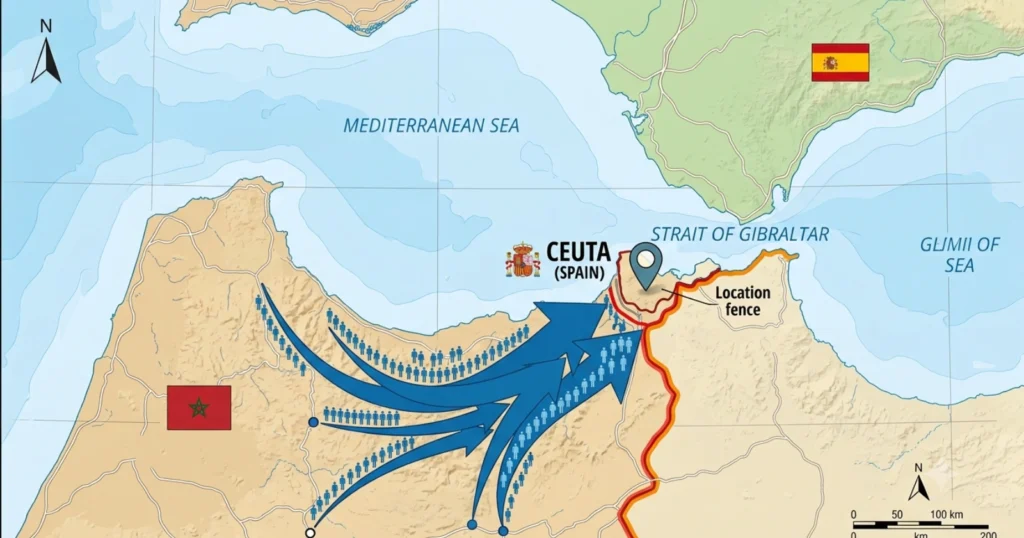
Spain’s North African enclave of Ceuta is reeling from what officials are calling its worst migration emergency in decades, after tens of thousands of people crossed illegally from Morocco within a span of roughly 24 hours. The sudden and overwhelming surge has left local shelters overrun, dozens of people dead, and European capitals scrambling to respond. What began as a routine week along one of the European Union’s only land borders with Africa turned, almost overnight, into a humanitarian and political emergency that is now drawing reactions from Washington to Rome.
Estimates of exactly how many people crossed vary depending on the source, but even the most conservative figures describe a movement of historic scale. Spain’s Interior Ministry said close to 50,000 migrants entered Ceuta since Thursday morning, while other reports citing security sources placed the number between 30,000 and 60,000. Ceuta’s president, Juan Jesús Vivas, said the arrivals were equivalent to as much as 70 percent of the city’s regular population of about 84,000, a proportion he described as absolutely unsustainable for a territory of its size.
What Happened in Ceuta
Ceuta is a small Spanish territory covering under 20 square kilometers on the northern coast of Africa, separated from mainland Spain by the Strait of Gibraltar. Along with Melilla, located roughly 140 miles to the southeast, it forms one of only two land borders shared by the European Union and the African continent. Spain has governed Ceuta since 1580, and the city today is home to a mixed population of Christian and Muslim residents, along with thousands of day workers who cross from Morocco regularly for employment.
For years, Ceuta has functioned as a departure point for migrants hoping to reach Europe, and its border fencing has been strengthened repeatedly in response to periodic surges. What set this week apart was not just the number of people involved but the speed at which the crossing unfolded. Footage from the border showed large groups, many of them young men, moving past the Tarajal fence and swimming through coastal waters to reach Spanish territory. Some migrants arrived from the Moroccan town of Fnideq, facing a swim of roughly five kilometers, while others entered from Belyounech, where the crossing distance is shorter.
The human cost has been severe. Death tolls reported by different outlets ranged from 27 to 57 as of Friday, with authorities warning the number could still rise. Many of the victims drowned attempting to swim across open water, while others were reportedly killed in a stampede near the breakwater fence at Tarajal beach. Around 7,000 of those who crossed are believed to be unaccompanied minors, according to figures cited by Spanish media, adding a particularly urgent layer to the humanitarian response.
A City Overwhelmed
Local officials described scenes of chaos as reception centers, already operating near capacity, were pushed far beyond their limits. Parks, sidewalks, and public squares across Ceuta filled with people who had nowhere else to go, many of them sleeping outdoors. Vivas told Spanish broadcaster Cadena SER that the city had already been absorbing more than 300 new arrivals a day in the lead-up to the crisis, a pace that had strained services long before Thursday’s surge.
Spain responded by deploying military units to support the Civil Guard and local police in maintaining order and assisting the injured. Rachid Sbihi, who leads an association representing Civil Guard officers, called the situation a serious humanitarian crisis and said personnel were working to help those hurt during the crossings while the influx continued. Some migrants who had already reached Ceuta were later seen walking back toward Morocco, either voluntarily or with assistance from Spanish authorities, even as new arrivals kept coming.
Why the Crossings Suddenly Surged
The scale of this week’s events has prompted intense scrutiny into what triggered such a rapid and coordinated movement of people. Spanish authorities point to a specific legal development as the likely spark. On June 29, Spain’s Supreme Court issued a ruling that limited the ability of authorities to summarily return migrants who arrive in Ceuta and Melilla by sea, requiring due process before removal in those cases. The ruling did not legalize irregular entry, nor did it guarantee that anyone who swam across the border could remain in Spain permanently.
Even so, Spanish officials believe the decision was misrepresented and spread rapidly across Moroccan social media in the days that followed, encouraging people to believe that reaching Spanish territory by water offered a safer legal path than crossing by land or scaling border fencing.
Prime Minister Pedro Sánchez said this interpretation of the ruling appeared to spread like wildfire and helped drive the sudden rush toward the coastline. Spain’s Interior Ministry went further, stating that human trafficking networks appear to be exploiting the court ruling to encourage undocumented migration, particularly among young people.
Not everyone accepts this explanation at face value. Some human rights activists in Morocco have questioned whether a detailed Spanish court ruling could realistically have reached and motivated tens of thousands of ordinary migrants so quickly, suggesting that smuggling networks and word of mouth likely played a larger organizing role than the ruling itself.
Economic Pressure Behind the Decision to Cross
Beyond the immediate legal trigger, the underlying motivations described by migrants themselves point to longstanding economic hardship. Ahmed Karim, a 33-year-old Moroccan man who reached Ceuta, told reporters that many young people in Morocco want to reach Europe or the United States but simply lack legal channels to do so. That sentiment echoes a pattern seen in previous Ceuta crossing waves, where economic opportunity, rather than any single policy change, remains the primary long-term driver of migration from the region.
A Pattern With Precedent
This is not the first time Ceuta has experienced a sudden mass crossing. In May 2021, amid a diplomatic dispute between Morocco and Spain over the Western Sahara region, Moroccan authorities loosened border controls, allowing nearly 8,000 people to enter Ceuta within just two days. That standoff was eventually resolved after Spain backed Morocco’s autonomy plan for Western Sahara in 2022.
The current crisis, however, appears larger in scale and driven more by domestic economic conditions and legal interpretation than by direct diplomatic friction, though tensions between Rabat and Madrid remain a persistent undercurrent given Morocco’s continued dispute over Spanish sovereignty in Ceuta and Melilla.
The Numbers at a Glance
Reported figures have varied across outlets as the situation developed rapidly. The table below summarizes the range of estimates published as of Friday, July 31, 2026.
| Metric | Reported Range |
|---|---|
| Migrants entering Ceuta in 24 to 48 hours | 30,000 to 60,000 |
| Share of Ceuta’s population (approx. 84,000) | Up to 70 percent |
| Confirmed deaths | 27 to 57 |
| Unaccompanied minors among arrivals | Approximately 7,000 |
| Migrants who returned to Morocco by Friday | More than 48,300 (per Spain’s Interior Ministry) |
| Attempted breach in Melilla | 300 to 400 crossed overnight |
Spain’s Interior Ministry had not confirmed the highest cited figure of 60,000 as of Friday evening, and Spanish media sources offered lower estimates ranging from 30,000 to nearly 50,000. Even the more conservative numbers represent one of the largest single-day border crossing events the European Union has recorded in recent years.
Related Article:
- Inside the Night Ceuta’s Border Fell: 60,000 Migrants, Dozens Dead
- Europe’s 2026 Migration Crisis: A Country by Country Snapshot
- Inside the Smuggling Networks Turning TikTok Videos Into Ceuta Border Crossings
- Ranking Europe’s Toughest and Softest Migration Policies in 2026
Political Fallout Spreads Across Europe
The crisis quickly moved beyond a local emergency into a continent-wide political flashpoint. Sánchez traveled to Ceuta on Friday alongside Interior Minister Fernando Grande Marlaska to assess the situation directly, calling the mass crossing a violation of Spain’s territorial integrity and placing blame on smuggling networks rather than on domestic immigration policy.
That framing has not stopped domestic critics from linking the crisis to Sánchez’s broader approach to migration. Earlier in 2026, his government moved to grant residency and work permits to roughly 500,000 undocumented migrants already living in Spain, with more than a million people reportedly applying to the program. Migrants who entered the country irregularly after January 1, 2026 were excluded from eligibility.
Conservative and far-right politicians, including Vox leader Santiago Abascal and Popular Party leader Alberto Núñez Feijóo, argued that the government’s welcoming stance had effectively invited the crisis. Madrid regional leader Isabel Díaz Ayuso went further, accusing the government of allowing Spain to be invaded through Ceuta. Sánchez has firmly rejected any connection between the regularization program and the border surge.
Reactions From Rome, Paris, and Beyond
The images from Ceuta drew swift reaction from other European governments. Italian Prime Minister Giorgia Meloni threatened to suspend the Schengen free travel agreement with Spain, framing the move as necessary to protect Italy’s borders and citizens. Spain responded by summoning Italy’s ambassador in Madrid.
Finland’s interior minister separately called for Spain’s temporary suspension from the Schengen Area, citing concerns that the country had lost control of a key external EU border. France announced it would immediately reinforce checks at its own border with Spain in response to the events.
European Commission President Ursula von der Leyen called the images from Ceuta unacceptable, saying dangerous crossings must stop and that smuggling networks must be dismantled, while insisting that returns be carried out swiftly and in line with EU rules. In the United States, President Donald Trump described the scenes from Ceuta as looking like an invasion, using the moment to warn that similar events could occur along the U.S. border if Republicans did not win future elections.
Tension Spreads to Melilla
The unrest was not confined to Ceuta alone. An attempted border breach was also reported overnight in Melilla, Spain’s other North African enclave, with between 300 and 400 people managing to cross. Clashes were reported nearby in the Moroccan town of Bni Nsar, where rocks were thrown, a police vehicle was set on fire, and dozens of arrests were made as Moroccan police attempted to contain the unrest.
What Comes Next
Spanish authorities face a difficult balancing act in the days ahead. On one hand, the government must manage an acute humanitarian response for tens of thousands of people, including thousands of unaccompanied children, who now require shelter, food, and medical care. On the other, it faces mounting diplomatic pressure from EU partners who view the episode as evidence of a broader border control failure.
Morocco’s ambassador to Spain, Karima Benyaich, said the situation was not something her government wanted, adding that Rabat would prefer legal, orderly, and safe migration for everyone involved. Additional Moroccan police have already been deployed along the border, with rights groups reporting the use of water cannons and warning shots aimed at deterring further crossings.
Whether the crisis proves to be a short-term spike tied to a specific legal misunderstanding, or the beginning of a longer-term shift in migration patterns toward Ceuta, will likely depend on how quickly Spain and Morocco can coordinate a joint response and how clearly the legal status of sea arrivals is communicated going forward. For now, Ceuta remains at the center of a story that has moved well beyond its 20 square kilometers, reshaping conversations about border security, legal migration pathways, and humanitarian obligation across an entire continent.