The scale of human loss during World War II stands unmatched in modern history. Estimates place total fatalities between 70 million and 85 million people, a figure that includes both military personnel and civilians caught in the crossfire of conflict, famine, and genocide. Such numbers represent roughly three percent of the world’s population at the time, concentrated in Europe, Asia, and the Pacific. These deaths did not occur evenly. Certain nations saw their populations decimated while others experienced relative stability or even temporary growth in specific regions due to wartime economic booms.
The conflict disrupted families on every continent. Men left for battlefields, women entered factories in unprecedented numbers, and children faced evacuation or orphanhood. Food shortages and disease spread rapidly in occupied territories. The war’s end brought no immediate return to normalcy.
Instead, it set in motion demographic forces that would alter population trajectories for decades. World War II population impact extended far beyond the battlefield counts, touching fertility patterns, life expectancy, and migration flows that continue to shape societies.
Reconstruction efforts after 1945 coincided with medical advances and economic recovery in many areas. Yet the scars remained visible in census data for years. Some countries recorded sharp drops in working-age adults, while others absorbed millions of displaced persons. These shifts influenced everything from labor markets to government policies on family support. The global population story after the war became one of uneven recovery, with lasting consequences for age pyramids and regional power balances.
The Human Cost in Numbers
Direct military deaths during World War II reached approximately 21 to 25 million, according to historical compilations from sources like the United States National Archives and postwar studies. Civilian casualties added another 50 million or more, driven by bombings, mass executions, starvation, and forced labor. The Soviet Union bore the heaviest burden, with total losses estimated at 26 to 27 million people. China followed with around 15 to 20 million deaths amid Japanese occupation and internal strife.
Poland lost nearly 20 percent of its prewar population, a staggering blow that included both Jewish communities targeted in the Holocaust and ethnic Poles killed in combat and reprisals. Germany and Japan also suffered immense losses, though precise figures vary due to chaotic record-keeping in the final months of fighting. Smaller nations in Eastern Europe and Southeast Asia saw proportional impacts that altered their demographic profiles for generations.
These losses created immediate gaps in population structures. Young men of reproductive age died in disproportionate numbers across combatant nations. This imbalance affected marriage rates and birth patterns well into the 1950s. In some regions, entire villages or urban neighborhoods lost most of their adult male population, forcing reliance on women, elders, and returning soldiers for recovery.
Shifts in Birth Rates and the Baby Boom
World War II population impact manifested clearly in fertility trends. Many Western nations experienced a sharp decline in births during the war years as uncertainty and separation kept families apart. The United States recorded a drop from about 2.5 million births in 1940 to lower figures mid-decade before a dramatic rebound. By 1946, American birth rates surged, marking the start of the famous baby boom that lasted until the early 1960s.
Similar patterns appeared in parts of Western Europe and Australia, though with variations tied to local economic conditions. The United Kingdom saw births fall during the Blitz and rationing periods, then rise sharply after victory. France and other liberated nations experienced comparable recoveries fueled by government incentives for larger families and a widespread desire for stability.
In contrast, many areas in Eastern Europe and Asia faced prolonged low fertility due to destruction and displacement. The Soviet Union, for instance, promoted pronatalist policies after the war to replenish its depleted population, offering medals and benefits to mothers of large families. Japan implemented similar measures amid its own recovery challenges. These policy responses reflected the urgent need to rebuild human capital after such widespread loss.
Mass Migration and Refugee Movements
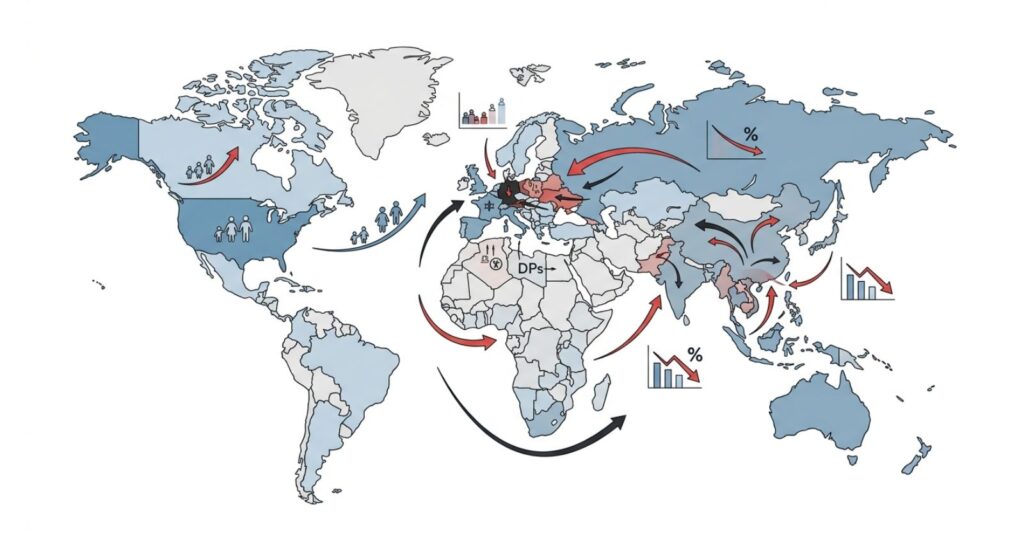
One of the most visible aspects of World War II population impact involved the forced relocation of tens of millions. The war displaced an estimated 60 million people worldwide, according to postwar international relief organizations. In Europe alone, borders shifted dramatically with the redrawing of maps at Yalta and Potsdam. Millions of ethnic Germans were expelled from territories in Poland, Czechoslovakia, and other Eastern European countries, creating one of history’s largest population transfers.
The partition of India in 1947, though technically postwar, stemmed directly from wartime pressures on British colonial structures and resulted in another 10 to 15 million people crossing new borders amid violence. In Asia, the Japanese surrender led to the return of millions of soldiers and settlers from occupied territories, while the Chinese civil conflict added further layers of movement.
The creation of Israel in 1948 drew Jewish survivors from displaced persons camps across Europe, adding to Middle Eastern demographic shifts. Meanwhile, labor shortages in Western Europe and North America attracted migrants from Southern Europe, the Caribbean, and later from former colonies. These movements reshaped urban centers and introduced new cultural dynamics that influenced population composition for decades.
Changes in Life Expectancy and Health Outcomes
Advancements in medicine during and after the war played a paradoxical role in global population dynamics. Penicillin and other antibiotics, refined through wartime research, reduced infection deaths in the postwar period. Improved nutrition programs and public health initiatives in many recovering nations contributed to rising life expectancy. Yet in war-torn regions, famine and disease outbreaks offset these gains for years.
Data from the World Health Organization’s historical records show that average global life expectancy, which stood around 48 years in 1950, began a steady climb partly attributable to lessons learned from wartime medical efforts. However, specific countries experienced setbacks. In parts of Eastern Europe, male life expectancy lagged due to the loss of younger cohorts and lingering health effects from combat injuries and malnutrition.
Gender differences in survival also widened in affected populations. Women often outlived men in higher proportions after the war, leading to skewed sex ratios in older age groups. This pattern persists in some demographic profiles today, where certain nations show noticeable imbalances traceable to mid-20th century events.
Regional Variations Across Continents
Europe faced the most concentrated World War II population impact. The continent’s total population dropped significantly in the immediate postwar years before rebounding through natural increase and migration. Western European nations generally recovered faster due to Marshall Plan aid and industrial revival, while Eastern Bloc countries followed different paths under centralized planning that emphasized population growth.
In Asia, the picture varied widely. Japan’s population, despite heavy losses, grew rapidly in the 1950s and 1960s thanks to economic miracles and health improvements. China experienced continued turmoil through civil war and later policy experiments that influenced its demographic trajectory in unique ways. India and Southeast Asian nations saw population surges amid decolonization and agricultural changes.
Africa and Latin America, less directly involved in combat, still felt ripple effects through disrupted trade, colonial troop movements, and eventual independence movements. Some regions recorded modest population gains during the period as global attention shifted away from European theaters. These differences highlight how a single global conflict produced highly localized demographic outcomes.
Comparative Data on Population Losses
The following table illustrates estimated total population losses for major combatant nations during World War II, drawn from aggregated historical research. Figures include both military and civilian deaths and reflect the broad consensus among demographers.
| Country | Estimated Total Deaths (millions) | Percentage of Prewar Population | Primary Causes |
|---|---|---|---|
| Soviet Union | 26-27 | 14% | Combat, famine, occupation |
| China | 15-20 | 3-4% | War with Japan, internal conflict |
| Germany | 6.5-7.5 | 8-9% | Combat, bombings, postwar expulsions |
| Poland | 5.5-6 | 17-20% | Holocaust, occupation, uprisings |
| Japan | 2.5-3.1 | 3-4% | Combat, atomic bombs, firebombing |
| United States | 0.4 | 0.3% | Military action primarily |
This comparison reveals the uneven burden shouldered by different societies and helps explain varying recovery speeds and policy priorities in the decades that followed.
Long-Term Effects on Age Structures and Labor Forces
The loss of millions in prime working years created distinctive bulges and gaps in national age pyramids. Many European countries entered the 1950s with a shortage of men aged 20 to 40, prompting policies to encourage female workforce participation and immigration. These adjustments influenced economic growth models for the next half-century.
In nations that experienced baby booms, the large postwar cohorts drove demand for housing, education, and consumer goods, fueling economic expansions. As these generations aged, they placed pressure on pension systems and healthcare infrastructure starting in the late 20th century. Countries with heavier losses faced different challenges, including slower workforce replenishment and reliance on guest worker programs.
Demographers continue to track these cohort effects. Studies from organizations like the United Nations Population Division show how wartime disruptions created predictable waves in dependency ratios that governments had to address through social planning.
Migration Patterns and Urbanization Trends
World War II accelerated urbanization in many parts of the world. Rural populations moved to cities for factory jobs during the conflict, and many stayed afterward as agricultural sectors modernized. In the United States, the war contributed to the Great Migration of African Americans from the South to Northern industrial centers, permanently altering urban demographics.
Europe saw internal and cross-border movements as people sought better opportunities in less damaged regions. The guest worker systems established in Germany and other Western European nations in the 1950s and 1960s brought millions from Turkey, Italy, and North Africa, adding layers to population diversity. Similar dynamics played out in Australia and Canada through targeted immigration policies designed to address labor shortages.
These shifts contributed to the growth of megacities and changed the rural-urban balance in ways that persist. Population density patterns in postwar Europe and Asia reflect decisions made in response to wartime destruction and subsequent rebuilding priorities.
Policy Responses and Demographic Planning
Governments around the world adjusted their approaches to population management after the war. Pronatalist measures in France, Italy, and the Soviet Union aimed to boost birth rates through family allowances and housing priorities. Scandinavian countries focused on social welfare systems that supported working mothers, reflecting lessons from wartime labor needs.
In Asia, Japan’s postwar constitution and economic policies indirectly supported family formation during recovery. China’s later one-child policy in the 1970s represented a stark contrast, emerging from different pressures but rooted in the broader context of 20th-century population concerns influenced by wartime experiences.
International organizations like the United Nations, founded in 1945, began collecting standardized demographic data to better understand these global shifts. Their early reports documented the war’s role in accelerating certain trends while reversing others, providing frameworks still used in modern population studies.
The Demographic Legacy Today
Traces of World War II population impact remain embedded in current global demographics. Countries with significant wartime losses often show distinctive age distributions or sex ratios traceable to the 1940s. Migration legacies have created multicultural societies in places that once maintained more homogeneous populations. Fertility patterns established in the immediate postwar period influenced subsequent generations’ family sizes and structures.
Modern challenges, such as aging populations in Europe and Japan, connect directly to the cohort disruptions of the mid-20th century. Meanwhile, regions that experienced rapid postwar growth now grapple with youth bulges or resource strains linked to those earlier surges. Understanding these connections helps explain contemporary debates around immigration, retirement systems, and family policy.
The war also accelerated technological and medical progress that supported larger populations overall. Yet it demonstrated the fragility of human numbers when conflict escalates on a global scale. These dual lessons continue to inform discussions about stability and growth in an interconnected world.
Key Conclusion and Analysis
World War II population impact represents one of the most significant demographic turning points of the modern era. The conflict’s toll created immediate voids and triggered compensatory mechanisms that reshaped societies. From baby booms to mass migrations, the responses to wartime losses set patterns that defined the second half of the 20th century and beyond. Nations adapted through policy innovation, economic restructuring, and social change, often in ways that balanced recovery with long-term planning.
Today, as populations face new pressures from climate shifts, technological disruption, and geopolitical tensions, the historical example of postwar adjustment offers a perspective on resilience. The ability of societies to rebuild after such profound loss highlights both human vulnerability and capacity for renewal. These insights remain relevant for anyone examining how sudden events can redirect the course of human numbers and distributions across the planet.
FAQ
How many people died in World War II?
Total deaths from World War II range from 70 million to 85 million, including military and civilian losses. The highest estimates come from comprehensive studies that account for famine and disease alongside direct violence. These figures represent an enormous portion of the global population at the time and explain many postwar demographic imbalances.
Which country suffered the most population loss in World War II?
The Soviet Union experienced the greatest losses, with estimates reaching 26 to 27 million people. This amounted to about 14 percent of its prewar population and included massive civilian deaths from occupation and battle. China and Poland also faced severe proportional impacts that affected their recovery for years.
Did World War II cause a baby boom?
Many Western countries saw birth rates rise sharply after 1945, creating the baby boom generation. Soldiers returning home, economic optimism, and government support for families contributed to this surge. The pattern varied by region, with some areas recovering more slowly due to ongoing hardships.
How did World War II affect migration patterns?
The war displaced around 60 million people through combat, border changes, and expulsions. Postwar Europe saw millions of ethnic Germans move westward, while decolonization and labor needs drove further movements to North America and other regions. These shifts permanently altered population distributions.
What was the impact of World War II on life expectancy?
Wartime medical advances like antibiotics helped raise life expectancy in the postwar period in many countries. However, war-torn regions initially saw declines due to injury, malnutrition, and disease. Global averages began climbing steadily from the 1950s onward as recovery progressed.
How did population losses differ between Europe and Asia during the war?
Europe suffered concentrated losses from industrialized warfare and occupation policies, while Asia experienced widespread disruption from prolonged conflicts and resource shortages. Both continents saw millions displaced, but recovery timelines and policy responses varied based on local conditions and external aid.
Did World War II change sex ratios in affected countries?
Many combatant nations recorded imbalances with fewer men in certain age groups due to military deaths. This affected marriage markets and family formation for years afterward. Some countries still show traces of these shifts in older population segments today.
How did governments respond to population declines after World War II?
Several nations introduced family support policies, immigration programs, and pronatalist incentives to rebuild their populations. Approaches ranged from financial benefits for mothers to organized labor recruitment from other countries. These measures reflected the urgent need to restore workforce and community strength.
What long-term effects did World War II have on global urbanization?
The conflict sped up the movement from rural areas to cities as people sought industrial jobs and better opportunities. Postwar reconstruction and economic growth reinforced these trends, leading to larger urban centers and changed rural-urban population balances that continue in many regions.
Does World War II still influence modern population trends?
Cohort effects from wartime losses and baby booms affect current age structures, dependency ratios, and policy discussions around pensions and immigration. Migration legacies have created more diverse societies in certain countries, while historical experiences inform ongoing demographic planning worldwide.