Population growth has shaped civilization in ways that are both visible and invisible. Every city that sprawls outward, every aquifer that drops another meter, every wave of youthful labor that lifts a developing economy, these are the fingerprints of demographic change.
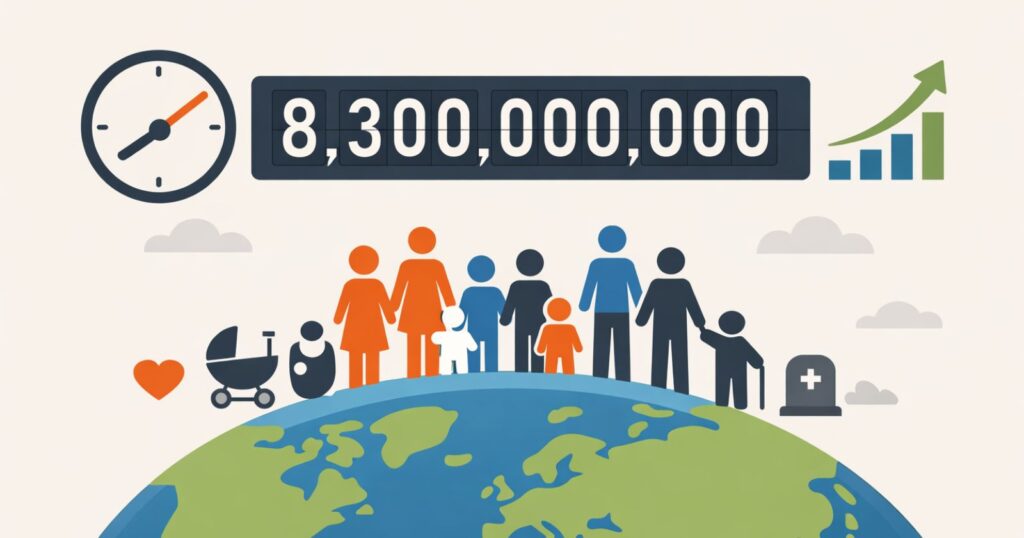
As of 2024, the global population stands at approximately 8.1 billion people, and according to United Nations projections, that number is expected to reach around 9.7 billion by 2050 before plateauing or beginning a slow decline in some regions. The question of whether that trajectory is a source of hope or alarm has animated debates among economists, ecologists, policymakers, and demographers for decades. It is a question with no clean answer, only trade-offs, contexts, and competing evidence.
The debate is not new. Thomas Robert Malthus famously argued in 1798 that population would inevitably outpace food supply, condemning large portions of humanity to misery and want. His framework shaped centuries of thinking about demographic limits.
Yet the Green Revolution of the mid-20th century, which multiplied crop yields dramatically through hybridization, irrigation, and synthetic fertilizers, challenged his core premise. Global hunger persists not primarily because there are too many people but because of distribution failures, political instability, and poverty. The story of population growth, in other words, cannot be reduced to arithmetic.
What makes this debate particularly consequential today is the geographic unevenness of demographic change. Sub-Saharan Africa’s population is projected to double by 2050, with countries like Nigeria potentially surpassing the United States in total population before the century ends.
Meanwhile, South Korea, Japan, and several Southern European nations face demographic contraction so severe that policymakers are offering financial incentives for childbirth. These are not two versions of the same problem, they are entirely different challenges requiring entirely different policy responses. Understanding population growth means reckoning with this complexity from the outset.
The Economic Case for Population Growth
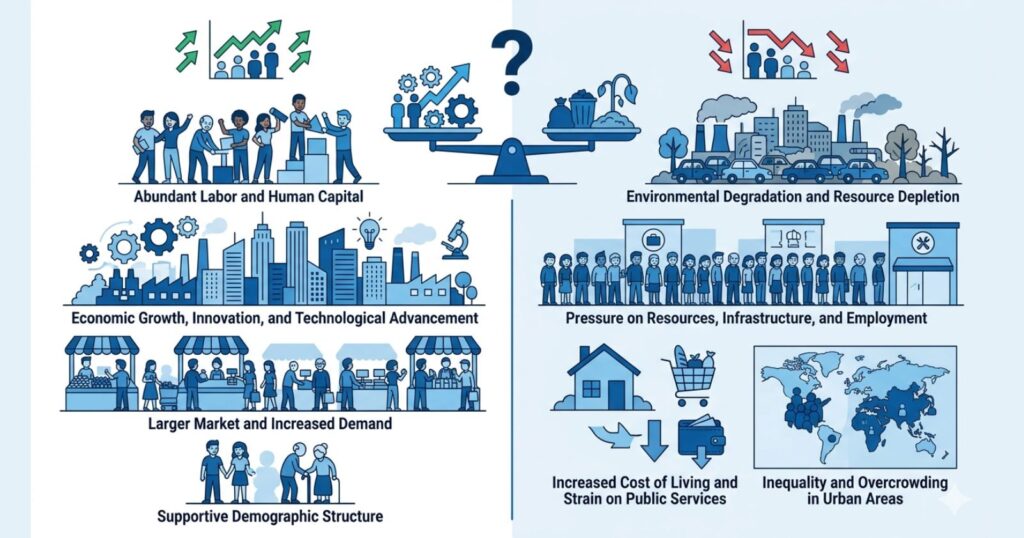
To a mainstream economist, people are not merely mouths to feed, they are hands to work, minds to innovate, and consumers to drive demand. The economist Julian Simon, one of the most forceful advocates of this perspective, called human beings the “ultimate resource,” arguing that more people generate more ideas, and more ideas compound into more solutions. There is a body of evidence supporting the productivity dimension of this argument.
Nations with young, growing populations often experience what demographers call the “demographic dividend”, a period during which the working-age population is proportionally larger than dependents, generating savings and labor surpluses that can accelerate economic growth. East Asia’s economic rise from the 1960s through the 1990s is frequently cited as a textbook case of this dividend being realized through investment in education and institutional reform.
Population growth also sustains the scale economies that support modern infrastructure. Hospitals, schools, roads, and transit networks are expensive to build and maintain. With more people contributing through taxes and usage, the per-capita cost of maintaining shared systems declines.
Cities with healthy population inflows typically exhibit stronger public service sustainability than those experiencing sharp depopulation. Japan’s rural municipalities, shrinking and aging rapidly, now face the prospect of infrastructure abandonment, a reminder that underpopulation carries its own fiscal costs.
Innovation, too, is partly a numbers game. The economic historian Michael Kremer proposed in a 1993 paper published in the Quarterly Journal of Economics that larger populations are associated with faster rates of technological progress, because a larger population produces more potential innovators. Pharmaceutical pipelines, engineering breakthroughs, and software development all benefit from deep talent pools. A world with twice the number of researchers working on cancer biology or renewable energy is not guaranteed to find solutions faster, but it is statistically more likely to.
The Environmental and Resource Case Against
The argument against unlimited population growth rests on ecological foundations that are difficult to dismiss. The planet’s biological carrying capacity, its ability to sustain life sustainably, is finite, even if the exact limits remain contested. According to the Global Footprint Network, humanity currently consumes natural resources at approximately 1.75 times the rate at which the Earth can regenerate them. This means that as of several decades ago, humanity crossed the threshold of sustainable extraction and began drawing down ecological capital. Adding another two billion people, even with efficiency improvements, intensifies this pressure.
Freshwater is the most immediate constraint. The United Nations estimates that roughly 2 billion people currently live in water-stressed conditions, and that by 2025, two-thirds of the global population could face water shortages under current usage patterns. Aquifer depletion is accelerating in agriculturally critical regions from the Ogallala in the United States to the Indus Basin in Pakistan. Groundwater is a finite resource replenished over centuries, not years. Population growth in arid and semi-arid regions places this resource under particular strain.
Biodiversity loss runs in parallel. Human population expansion drives habitat conversion more directly than any other single factor. The IPBES Global Assessment Report published in 2019 found that around one million animal and plant species face extinction, many within decades, largely due to land-use change, which is predominantly agricultural expansion to feed growing populations. The link between population size and biodiversity pressure is not one-to-one, since consumption patterns and technology matter enormously, but the correlation between human footprint and species loss is robust in the empirical literature.
Climate change adds a compounding dimension. While per-capita emissions vary wildly across countries, an American emits roughly 14 metric tons of CO₂ equivalent per year compared to 0.3 for a citizen of Chad, total greenhouse gas output scales in part with population. A world of 10 billion people will require substantially more energy, food, and materials than one of 7 billion, even assuming significant efficiency gains. The question is whether technological decarbonization can outpace the absolute growth in demand.
Demographic Decline: The Other Side of the Equation
It is tempting to frame the population debate as simply “more is worse,” but countries experiencing population decline are confronting serious structural problems that complicate that conclusion. South Korea’s total fertility rate fell to approximately 0.72 in 2023, an unprecedented low for any country not in active conflict. Italy, Germany, and several Eastern European nations are also well below the replacement fertility rate of roughly 2.1 children per woman. The economic consequences of sustained demographic decline are multifaceted.
Pension systems built on pay-as-you-go models require a sufficient ratio of workers to retirees to remain solvent. As that ratio deteriorates, governments face the unappealing choice of raising contribution rates, cutting benefits, extending retirement ages, or increasing public debt. Japan, which has navigated demographic aging longer than any other major economy, has managed the transition through high savings rates, technological investment, and cautious immigration, but analysts broadly agree that its fiscal trajectory is unsustainable without structural reform.
Labor shortages in declining-population economies also constrain growth. Construction, healthcare, elder care, and agriculture all face mounting gaps in many high-income countries that cannot be filled purely through automation. Germany’s government has acknowledged that it needs hundreds of thousands of skilled workers annually just to maintain current output levels. This reality has pushed immigration to the center of political debate in multiple European countries, as the economic logic of managed population supplementation clashes with social and political dynamics.
The Role of Consumption Patterns
Perhaps the most important complication in this debate is that population size and ecological impact are not the same thing. A child born in Norway will, over a lifetime, generate roughly 50 to 100 times the carbon footprint of a child born in Malawi. This asymmetry means that demographic growth in high-consumption societies carries disproportionate environmental weight. Conversely, population growth in low-income regions, where per-capita resource consumption is minimal, contributes far less to global ecological strain in absolute terms, even if it generates urgent local challenges around food, water, and sanitation.
The consumption lens shifts the policy emphasis considerably. Rather than focusing solely on demographic numbers, it points toward lifestyle change, technological efficiency, and redistribution of wealth as central levers. The IPCC has consistently noted in its assessment reports that demand-side shifts, changes in diet, mobility, housing, and energy use, are among the most powerful tools for limiting emissions growth, independent of population trends. A world that decarbonizes its energy supply and moderates consumption in wealthy countries could theoretically support a population of 10 billion sustainably, though doing so would require systemic transformation.
Comparative Global Demographic Snapshot
| Region | Projected Population Change by 2050 | Total Fertility Rate (approx.) | Primary Concern |
|---|---|---|---|
| Sub-Saharan Africa | +1.2 billion | 4.3 | Food security, infrastructure |
| South Asia | +400 million | 2.2 | Water scarcity, urbanization |
| East Asia | -80 million | 1.2 | Aging, pension system stress |
| Europe | -30 million | 1.5 | Labor shortages, fiscal strain |
| North America | +60 million | 1.7 | Immigration policy, housing |
| Latin America | +120 million | 1.9 | Urban inequality, resource use |
Sources: United Nations World Population Prospects 2022; World Bank Fertility Data
Urbanization as a Mediating Factor
Population growth rarely occurs uniformly across landscapes. In the 21st century, it is increasingly an urban phenomenon. By 2050, approximately 68 percent of the global population is expected to live in urban areas, up from around 55 percent today. Cities, despite their problems, are generally more resource-efficient than dispersed rural populations. Higher urban density allows for shared infrastructure, reduced per-capita energy use for heating and cooling, and lower vehicle miles traveled. Research published in journals including Nature Sustainability has shown that urbanization, when well-managed, can reduce the per-capita environmental footprint of population growth.
The critical caveat is urban governance. Cities in rapidly growing economies that lack investment in housing, sanitation, transit, and governance tend to generate sprawling informal settlements, often called slums, though the preferred UN terminology is informal settlements, where resource inefficiency, disease burden, and social inequity are concentrated. Lagos, Dhaka, and Kinshasa are adding millions of residents in contexts where institutional capacity is struggling to keep pace. The outcome of population growth in these settings depends less on the numbers themselves than on the political and fiscal response of governments.
Closing Synthesis
The question of whether population growth is good or bad admits no universal answer, because the consequences of demographic change depend almost entirely on context. Growth in a resource-abundant, institutionally strong, and low-consumption society looks quite different from growth in a water-scarce, governance-challenged, high-fertility region. Decline in an economy with adequate immigration pathways and a robust pension reserve is far less alarming than a decline in one with closed borders and fiscal fragility.
What the evidence consistently suggests is that the population is never the independent variable it is sometimes made to appear. Governance, technology, consumption, distribution, and institutional investment all mediate its effects profoundly. The countries that have most successfully turned demographic growth into prosperity, South Korea in the 1970s, Bangladesh in the 1990s, Rwanda in the 2000s, did so through deliberate choices about education, health, and economic policy, not simply because their populations grew. And the countries facing the most acute consequences of demographic pressure are typically those where those mediating investments have been most absent.
For policymakers and analysts, the practical insight is that neither a pro-natalist nor an anti-natalist stance captures the full picture. What matters is building the conditions under which any population size can thrive sustainably, through clean energy, efficient cities, resilient food systems, and institutions capable of distributing prosperity rather than concentrating it. The demographic trajectory of the 21st century will be shaped not just by how many people inhabit the planet, but by the choices those people make and the systems within which they are embedded.
FAQ
1. What is the current world population growth rate?
As of 2024, the global population growth rate has slowed to approximately 0.9 percent annually, down from a peak of about 2.1 percent in the late 1960s. The absolute number of people added each year remains in the range of 70 to 80 million, though projections suggest that number will continue to decline as fertility rates fall across most world regions.
2. Which countries have the fastest population growth today?
Countries in Sub-Saharan Africa, including Niger, Mali, Chad, and the Democratic Republic of Congo, currently have among the world’s highest population growth rates, driven by fertility rates that remain above 4 to 6 children per woman on average. Nigeria is projected to become one of the most populous nations on Earth by 2100 if current trends persist.
3. Does population growth cause climate change?
Population growth is one factor contributing to greenhouse gas emissions, but it is not the dominant driver on its own. Per-capita consumption and the energy mix of an economy matter more than sheer numbers, high-income countries with stable or declining populations are responsible for a disproportionately large share of cumulative historical emissions. Decarbonization of energy systems remains the most direct lever for addressing climate change, regardless of population trends.
4. What is the demographic dividend, and which regions have benefited from it?
The demographic dividend refers to the economic boost that occurs when a country’s working-age population grows proportionally larger than its dependent population (children and elderly), generating savings and labor surpluses. East and Southeast Asian economies, including South Korea, Taiwan, and Thailand, are widely cited as having harnessed this dividend through strategic investment in education, healthcare, and export-led industrialization during the second half of the 20th century.
5. Is overpopulation the main cause of world hunger?
The evidence does not support overpopulation as the primary cause of global hunger. The world currently produces more than enough calories to feed every person alive, yet approximately 733 million people remain food insecure, according to the FAO’s 2023 State of Food Security report. Poverty, conflict, political instability, and inequitable distribution systems, not an absolute shortage of food, account for the persistence of hunger.
6. What happens economically when a country’s population declines?
Sustained population decline typically exerts pressure on pension and healthcare systems that depend on a sufficient ratio of working contributors to retirees. It can also reduce domestic demand, slow GDP growth, and create labor shortages in sectors that resist automation. Countries like Japan and South Korea are actively working through these challenges with mixed results, and their experiences are being closely studied by other nations facing similar trajectories.
7. How does urbanization affect the population growth debate?
Urbanization tends to lower fertility rates, since urban dwellers typically have fewer children than their rural counterparts due to higher costs of living, greater access to education for women, and changing social norms. At the same time, cities can concentrate and amplify both the benefits (innovation, productivity) and the costs (inequality, environmental strain) of population growth, depending heavily on how well they are governed and resourced.
8. Can technology support a world of 10 billion people sustainably?
Many researchers argue that the technological capacity to feed, power, and house 10 billion people sustainably already exists or is within reach, through vertical farming, precision agriculture, renewable energy, and circular economy principles. The constraint is not primarily technological but political and economic: deploying these solutions at scale requires significant institutional coordination, investment, and a willingness to challenge entrenched interests in food, energy, and land use.
9. Why do some governments pay people to have more children?
Countries facing below-replacement fertility rates and aging populations have experimented with financial incentives for childbearing, including cash bonuses, extended parental leave, subsidized childcare, and housing support, to avoid long-term demographic decline. South Korea, Hungary, and several Nordic countries have implemented such programs with varying degrees of success. Research suggests that while these policies can modestly increase birth rates, no program has yet fully reversed sustained fertility decline.
10. How does population growth affect water security?
Population growth amplifies pressure on freshwater systems by increasing demand for drinking water, agriculture, and industry simultaneously. In regions where water is already scarce or where aquifers are being depleted faster than they recharge, including parts of India, the Middle East, and the American Southwest, population growth accelerates the timeline to supply crises. Effective water governance, pricing reform, and investment in desalination and recycling technologies are increasingly viewed as essential adaptive responses.