High birth rates shape population trajectories across regions with profound effects on resources, economies, and societies. In 2026, countries with the highest birth rates concentrate overwhelmingly in sub-Saharan Africa, where crude birth rates surpass 40 per 1,000 people in several cases, and total fertility rates remain well above the global average of roughly 2.25 children per woman.
These elevated figures stem from a combination of factors, including lower access to modern contraception, cultural preferences for larger families, and economic conditions in which children contribute to household labor and old-age support. Global fertility has declined steadily over decades, yet progress stalls in specific zones where child mortality improvements outpace shifts in family size norms.
The 2026 rankings draw from estimates by the United Nations World Population Prospects, the World Bank, and complementary sources such as the CIA World Factbook. Variations exist between crude birth rate (live births per 1,000 population) and total fertility rate (average children per woman), yet both metrics consistently flag the same cluster of nations. Understanding these patterns requires attention to local contexts rather than broad generalizations.
Measuring Birth Rates: Crude Rate Versus Total Fertility Rate
Crude birth rate counts annual live births against total population, capturing immediate demographic momentum. Total fertility rate projects lifetime births per woman under current age-specific patterns, offering a clearer view of reproductive behavior stripped of population age structure effects.
In high-birth-rate settings, young populations inflate crude rates because a larger share of residents falls into childbearing ages. Data for 2025-2026 place the Central African Republic near the top for crude birth rate at approximately 46.9 births per 1,000, followed by Chad at 44.7 and Somalia at 43.3.
Total fertility rates for the same period show Chad, Somalia, the Democratic Republic of the Congo, and the Central African Republic all hovering between 5.8 and 6.0 children per woman, according to multiple compilations.
These two indicators sometimes produce slight ranking shifts. A country with a very young population may record a high crude rate even if fertility per woman moderates. Analysts therefore examine both to assess short-term growth pressure versus longer-term reproductive trends.
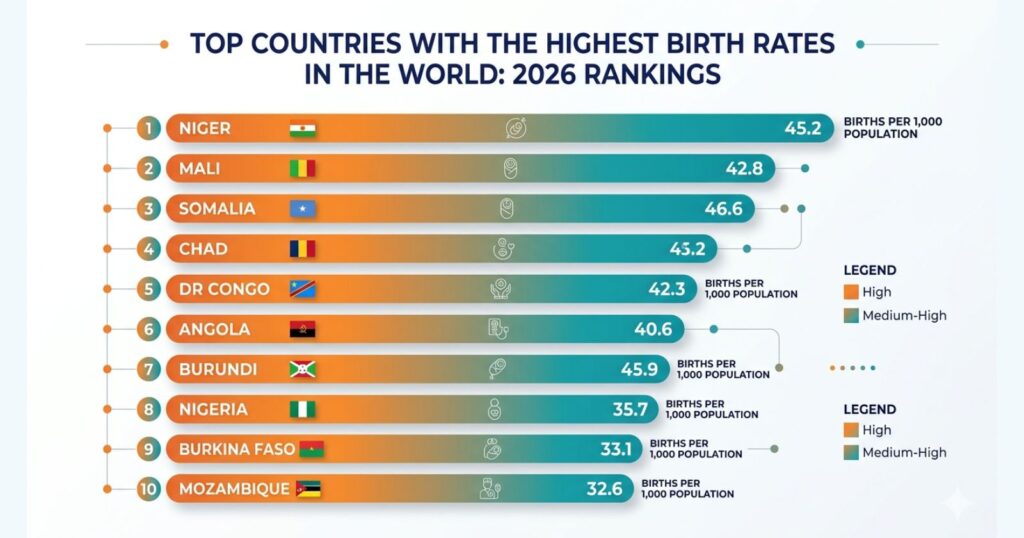
2026 Top 10 Countries by Crude Birth Rate
Recent projections identify the following leaders in crude birth rate:
- Central African Republic – approximately 46.9 births per 1,000
- Chad – 44.7
- Somalia – 43.3
- Niger – 42.1
- Democratic Republic of the Congo – 41.7
- Mali – 40.3
- Angola – 37.7
- Mozambique – 37.7
- Afghanistan – 35.4
- Tanzania – 35.3
Sub-Saharan dominance stands out. Afghanistan represents one of the few non-African entries in the upper tier, linked to specific cultural and security-related dynamics.
2026 Leaders by Total Fertility Rate
Fertility rate rankings align closely but emphasize lifetime reproductive output:
- Chad leads with estimates around 5.8–6.0 children per woman.
- Somalia follows at similar levels.
- Democratic Republic of the Congo and the Central African Republic trail by small margins.
- Niger, Mali, Angola, and others round out the top tier, all exceeding 5 births per woman in many datasets.
Global contrast appears stark. Many European and East Asian nations report rates below 1.5, with some dipping under 1.0. The replacement level of 2.1 serves as a benchmark; countries far above it face sustained population expansion unless offset by mortality or migration.
Key Data Comparison Table
The table below organizes 2026 estimates for select high-birth-rate countries. Figures drawn from aggregated UN, World Bank, and related sources should be treated as mid-range projections subject to revision with new vital registration data.
| Country | Crude Birth Rate (per 1,000) | Total Fertility Rate (children per woman) | Primary Region |
|---|---|---|---|
| Central African Republic | 46.9 | 5.8–6.0 | Sub-Saharan Africa |
| Chad | 44.7 | 5.8–6.0 | Sub-Saharan Africa |
| Somalia | 43.3 | 5.8–6.0 | Sub-Saharan Africa |
| Niger | 42.1 | 5.6–6.7 | Sub-Saharan Africa |
| Democratic Republic of the Congo | 41.7 | 5.8–6.0 | Sub-Saharan Africa |
| Mali | 40.3 | 5.3–5.5 | Sub-Saharan Africa |
| Angola | 37.7 | 5.0–5.7 | Sub-Saharan Africa |
| Mozambique | 37.7 | 4.6–5.0 | Sub-Saharan Africa |
| Afghanistan | 35.4 | 4.7–4.8 | South Asia |
Discrepancies across sources arise from differences in survey methods, vital registration coverage, and projection assumptions. Nations with weaker statistical systems rely more heavily on modeled estimates.
Drivers Behind High Birth Rates
Several interconnected elements sustain elevated fertility in these settings. Child mortality declines create a lag: families continue having more children even as survival rates improve, a pattern observed historically in many regions. High infant and under-five mortality historically prompted compensatory births; partial reductions leave residual effects.
Limited contraceptive access plays a central role. Modern method prevalence remains low across parts of sub-Saharan Africa compared with global averages. Unmet need for family planning affects a substantial share of women, particularly in rural areas and lower socioeconomic groups.
Cultural and social norms favor larger families in many communities. Children provide labor in agrarian economies, old-age security where pension systems are absent, and status within kinship networks. Early marriage and adolescent childbearing extend reproductive spans, adding to completed family size.
Economic structures reinforce these patterns. In settings where formal employment opportunities stay scarce and agriculture dominates, additional children represent both immediate help and future insurance. Gender dynamics influence decision-making; where women’s autonomy in reproductive choices remains constrained, fertility stays higher.
Education levels, especially for girls and women, correlate strongly with lower fertility. Each additional year of schooling is associated with delayed marriage, greater awareness of health services, and shifted preferences toward smaller families. Countries that expanded female secondary education fastest often recorded the steepest fertility drops.
Urbanization exerts mixed influence. City life can raise child-rearing costs and improve service access, yet rapid urban growth without adequate infrastructure sometimes sustains high rates in informal settlements.
Regional Patterns and Sub-Saharan Africa Focus
Sub-Saharan Africa accounts for the clear majority of nations with birth rates above 35 per 1,000. The Sahel belt and Central African zones show particular persistence. Niger frequently appears at or near the top across metrics, reflecting very high fertility combined with a youthful age structure.
Conflict and fragility compound challenges in places such as Somalia, the Central African Republic, and parts of the Democratic Republic of the Congo. Instability disrupts service delivery, heightens mortality risks, and can strengthen reliance on traditional family structures.
Some countries within the region demonstrate transition. Rwanda and Ethiopia achieved notable fertility reductions through expanded family planning, health system reforms, and education investments. These cases illustrate that rates can shift with coordinated policy effort even amid resource constraints.
Economic and Social Implications
Rapid population growth strains infrastructure, education systems, and health services. Youth bulges create opportunities for a demographic dividend if investments in human capital succeed, yet risks of unemployment and social tension rise when job creation lags.
Food security, water resources, and climate adaptation grow more complex under sustained high growth. Many high-birth-rate countries already face environmental pressures; additional population multiplies demands on arable land and ecosystems.
On the positive side, a large young cohort can fuel labor markets and innovation when paired with skills development. Historical examples from Asia show how fertility transitions, when managed alongside economic reforms, supported accelerated growth.
Healthcare systems must scale to handle maternal and child needs. High fertility correlates with elevated risks in settings where skilled birth attendance and emergency obstetric care remain limited.
Global Context and Contrasting Trends
Most of the world experiences fertility decline. East Asia, Europe, and parts of Latin America post rates below replacement, prompting concerns over aging populations, shrinking workforces, and pension sustainability. South Korea, Japan, and several European nations record some of the lowest figures.
This divergence widens global demographic imbalances. Sub-Saharan Africa is projected to contribute a rising share of world population growth through 2050 and beyond. Migration pressures, resource competition, and development assistance priorities all reflect these shifts.
International organizations track these trends through initiatives focused on reproductive health, education, and sustainable development goals. Progress on girls’ schooling and voluntary family planning access consistently links to moderated fertility without coercive measures.
Challenges in Data Collection and Projection
Vital registration systems in many high-fertility countries cover only a fraction of births and deaths. Surveys such as Demographic and Health Surveys provide essential inputs, yet sampling and recall biases can affect accuracy.
Projections incorporate assumptions about future mortality decline, contraceptive uptake, and normative change. Small shifts in these variables alter long-range population estimates significantly.
Improved data systems would sharpen policy targeting. Investments in civil registration and statistical capacity yield returns across multiple development domains.
Future Outlook for High Birth Rate Countries
Fertility continues a gradual downward path even in leading nations, though the pace varies. Urbanization, rising education, and broader media exposure tend to accelerate change. Economic development that raises the opportunity costs of childbearing often reinforces smaller family preferences.
Climate change introduces new variables. Environmental degradation in vulnerable zones may alter migration, livelihoods, and reproductive decisions in unpredictable ways.
Policy attention centers on voluntary measures: expanding contraceptive choice, delaying marriage through education, and supporting maternal health. Coercive approaches have proven ineffective and ethically problematic over time.
Countries that combine fertility moderation with workforce investments position themselves for stronger development outcomes. The demographic dividend remains possible where timing aligns with economic opening.
High birth rates reflect deep social, economic, and cultural realities rather than isolated statistics. Addressing associated challenges requires integrated efforts across health, education, and economic opportunity. The 2026 rankings underscore both continuity in global demographic divides and the potential for measured change where conditions evolve.
FAQ
What country has the highest birth rate in 2026?
The Central African Republic or Chad ranks at or near the top, depending on the exact metric and source. Crude birth rates place the Central African Republic highest in several 2025-2026 projections, while total fertility rate estimates often list Chad or Somalia in leading positions.
Which African countries have the highest fertility rates?
Nations including Chad, Somalia, the Democratic Republic of the Congo, Niger, Mali, Angola, and Mozambique consistently appear among global leaders. Sub-Saharan Africa dominates both the crude birth rate and the total fertility rate lists.
Why do some countries maintain very high birth rates?
Lower contraceptive prevalence, cultural preferences for larger families, economic reliance on child labor, and limited female education contribute. Declines in child mortality without corresponding shifts in desired family size also sustain higher fertility for a period.
How do crude birth rates differ from total fertility rates?
Crude birth rate measures births per 1,000 total population in a year and reflects age structure. The total fertility rate estimates the average number of children per woman across her lifetime and better indicates reproductive behavior.
Is the global birth rate still declining in 2026?
Yes. The worldwide average total fertility rate stands near 2.25 children per woman, down from higher levels in prior decades. Declines occur in most regions, though the pace remains slower in parts of sub-Saharan Africa.
Does a high birth rate always mean rapid population growth?
High birth rates drive growth when paired with moderate or declining mortality. In settings with still-elevated death rates, net growth moderates. Age structure also influences outcomes.
How does women’s education affect birth rates?
Higher education levels among girls and women correlate with later marriage, greater reproductive autonomy, and smaller desired family sizes. Many countries recorded fertility drops following expanded female schooling.
What role does contraception access play in high birth rate countries? Limited availability and use of modern methods sustain higher fertility. Increasing voluntary access through quality services forms a core element of observed transitions elsewhere.
Are there non-African countries with high birth rates?
Afghanistan ranks among the higher entries outside Africa. A few Pacific island nations or other fragile contexts occasionally appear, yet the top positions remain concentrated in sub-Saharan Africa.
Will high birth rates in Africa continue indefinitely?
Trends point toward gradual moderation as education, urbanization, and health services expand. The speed depends on policy effectiveness and socioeconomic progress in individual countries.