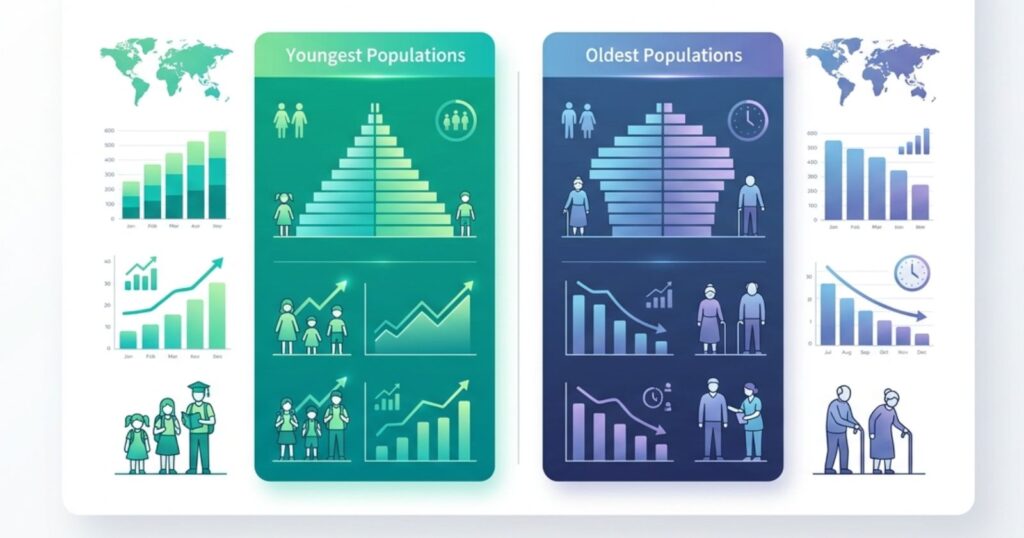
Niger stands out with one of the lowest median ages recorded anywhere, a figure that captures the heavy concentration of children and adolescents in its population pyramid. Across sub-Saharan Africa, similar structures appear where birth rates remain elevated, and child survival has improved enough to swell younger cohorts without a corresponding rise in older groups.
At the opposite end, places like Monaco register median ages well into the mid-50s, reflecting decades of low fertility combined with exceptional longevity. These extremes highlight how fertility rates, mortality patterns, and migration interact to produce distinct age distributions that influence everything from school enrollment to pension sustainability.
The global median age sits near 31 years in 2026, yet regional gaps have widened. Africa averages around 19.5 years, while Europe approaches 43 years. Such differences trace back to the demographic transition that unfolded unevenly across continents. In high-fertility settings, populations expand rapidly at the base.
In low-fertility, high-longevity settings, the pyramid inverts toward an obelisk shape with a broad top. Understanding these age structures matters because they determine dependency ratios, workforce size, and the fiscal pressures governments face in education, healthcare, and retirement systems.
Data drawn from the United Nations World Population Prospects and compiled sources such as World Population Review, provide consistent snapshots. Projections for 2026 show persistent clustering: the ten youngest countries cluster almost exclusively in sub-Saharan Africa, while the oldest concentrate in Europe and a handful of East Asian and microstate economies. These patterns do not shift quickly. Even modest changes in fertility or life expectancy take decades to reshape the overall age profile.
Drivers Behind Extremely Young Populations
High total fertility rates stand as the primary force behind youthful age structures. In countries where women average five or more children, each generation significantly outnumbers the one before it. Improved infant and child survival rates amplify this effect without immediately increasing the number of older adults. Niger, for instance, maintains a fertility rate well above replacement level, resulting in a median age around 15 to 16 years depending on the exact projection year. Similar conditions prevail in neighboring Sahel and Central African nations, where cultural, economic, and access-related factors sustain larger family sizes.
Poverty, limited female education, and rural livelihoods often correlate with these high fertility patterns. When child mortality drops due to better vaccination programs and basic healthcare, while birth rates stay elevated, the population skews dramatically young. More than 40 percent of residents in the youngest nations fall below age 15. This creates a youth bulge that can fuel economic dynamism if education and job creation keep pace, or social strain if opportunities lag.
Migration sometimes plays a secondary role. Young adults may leave for urban centers or abroad, yet the sheer volume of births keeps the median low. Conflict and instability in places like Somalia or the Democratic Republic of the Congo further complicate data collection, but do not erase the underlying demographic reality of rapid natural increase.
Countries with the Youngest Populations
Recent compilations rank the Central African Republic, Niger, Somalia, Mali, and Chad at the bottom of global median age lists for the mid-2020s. Figures hover between roughly 14.5 and 16 years.
Other nations in the top tier of youthfulness include Burundi, Mozambique, Angola, Uganda, and the Democratic Republic of the Congo, all registering medians under 17 years. These countries share high fertility, often exceeding 5 births per woman, alongside life expectancies that, while rising, remain below global averages.
A clear table illustrates the pattern among the youngest:
| Country | Median Age (approx. 2025-2026) | Region | Key Characteristic |
|---|---|---|---|
| Central African Republic | 14.5 | Central Africa | Extremely high youth share |
| Niger | 15.5-15.6 | Sahel, Africa | Highest fertility in many rankings |
| Somalia | 15.6 | Horn of Africa | Conflict-affected yet youthful |
| Mali | 15.7-16.4 | Sahel, Africa | Rapid population growth |
| Chad | 15.8-16.7 | Central Africa | Similar Sahel dynamics |
| Democratic Republic of the Congo | 15.8-16.9 | Central Africa | Large absolute youth population |
| Burundi | 16.4 | East Africa | Dense rural settlement |
| Mozambique | 16.5-17.3 | Southern Africa | Post-conflict recovery |
| Angola | 16.3-16.6 | Southern Africa | Oil-driven economy with a young base |
| Uganda | 16.2-16.9 | East Africa | Strong fertility persistence |
These numbers come from UN-derived estimates and align across multiple aggregators. In each case, the population pyramid displays a broad base that narrows sharply with age. Policy attention often turns to investing in schooling, vocational training, and family planning services to harness the potential demographic dividend while mitigating risks of unemployment or unrest among large youth cohorts.
Factors Shaping Oldest Populations
Low fertility rates below the replacement level of 2.1 children per woman drive aging at the other extreme. When successive generations shrink, and life expectancy climbs into the 80s or higher, older cohorts grow as a proportion of the total. Southern and Eastern Europe, along with advanced East Asian economies, illustrate this trajectory. Decades of economic development, urbanization, rising female workforce participation, and changing social norms around family size have lowered birth rates. At the same time, advances in healthcare, nutrition, and public health have extended life expectancies.
Monaco tops many lists with a median age exceeding 53 to 57 years, influenced by its small population, high-income residents, and attractive retirement environment. Japan follows closely with medians near 49 to 50 years, a result of sustained sub-replacement fertility since the 1970s, combined with world-leading longevity. Italy, Andorra, Hong Kong, Germany, Spain, and Portugal occupy subsequent positions, each showing median ages in the mid-to-upper 40s or higher. These societies face inverted dependency ratios where the working-age share contracts while elderly support needs expand.
Cultural shifts matter. Later marriage, higher education costs, housing pressures, and dual-career households contribute to smaller families. Immigration can temporarily slow the aging process in some European countries, yet overall trends point toward continued increases in median age absent major policy changes.
Countries with the Oldest Populations
Compilations for the mid-2020s place Monaco, Japan, Andorra, Italy, and Hong Kong among the global leaders in median age. Other notable entries include Germany, Spain, Greece, Portugal, and Slovenia, with figures often between 46 and 49 years. Microstates and territories sometimes rank high due to selective migration or small base populations, yet the pattern among larger nations centers on Europe and parts of East Asia.
Here is a comparative table for the oldest:
| Country / Territory | Median Age (approx. 2025-2026) | Region | Key Characteristic |
|---|---|---|---|
| Monaco | 53-57 | Europe (microstate) | High longevity, affluent retirees |
| Japan | 49-50 | East Asia | Long-term low fertility, top longevity |
| Andorra | 48-49 | Europe (microstate) | Small population dynamics |
| Italy | 48 | Southern Europe | Classic aging profile |
| Hong Kong | 47 | East Asia | Urban density and low births |
| Germany | 46-47 | Western Europe | Strong economy with low fertility |
| Spain | 46-47 | Southern Europe | Similar Mediterranean pattern |
| Greece | 46 | Southern Europe | Economic and demographic pressures |
| Portugal | 46 | Southern Europe | Out-migration of youth |
| Slovenia | 46 | Eastern Europe | Post-transition aging |
In these settings, more than 20 percent of the population often exceeds age 65. Governments respond with adjustments to retirement ages, healthcare funding, and efforts to raise fertility through family supports, though results vary. Japan has pioneered robotics and automation partly to offset labor shortages, while several European nations experiment with immigration policies and lifelong learning programs.
Economic and Social Consequences of Age Extremes
Young populations present both opportunity and challenge. A large cohort entering working age can drive innovation, consumption, and GDP growth when paired with quality education and job creation. The demographic dividend observed in parts of East Asia during earlier decades offers a historical precedent. Yet without adequate infrastructure, these same youth bulges risk high unemployment, political instability, or outward migration. Education systems strain under rapid enrollment growth while health services focus on maternal and child needs.
Old populations generate different pressures. Pension and healthcare expenditures rise as the tax base of working-age adults shrinks. Labor shortages appear in sectors ranging from manufacturing to elder care. Productivity gains through technology become essential. Savings rates and investment patterns shift toward retirement security rather than expansion. Innovation may slow if experienced workers retire without sufficient younger replacements, although healthy aging can extend productive years.
Globally, these contrasts influence migration flows. Younger regions may see emigration of skilled workers toward aging economies seeking labor. Remittances then flow back, affecting household economies in origin countries. Trade and investment patterns also adapt. Companies evaluate market potential based on age-driven demand for goods and services, from diapers and schools in youthful nations to pharmaceuticals and leisure in older ones.
Regional Patterns and Future Projections
Africa remains the clear outlier on the young side, with 21 countries showing median ages below 20 years and a collective population exceeding 790 million. High fertility persists despite gradual declines in some urban areas. Latin America and parts of Asia occupy a middle ground with medians in the low-to-mid 30s, reflecting completed or ongoing demographic transitions. Europe leads in aging, followed by North America.
UN projections indicate that even the youngest countries will see slow rises in median age as fertility moderates and life expectancy continues to climb. The oldest nations will age further unless fertility rebounds or net immigration surges. By mid-century, the global share of people aged 65 and over is expected to surpass the share under 18 in many scenarios. Sub-Saharan Africa stands as the main exception where youthful structures may endure longer.
Climate change, technological disruption, and policy choices will interact with these demographics. Youthful countries may face amplified resource demands while aging ones grapple with fiscal sustainability. International cooperation on migration, knowledge transfer, and development assistance gains relevance in this context.
Key Conclusion and Analysis
The stark division between the youngest and oldest populations underscores the uneven pace of the global demographic transition. Countries at the youthful end must prioritize human capital formation to convert population momentum into sustainable progress. Societies at the older end need strategies that maintain economic vitality amid slower natural replacement.
In both cases, data-driven planning around age structure offers a foundation for anticipating needs and designing responsive policies. The coming decades will test how effectively governments, businesses, and communities adapt to these entrenched demographic realities while the world overall grows somewhat older but remains sharply differentiated by region and development level.
FAQ
What is the median age, and why does it matter for countries?
Median age divides a population into two equal groups, with half younger and half older. It serves as a practical summary of age structure that reveals dependency burdens, labor supply potential, and service demands more clearly than crude birth or death rates alone. Governments and planners use it to forecast needs in education, healthcare, and pensions.
Which country currently has the youngest population in the world?
The Central African Republic registers one of the lowest median ages, near 14.5 years in recent mid-decade estimates. Niger follows closely and often appears at or near the top of the youngest rankings due to its combination of very high fertility and improving child survival.
Which African nations consistently rank among the youngest populations?
Niger, Mali, Chad, Somalia, Uganda, the Democratic Republic of the Congo, Burundi, Mozambique, and Angola regularly appear in the lowest median age lists. These nations share elevated fertility rates and youthful pyramids shaped by demographic patterns common across much of sub-Saharan Africa.
Why do sub-Saharan African countries dominate the youngest population lists?
Sustained high fertility rates, often above five children per woman, combine with declining child mortality to produce large young cohorts. Economic structures centered on agriculture and limited access to higher education or urban opportunities in many areas help maintain these patterns even as overall development advances.
Which country has the oldest population globally?
Monaco leads with a median age often exceeding 53 to 57 years. Its small size, high-income profile, and appeal to longer-lived residents contribute to this extreme. Among larger nations, Japan holds a prominent position with a median of 49 to 50 years.
What explains the high median ages in Japan, Italy, and similar nations?
Long-term fertility rates below replacement level shrink younger generations, while advances in healthcare extend life expectancy into the 80s and beyond. Urbanization, career priorities, and social changes have reduced average family sizes over multiple decades.
How do fertility rates influence whether a population skews young or old?
Fertility above replacement expands the base of the age pyramid and keeps the median age low. Rates persistently below 2.1 children per woman cause successive generations to shrink, raising the median as older groups comprise a larger share.
Can immigration significantly alter a country’s median age?
Immigration of working-age adults can temporarily lower the median and ease dependency pressures in aging societies. However, sustained impact requires continued inflows and integration, as immigrant fertility often converges toward host-country norms over time.
What challenges arise from having a very young population?
Rapid demand for schools, teachers, and jobs strains public resources. High youth unemployment can emerge if economic growth fails to absorb new labor market entrants. At the same time, a large future workforce offers potential for accelerated development if investments in health and education succeed.
What policy issues surface in countries with the oldest populations?
Rising costs for pensions, long-term care, and healthcare strain budgets as the worker-to-retiree ratio declines. Labor shortages appear in key sectors, prompting interest in automation, later retirement, and selective immigration. Maintaining productivity and innovation becomes central to economic resilience.