For most of human existence, population numbers rose with painful slowness. Groups of hunter-gatherers and early farmers lived under tight natural limits. High birth rates met equally high death rates from disease, famine, injury, and childbirth complications.
Growth stayed modest for tens of thousands of years. Then conditions shifted in ways that broke the old balance. The population explosion began in earnest around the year 1800, when the world population reached roughly one billion for the first time. In the two centuries that followed, numbers multiplied eightfold.
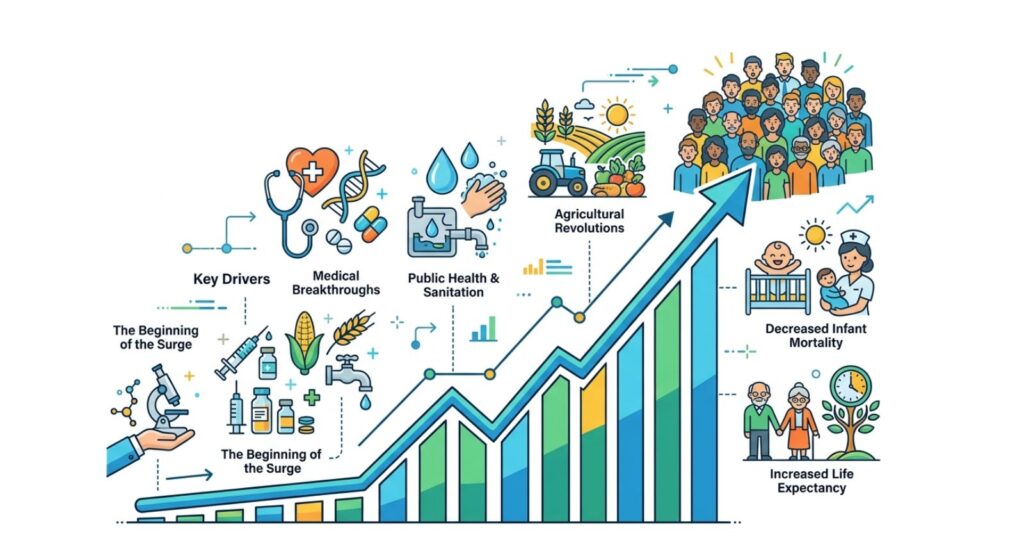
This acceleration did not stem from a sudden surge in births. Instead, more people survived to adulthood and old age. Improvements in agriculture, sanitation, public health measures, and later medical knowledge lowered mortality, especially among infants and children.
Birth rates remained elevated for decades in many regions, creating a widening gap that fueled rapid net growth. The pattern first appeared clearly in parts of Europe and spread unevenly across the globe as economic and technological changes took hold elsewhere.
Historians and demographers trace the roots of this shift to developments that began in the 18th century but gathered decisive momentum after 1800. The transition marked a departure from the long era in which population size fluctuated with harvests, plagues, and local conflicts. Understanding exactly when and why the explosion started clarifies how societies moved from fragile stability to sustained expansion, and why growth rates have since begun to moderate in many places.
Early Human Population Dynamics Before the Explosion
Human numbers stayed low for the vast majority of history. Estimates place the global population at a few million or fewer for much of the Paleolithic era. Even after the Neolithic transition to agriculture around 10,000 BCE, growth remained gradual.
Farming allowed more reliable food supplies and larger settlements, yet disease, poor nutrition in some periods, and periodic crises kept death rates high enough to limit net increases. By the start of the Common Era, the world population likely stood near 170 to 300 million. It climbed slowly to around 500 million by the mid-17th century.
Throughout these centuries, societies operated in what demographers call a high-mortality, high-fertility regime. Families had many children because few were expected to reach reproductive age. Life expectancy at birth often hovered in the low 30s in many regions, pulled down by infant and child mortality that could claim 30 to 40 percent or more of births. Famines and epidemics periodically reset local populations. The Black Death in the 14th century, for example, cut European numbers sharply before recovery began. Growth occurred, but at annual rates often below 0.1 percent on average over long stretches.
Smaller-scale accelerations happened in certain times and places. Some genetic and archaeological evidence points to population expansions among early modern humans tens of thousands of years ago, and the spread of agriculture supported larger densities in fertile river valleys. Yet none of these episodes produced the sustained, global-scale multiplication seen after 1800. Pre-modern growth remained constrained by the Malthusian trap, in which any temporary rise in numbers eventually pressed against food supplies and living conditions, restoring equilibrium through higher mortality.
The Turning Point Around 1800
The population explosion gained clear momentum in the late 18th and early 19th centuries. The world population crossed the one-billion mark in 1804. From that baseline, it took 123 years to add the second billion, reaching that level around 1927. Subsequent billions arrived far more quickly: the third by 1960, the fourth by 1974, and so on, until eight billion in 2022. This compression of time intervals signals the intensity of the change that began two centuries earlier.
Europe showed early signs. The population there roughly doubled during the 18th century and doubled again in the 19th. Similar patterns emerged in parts of North America. The shift was not uniform; some regions experienced slower or interrupted progress due to conflict or slower adoption of new practices.
Still, the global trend pointed upward as mortality fell while fertility stayed relatively stable initially. Annual growth rates, which had averaged a tiny fraction of a percent for millennia, climbed toward 0.5 percent and higher in affected areas before peaking above 2 percent in the mid-20th century.
Precise dating depends on definitions. Some observers note modest accelerations as early as the mid-18th century linked to better agricultural output and reduced crisis mortality. Yet the decisive break, where sustained exponential growth became visible in aggregate data, centers on the period from 1750 to 1850, with the sharpest global effects after 1800. By then, cumulative improvements in food security, transport, and basic hygiene had begun to compound across societies.
Key Drivers Behind the Population Surge
Several interconnected factors explain why mortality declined enough to trigger rapid growth. Agricultural innovations played a central role. New crops, crop rotation systems, selective breeding, and expanded cultivation increased food availability. The potato, introduced from the Americas, became a staple in parts of Europe and supported denser populations with fewer famines. Better transport networks moved surplus food to deficit areas, buffering local shortages.
Public health measures gained traction in the 19th century. Cleaner water supplies, sewage systems, and basic sanitation reduced the spread of waterborne diseases such as cholera and typhoid. Vaccination campaigns, notably against smallpox, cut specific causes of death. Child survival rates improved markedly. In many places, the proportion of children dying before age five dropped from 30-40 percent to much lower levels over decades. These changes meant more individuals lived long enough to have families of their own, amplifying the next generation.
Medical knowledge advanced more slowly at first, but contributed later. Germ theory, developed in the late 19th century, informed hospital practices and personal hygiene. Antibiotics and other treatments arrived in the 20th century, further lowering death rates.
Economic growth from industrialization raised living standards for many, improving nutrition and housing. Urbanization brought challenges, including crowded conditions that initially raised some disease risks, yet overall gains in productivity and income supported larger populations.
Fertility did not fall immediately. Cultural norms, economic reliance on family labor in agrarian settings, and limited access to contraception kept birth rates high. In the classic demographic transition model, societies move from high birth and high death rates (Stage 1) to a phase of declining death rates with persistent high birth rates (Stage 2). The resulting natural increase drives the explosion. Only later, in Stage 3 and beyond, do birth rates decline as education, urbanization, women’s opportunities, and family planning spread.
The following table compares approximate world population milestones and the time required to add each billion:
| Population Milestone | Approximate Year Reached | Years to Add This Billion | Average Annual Growth Context |
|---|---|---|---|
| 1 billion | 1804 | All prior human history | Very slow pre-1800 rates |
| 2 billion | 1927 | 123 years | Accelerating in industrial areas |
| 3 billion | 1960 | 33 years | Post-WWII global surge |
| 4 billion | 1974 | 14 years | Peak growth period |
| 5 billion | 1987 | 13 years | Continued high rates |
| 6 billion | 1999 | 12 years | Moderating in some regions |
| 7 billion | 2011 | 12 years | Varied by development level |
| 8 billion | 2022 | 11 years | Slowing overall trend |
Data synthesized from historical estimates and United Nations records. Actual intervals vary slightly by source due to estimation methods, but the pattern of compression after 1800 remains consistent.
Regional Variations in the Timing and Pace
The explosion did not hit every continent simultaneously. Western Europe and North America led, benefiting from early industrialization and agricultural changes. Eastern Europe and parts of Asia followed with a lag. In many developing regions, the sharpest mortality declines occurred in the 20th century, often after colonial or post-colonial public health campaigns introduced vaccines, antibiotics, and sanitation improvements. Sub-Saharan Africa and parts of South Asia saw rapid growth later, extending the global phenomenon into recent decades.
China and India, with their large base populations, contributed significantly to absolute numbers even when percentage growth rates differed. Some areas experienced setbacks from wars, famines, or political disruptions that temporarily slowed local gains. The Haber-Bosch process for synthetic fertilizer, commercialized in the early 20th century, deserves mention for its role in sustaining food production at scales that supported billions. Without such advances, growth could not have continued at observed rates.
Urbanization introduced a complex dynamic. Cities initially suffered higher mortality from crowding and poor infrastructure, creating an “urban penalty.” Over time, investments in water treatment, waste management, and healthcare reversed this in many places. By the mid-20th century, urban areas in developed nations often showed better health outcomes than rural ones. Migration from the countryside to cities also reshaped family structures and eventually influenced fertility decisions.
Demographic Transition Theory and Its Explanatory Power
The demographic transition framework organizes these changes into stages. Stage 1 reflects pre-industrial conditions with balanced high rates and minimal net growth. Stage 2 features falling death rates and sustained high birth rates, producing the explosion. Stage 3 brings declining birth rates as societies urbanize, educate women, and shift economic incentives away from large families. Stage 4 features low rates for both, with growth nearing zero or turning negative in some cases. A possible Stage 5 involves very low fertility and population decline.
This model originated from observations of European experience but has been applied, with adjustments, to other regions. Not every society follows the exact sequence or timing. Cultural, religious, and policy factors influence birth rate declines. Some countries compressed the transition into a few decades through aggressive public health and family planning programs. Others still show elevated fertility alongside falling mortality, maintaining positive growth.
Critics note that the model simplifies complex social processes and underplays economic inequality or external influences such as international aid. Still, it captures the core mechanism: mortality improvements outpaced fertility adjustments for a prolonged period, generating the surge in numbers.
Consequences and the Shift Toward Slower Growth
Rapid population increase brought both opportunities and strains. Larger workforces supported industrial expansion and innovation. Yet pressures on resources, land, and urban infrastructure mounted. Environmental impacts, including deforestation, water stress, and biodiversity loss, intensified with scale. Food systems were adapted through the Green Revolution of the mid-20th century, which raised yields dramatically through new crop varieties, fertilizers, and irrigation.
Global growth rates peaked around 2.2 percent per year in the late 1960s and have since declined to near 0.8-0.9 percent. Fertility has fallen in most regions as education levels rise, women enter the workforce, and access to contraception improves. Many high-income countries now face aging populations and sub-replacement fertility. Projections suggest the world population may stabilize or peak later this century, though absolute numbers will remain high for decades.
The legacy of the explosion includes profound shifts in age structure, migration patterns, and economic dependencies. Countries that experienced early transitions often built wealth that buffered larger numbers. Late-transition societies sometimes face the challenge of supporting growing populations with fewer resources per person. Policy responses have varied from promotion of family planning to concerns over labor shortages in low-fertility settings.
Population Explosion in Historical Perspective
The population explosion that began around 1800 stands as one of the most consequential transformations in human history. It arose not from deliberate design but from cumulative practical advances that allowed more people to survive and thrive.
Agricultural productivity, public sanitation, medical insights, and economic changes combined to lower death rates while birth patterns adjusted more slowly. The result was a multiplication of human numbers on a scale and speed unmatched in prior eras.
Today, with growth moderating in many places, attention turns to the quality of life within large populations and the sustainability of supporting systems. The same forces that drove expansion—innovation, knowledge diffusion, and improved living conditions—now shape pathways toward stabilization.
Societies that once struggled against high mortality now contend with the long-term effects of the demographic shifts set in motion two centuries ago. The story remains one of adaptation, where each generation inherits both the gains and the responsibilities created by unprecedented numbers.
FAQ
When exactly did the world population reach one billion?
Estimates place the crossing of the one-billion threshold near 1804. This milestone came after millennia of much slower growth and signaled the start of sustained acceleration driven by falling mortality.
What triggered the initial drop in death rates around the late 18th century?
Improvements in food production through better farming techniques and new crops reduced famine frequency. Early gains in hygiene and reduced crisis mortality from epidemics also contributed before widespread medical breakthroughs.
Did birth rates increase during the population explosion? Birth rates generally stayed high rather than rising sharply. The key change was the survival of more infants and children to adulthood, which increased the number of people reaching reproductive age and having families.
How does the demographic transition explain the population surge?
The model describes a shift from high birth and death rates to lower ones. In the middle phase, death rates fall first while birth rates remain elevated, producing rapid net growth until fertility also declines.
Why did population growth accelerate more in Europe initially?
Industrial and agricultural changes took hold earlier there, combined with improvements in transport, sanitation, and public health measures that lowered mortality ahead of many other regions.
What role did the Industrial Revolution play in population growth?
It boosted productivity, raised incomes for segments of society, and supported larger food supplies through mechanization and trade. Urbanization and economic shifts eventually influenced family sizes as well.
When did global population growth rates peak?
Annual growth rates reached their highest levels around the late 1960s, exceeding 2 percent per year, before beginning a gradual decline as fertility fell in more countries.
Has the population explosion ended?
Growth continues but at slower rates in most regions. Many countries have entered later stages of the demographic transition with low or declining fertility, pointing toward eventual stabilization later this century.
How did changes in child mortality contribute to the explosion?
Sharp reductions in deaths among infants and young children meant far more individuals survived to have their own families, multiplying generational size without an immediate drop in average family size.
What factors are slowing population growth today?
Rising education levels, especially for women, greater workforce participation, urbanization, access to family planning, and changing economic incentives have lowered fertility rates in most parts of the world.