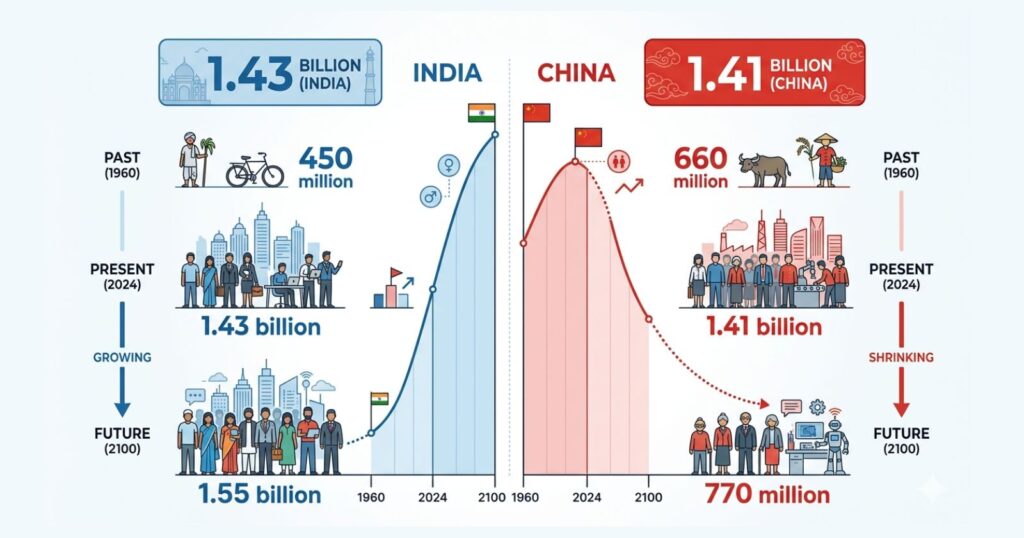
Population size has long served as a marker of national scale and potential influence. For decades, China held the position of the world’s most populous country, a status rooted in centuries of demographic history. That balance shifted when India crossed ahead, a transition confirmed in United Nations estimates around 2023 and solidified in subsequent years. As of 2026, India leads with an estimated population of approximately 1.47 billion, compared to China’s roughly 1.41-1.42 billion. This reversal reflects deeper differences in fertility trends, policy decisions, and societal changes that continue to unfold.
The gap between the two nations widened through contrasting growth patterns. India’s population expanded steadily even as birth rates moderated, driven by a large base of young people entering reproductive years. China, by contrast, experienced an earlier and sharper slowdown, accelerated by decades of restrictive family planning measures followed by persistent low birth rates. Recent official data from China show its population declining for multiple consecutive years, with a drop of over 3 million in 2025 alone amid record-low birth figures. India maintains positive, though slowing, growth that keeps its total higher and its structure younger.
These numbers carry weight beyond simple counts. Population dynamics influence labor supply, consumer markets, defense capabilities, and resource demands. India’s current edge in numbers coincides with a youthful demographic profile that many analysts view as a window for economic momentum, often termed a demographic dividend. China’s situation highlights the challenges of rapid aging after earlier gains from a large working-age cohort. Understanding the past, present, and projected paths of India versus China population trends reveals how these forces interact with development strategies and global positioning.
Historical Context of India vs China Population Growth
Demographic records trace the modern divergence between India and China back to the mid-20th century. Both countries entered the post-war era with large populations shaped by high fertility and improving survival rates due to advances in public health. China’s population stood at around 823 million in 1970, while India’s was near 558 million. By the early 2000s, both had crossed the billion mark, but China maintained a consistent lead until the early 2020s.
Policy played a central role in accelerating China’s transition to lower fertility. The one-child policy, implemented in the late 1970s and enforced with varying intensity, contributed to a steep decline in birth rates. Total fertility fell well below replacement levels—around 2.1 children per woman needed for long-term stability without migration—earlier than in many comparable economies. India pursued family planning programs from the 1950s onward, using a mix of education, incentives, and voluntary measures rather than strict quotas. Its fertility rate dropped from over 5 children per woman in 1950 to near or below 2.0 in recent surveys, but the decline occurred more gradually and with a larger youthful base sustaining momentum.
Censuses and sample surveys provide the foundation for these trends, though challenges persist in data precision for both nations. India’s last full census occurred in 2011, with subsequent estimates relying on vital registration systems and health surveys. China’s data include regular statistical releases, yet independent analysts sometimes question underreporting or adjustments related to past policy impacts. Despite these limitations, the broad pattern holds: India added people at a higher net rate in recent decades while China’s growth stalled and reversed.
By 2023, United Nations projections placed the crossover point in mid-year, with India reaching roughly 1.428 billion against China’s slightly lower figure. Updated estimates for 2026 confirm India at approximately 1.47 billion and China near 1.41-1.42 billion, reflecting continued divergence. China’s population has contracted annually in recent years, with births falling to levels not seen in modern records and deaths rising as the age structure shifts upward.
Current Demographics: Size, Growth Rates, and Age Structures
Today, India leads in total population while exhibiting a markedly younger profile. Roughly 65 percent of Indians fall under age 35 in many assessments, with a median age around 28-29 years. This youth bulge translates into a large working-age group—individuals aged 15 to 64—that supports economic activity and keeps dependency ratios relatively favorable for now. Annual population growth, though slowing, adds millions each year, concentrated in certain northern states with higher fertility.
China’s median age exceeds 40, and the share of people aged 60 and above has climbed toward 23 percent in recent figures. The working-age population has already begun to shrink, creating pressures on labor markets, pension systems, and healthcare. Official statistics for 2025 recorded only about 7.92 million births against over 11 million deaths, resulting in a net decline. The total fertility rate hovers near or below 1.0 in many estimates—far under replacement—despite policy shifts toward encouraging larger families.
These structural differences appear in key indicators. India’s total fertility rate stands around 1.9-2.0 according to recent health surveys and UN-aligned reports, still above China’s but trending downward across religious and regional groups. Urbanization, rising education levels—especially for women—and changing aspirations contribute to smaller family sizes in both countries, yet India’s larger rural base and uneven development sustain higher national averages for the time being.
A comparison table highlights selected metrics based on recent estimates and projections:
Key Population Indicators: India vs China (Approximate 2025-2026 Figures)
- Total Population: India ~1.46-1.47 billion; China ~1.40-1.41 billion
- Annual Growth Rate: India positive (~0.8-0.9%); China negative (~ -0.2% to -0.24%)
- Total Fertility Rate: India ~1.9-2.0; China ~1.0 or below
- Median Age: India ~28-29 years; China ~40+ years
- Share Aged 60+: India ~10% or less; China ~22-23%
- Working-Age Population Trend: India still expanding; China contracting
Data drawn from UN World Population Prospects updates and national statistical releases show these gaps widening in the near term. India’s youthful structure offers potential for a demographic dividend if investments in education, skills, and job creation align with the incoming cohorts. China’s earlier demographic transition delivered rapid workforce growth during its economic takeoff but now transitions into higher dependency burdens.
Fertility Trends and Policy Impacts
Fertility stands at the core of divergent India vs China population trajectories. India’s national family welfare initiatives achieved substantial reductions without the intensity of China’s approach. Surveys such as the National Family Health Survey document declines across all major groups, with gaps narrowing even as absolute numbers remain higher in some communities. Urban areas and southern states often record fertility below replacement, while northern regions drive much of the remaining growth through demographic momentum—the echo of earlier large birth cohorts now reaching adulthood.
China’s fertility collapse traces to multiple factors. The one-child policy created lasting shifts in family norms, gender imbalances in some cohorts, and high costs of child-rearing in competitive urban environments. Even after relaxation to two- and then three-child allowances, birth rates have not rebounded meaningfully. Recent years show births dropping to historic lows, with experts citing economic pressures, housing costs, work-life balance challenges, and evolving social expectations. Some analyses suggest actual fertility may sit near 1.0, contributing to faster-than-expected population contraction.
Both nations face the reality that fertility below replacement leads eventually to decline once momentum fades. India’s rate has fallen below or near 2.1 in national aggregates according to certain reports, signaling that peak growth lies ahead but will moderate. Projections indicate India’s total could reach 1.7 billion around the 2060s before gradual stabilization or slow decline. China’s path points to steeper losses, potentially halving its current size by 2100 under medium-variant assumptions.
Economic and Social Implications of Shifting Demographics
Population size alone does not determine economic outcomes, yet it interacts powerfully with workforce quality, productivity, and dependency loads. India’s large and growing cohort of young adults creates opportunities for labor-intensive sectors, domestic consumption, and innovation if education systems expand access and quality. Female labor force participation remains an area for potential gains; higher rates could amplify the demographic advantage. Challenges include job creation at scale, infrastructure to support urban migration, and addressing regional disparities in human development.
China leveraged its earlier demographic dividend to fuel manufacturing and export-led growth. The current reversal brings rising pension and healthcare costs, potential labor shortages in key industries, and incentives for automation or productivity-enhancing technologies. Some studies suggest China may sustain economic edges longer through higher educational attainment and workforce experience despite smaller numbers. For India, realizing a comparable dividend requires focused investments in schooling, vocational training, and removing barriers to participation—particularly for women.
Resource demands differ as well. A larger Indian population places pressure on food systems, water, energy, and environmental sustainability. Urban planning and agricultural productivity become critical. China’s shrinking population may ease some ecological burdens over time, though legacy pollution and aging-related service needs present separate strains. Globally, these shifts influence migration patterns, trade balances, and geopolitical weight as markets and labor pools realign.
Long-Term Projections to 2100
United Nations World Population Prospects, including the 2024 revision, outline plausible futures under different fertility and mortality assumptions. In the medium variant, India remains the most populous country through the century, peaking near 1.7 billion around 2060-2064 before easing toward 1.5 billion by 2100. China experiences sustained decline, potentially falling to around 600-630 million by century’s end—levels last seen decades ago.
Alternative scenarios show variability. Higher fertility paths could push India’s total above 2 billion temporarily, while lower paths accelerate decline for both. China’s trajectory appears more sensitive to persistent sub-replacement fertility, with some models forecasting losses exceeding 700-800 million from current levels. India benefits from demographic momentum that delays its own downturn.
These forecasts rest on assumptions about continued improvements in life expectancy, migration flows, and policy responses. Uncertainties include the effectiveness of pro-natal measures, impacts of climate or economic shocks, and data refinements from future censuses. Still, the central tendency points to India holding numerical superiority while both nations confront eventual stabilization or contraction amid global population dynamics that peak mid-to-late century.
A forward-looking perspective underscores that population size interacts with human capital. Education levels, health outcomes, and institutional quality often matter more than raw headcounts for long-term prosperity. Countries that invest early in their people tend to convert demographic potential into sustained gains, regardless of whether totals rise or fall.
Future Outlook
India holds the current lead in India vs China population comparisons and appears positioned to maintain it through 2100 under most projections. The real test lies in how each society adapts its policies, economies, and social systems to the age structures and growth patterns now taking shape.
Youthful energy in one case meets the challenges of maturity and contraction in the other, setting the stage for distinct development stories in the decades ahead. The outcome will depend less on who has more people at any single point and more on the quality and productivity of those populations over time.
FAQ
When did India surpass China as the world’s most populous country?
India overtook China around 2023 according to United Nations estimates, with the crossover occurring in the first half of the year. By 2026, India’s lead has widened to several tens of millions as China’s numbers contract while India’s continue to grow modestly.
What is the current population of India compared to China in 2026?
Recent estimates place India’s population near 1.47 billion, ahead of China’s approximately 1.41-1.42 billion. India adds millions annually while China records net losses due to more deaths than births.
Why is China’s population declining while India’s is still growing?
China’s total fertility rate has fallen to around 1.0 or below, leading to fewer births than deaths in an aging society. India’s rate remains closer to 1.9-2.0, supported by a younger age structure and demographic momentum from earlier generations.
What is the projected peak population for India?
Medium-variant projections suggest India could reach about 1.7 billion around the 2060s before growth slows and eventually reverses. The exact timing and level depend on future fertility trends and improvements in health and education.
How low could China’s population fall by 2100?
Under medium assumptions from UN models, China’s population may decline to roughly 600-630 million by 2100. Steeper declines are possible if fertility stays extremely low, returning the country to mid-20th-century sizes.
Does a larger population give India an economic advantage over China?
Population size contributes to labor supply and market scale, yet outcomes hinge on education, skills, job creation, and productivity. India’s youthful workforce offers potential, but realizing gains requires substantial investments in human capital and infrastructure.
What role did family planning policies play in these trends?
China’s strict one-child policy accelerated fertility decline decades ago. India’s programs emphasized voluntary measures and education, resulting in a more gradual transition that preserved greater demographic momentum into the present.
How does aging affect China differently from India?
China faces a rapidly rising share of elderly residents and shrinking working-age groups, increasing dependency burdens. India maintains a younger profile with lower old-age dependency for now, though it will eventually encounter similar pressures later this century.
Will India remain the most populous country through 2100?
Most UN projections indicate India will hold the top position, with its population stabilizing or declining more slowly than China’s. Variations exist across high- and low-fertility scenarios, but the relative lead persists in central forecasts.
What factors could change these long-term population projections?
Shifts in fertility driven by policy, economic conditions, education, or cultural norms could alter paths. Migration, major health advances, or unforeseen events might also influence totals, though current trends point to continued divergence between the two nations.