
Cities have anchored human civilization for thousands of years. Their size at any given moment signals economic vitality, administrative reach, and the capacity to sustain dense populations through food supply, infrastructure, and governance. The most populated cities in history stand out not merely for raw numbers but for the way they concentrated power, culture, and innovation while facing limits imposed by pre-modern logistics or modern pressures like sprawl and resource strain.
Early urban settlements emerged in fertile river valleys where agriculture produced surpluses. These places grew into regional hubs long before written records offered precise counts. Historians rely on archaeological evidence, tax records, grain distribution data, and comparative studies to build estimates. Such figures carry uncertainty, especially before systematic censuses, yet patterns emerge clearly across regions and centuries.
The story of the most populated cities in history tracks a slow climb for millennia followed by explosive acceleration after the Industrial Revolution. Factors such as reliable water sources, defensive walls, imperial administration, and later rail networks or port facilities determined which settlements scaled up. Today, urban agglomerations in Asia dominate lists produced by the United Nations World Urbanization Prospects, reflecting continued demographic momentum in developing economies.
Early Urban Centers in Mesopotamia and Egypt
The earliest large settlements appeared in the Fertile Crescent and along the Nile. Around 7000 BC, proto-cities in the ancient Near East held perhaps 1,000 to 2,000 residents. By 3000 BC, Uruk in southern Mesopotamia stood as one of the standout examples. Estimates place its core population near 40,000, with surrounding areas supporting up to 80,000 to 90,000 more.
This growth rested on irrigation systems that boosted barley and wheat yields, allowing specialists in crafts, administration, and temple rituals to gather in one place. Ziggurats and defensive structures marked these sites as political and religious foci. Similar dynamics played out in Egypt, where Memphis served as a major center from roughly 2050 BC onward with an estimated peak around 35,000 residents at times when it ranked among the world’s largest.
These ancient giants operated at scales modest by later standards. Yet their existence required coordinated labor for canals, storage, and distribution. Population density created both opportunities for cultural exchange and risks from disease or crop failure. When river courses shifted or conflicts disrupted trade, many settlements contracted sharply.
Classical Antiquity and the Rise of Million-Plus Cities
The scale of urban life expanded significantly in the centuries around the turn of the common era. Babylon reached an estimated 100,000 to 200,000 residents by 700 BC during periods of regional dominance. Carthage in North Africa grew to roughly 400,000 to 500,000 by 300 BC, fueled by Mediterranean trade networks before its conflicts with Rome.
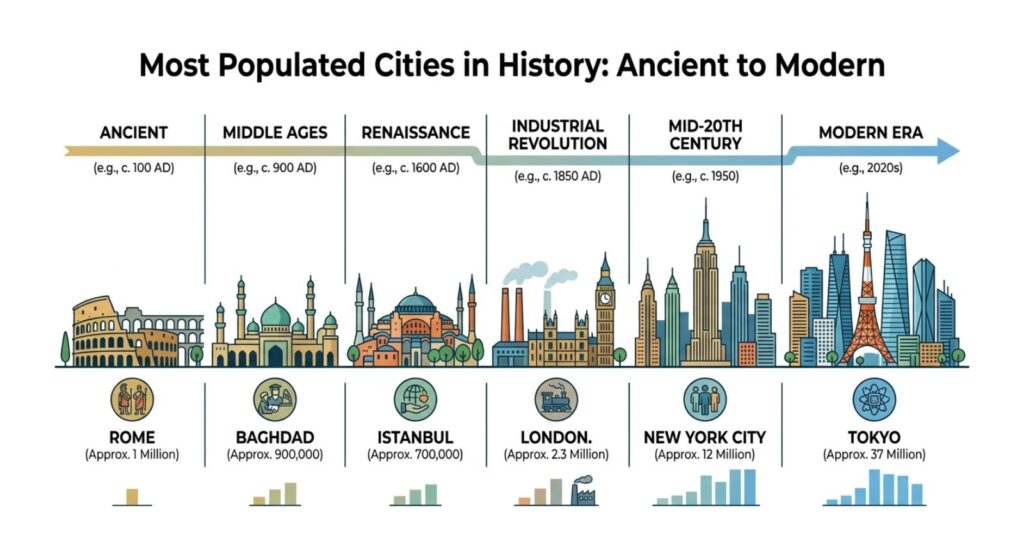
Rome itself emerged as a benchmark. By the 1st or 2nd century CE, the city likely housed close to 1 million people, making it one of the first, if not the first, to cross that threshold according to multiple historical analyses. Grain shipments from Egypt, extensive aqueducts delivering fresh water, and a network of roads supported this density. At its height under the early empire, Rome’s population dwarfed contemporary rivals and represented a remarkable concentration for the era.
Estimates vary between 800,000 and 1.2 million depending on inclusion of suburbs and transient populations. The city maintained this size for centuries through public works, markets, and imperial administration. Its decline after the 5th century reflected broader disruptions in supply lines and governance rather than any sudden technological reversal.
In the same broad period, Alexandria in Egypt and later Constantinople served as major population centers. Alexandria benefited from its role as a Mediterranean port and intellectual hub, while Constantinople, founded as the eastern capital, sustained hundreds of thousands through strategic location and defensive advantages. These cities demonstrated how political centrality and maritime access could sustain large populations even without industrial tools.
Medieval Peaks in Asia and the Islamic World
After the fragmentation of the western Roman sphere, urban leadership shifted eastward. Chinese cities such as Chang’an (modern Xi’an) and later Kaifeng, Hangzhou, and Beijing repeatedly ranked among the most populated. Chang’an under the Tang dynasty may have approached or exceeded 1 million in the 8th century, supported by canal systems linking agricultural heartlands and a sophisticated bureaucratic state.
Baghdad rose prominently during the Abbasid Caliphate. Around 900 CE, estimates place its population near 900,000 to 1.1 million, making it a leading contender for the world’s largest at the time. The city functioned as a center of learning, trade, and administration across a vast Islamic empire. Its markets, libraries, and house of wisdom attracted scholars and merchants, while river and overland routes ensured steady supplies.
Other notable medieval entries included Cordoba in Islamic Spain and various Chinese capitals that rotated in prominence as dynasties shifted. These cities often featured advanced water management, dense residential quarters, and economies built on specialized crafts and long-distance commerce. Population estimates remain debated due to limited records, yet consensus points to several Asian and Middle Eastern centers sustaining 500,000 to over 1 million residents at various points between 600 and 1400 CE.
Europe lagged in this era. Constantinople maintained significant size, sometimes estimated around 300,000 to 600,000, but few western European settlements approached comparable figures until much later. The pattern underscores how centralized empires with effective taxation and infrastructure could concentrate people more efficiently than fragmented feudal systems.
Early Modern Shifts and the Impact of Empire and Trade
From the 15th century onward, Beijing frequently topped lists as Chinese dynasties consolidated power. Estimates for the early 15th century place it around 600,000 to 1 million, growing further in subsequent periods. Other Asian centers like Vijayanagara in India or Dhaka in Bengal also featured prominently during regional economic booms.
By the 17th and 18th centuries, Beijing and later London began to reflect new dynamics. London’s growth accelerated with the expansion of British trade and the beginnings of industrialization. The city reached roughly 2 million by the mid-19th century, widely accepted as the first to achieve that mark in modern times.
Industrialization transformed urban possibilities. Steam power, railways, and factory production allowed cities to draw labor from rural areas and import food from distant regions. London’s population surged from about 2.3 million in 1850 to over 6 million by 1900, driven by empire, finance, and manufacturing. New York followed a similar trajectory, benefiting from immigration and its role as an Atlantic gateway.
Here is a comparison of selected historical population peaks for major cities at key periods, drawn from historian estimates and UN-aligned modern data:
| City | Approximate Year | Estimated Population | Key Supporting Factors |
|---|---|---|---|
| Uruk (Mesopotamia) | 3100 BC | 40,000 (core) | Irrigation agriculture, temple economy |
| Rome | 100-200 CE | 800,000–1,200,000 | Grain imports, aqueducts, roads |
| Baghdad | 900 CE | 900,000–1,100,000 | Abbasid administration, trade routes |
| London | 1900 | 6,500,000 | Industrial Revolution, empire trade |
| New York | 1950 | 12,000,000+ | Immigration, industrialization, finance |
| Tokyo | 2000 | 26,000,000+ | Post-war economic boom, efficient transit |
These figures represent urban or metropolitan estimates and illustrate both absolute growth and the lengthening gap between leading cities and the global average settlement size.
20th Century Acceleration and the Emergence of Megacities
The 20th century marked a decisive break. New York became the first city widely recognized as exceeding 10 million around 1925 to 1950, reflecting waves of European and internal migration plus economic centrality. Tokyo surpassed it later, reaching over 20 million by the 1970s and approximately 26 million by 2000 in its urban agglomeration.
Several forces converged: improvements in sanitation and medicine reduced urban mortality, agricultural modernization freed rural labor, and global trade expanded food and energy supplies. Automobile and rail systems enabled suburban sprawl while high-rise construction increased density in cores. Government planning, or its absence, influenced outcomes. Tokyo developed extensive public transit that supported continued growth without total gridlock, whereas many cities in developing regions faced informal settlements and infrastructure strain.
By mid-century, the list of the most populated cities in history included a mix of established industrial hubs and emerging centers in Latin America and Asia. Mexico City, São Paulo, and Mumbai joined the ranks as national populations swelled and rural-to-urban migration intensified.
Contemporary Leaders and Projections
Current data from United Nations sources highlight a clear Asian emphasis. As of recent 2025 estimates, Jakarta leads with roughly 41.9 million in its urban agglomeration, followed by Dhaka at about 36.6 million and Tokyo at 33.4 million. Delhi, Shanghai, and other large Indian and Chinese centers follow closely. These figures use consistent agglomeration definitions that capture contiguous high-density areas rather than strict municipal boundaries.
Growth in these places stems from sustained high fertility in surrounding regions combined with economic pull factors. Many residents arrive seeking jobs in manufacturing, services, or informal sectors. Challenges include housing shortages, pollution, water management, and vulnerability to climate events such as flooding in low-lying coastal cities like Jakarta and Dhaka.
Projections to 2050 suggest continued expansion in South and Southeast Asia. Dhaka may approach or exceed 50 million under medium scenarios, while other centers stabilize or grow more modestly depending on fertility declines and migration patterns. Tokyo, with lower natural increase, maintains size through density and productivity rather than raw expansion.
Drivers Behind Urban Scale Across Eras
Several recurring elements explain why certain cities became the most populated in their time. Agricultural surplus provided the caloric foundation. Reliable transport—whether rivers, roads, or later rails and ports—moved food and goods. Administrative capacity collected taxes and organized labor for public works. Security from invasion or internal disorder encouraged settlement. Cultural or religious prestige attracted migrants and elites.
Technological leaps amplified these advantages. The Roman aqueduct system, medieval Chinese Grand Canal, and 19th-century steam engines each removed prior bottlenecks. In the modern period, electrification, elevators, and mass transit allowed vertical and horizontal scaling. Public health measures such as clean water and vaccines prevented the worst effects of density-related disease that had capped earlier cities.
Economic specialization also mattered. Cities that served as imperial capitals, trade entrepôts, or industrial cores attracted more residents than purely agricultural or defensive settlements. Global integration since the 16th century widened the catchment area for labor and resources, enabling sustained growth beyond what local hinterlands could support alone.
Limits and Sustainability Questions
Even the largest historical cities eventually faced constraints. Rome declined when supply chains fractured. Baghdad suffered from political upheaval and invasions. Many medieval Chinese capitals saw populations fluctuate with dynastic changes. Modern megacities confront different pressures: affordable housing, environmental carrying capacity, and aging infrastructure.
Urban planners and demographers note that density can bring efficiency in energy use and service delivery when managed well. Yet unplanned growth often produces slums, traffic congestion, and inequality. Future trajectories for the most populated cities in history will depend on policy choices around transit investment, green space, and inclusive development as much as on raw demographic trends.
The shift toward service and knowledge economies may also moderate growth in some places while accelerating it in others. Coastal locations remain attractive for trade but carry rising risks from sea-level changes. Inland centers with strong digital connectivity may gain relative advantage.
Key Conclusion and Analysis
The trajectory of the most populated cities in history reveals humanity’s enduring drive to cluster for opportunity and connection. From the mud-brick complexes of Uruk to the skyscraper clusters of contemporary Asia, each era’s leading centers adapted available technology and organization to support unprecedented densities.
The coming decades will test whether governance and innovation can sustain these scales amid environmental and social pressures. Cities remain the primary stage on which economic, cultural, and demographic stories unfold, and their size continues to mirror the ambitions and constraints of the societies that build them.
FAQ
What was the first city in history to reach 1 million people?
Rome, Chang’an, or Baghdad are frequently cited as candidates, with Rome possibly achieving the mark by the 1st or 2nd century CE. Precise figures remain estimates, but these centers stand out in historical analyses for crossing the million-person threshold well before the modern era.
Which ancient city had the largest population before the common era?
Uruk in Mesopotamia and later Babylon or Carthage rank highly. Uruk may have supported 40,000 in its core around 3100 BC, while Carthage reached several hundred thousand by the 3rd century BC. Exact rankings depend on definitions of urban boundaries.
How did Rome sustain such a large population in ancient times?
Extensive grain imports from provinces like Egypt, a sophisticated aqueduct network for water, and paved roads for distribution enabled the city to feed and supply hundreds of thousands. Public infrastructure and imperial organization played central roles.
When did London become one of the world’s most populated cities?
London grew rapidly during the 19th century and reached approximately 6.5 million by 1900, making it the largest at that time. It held the top position for decades thanks to industrial output and global trade links.
What made Tokyo the leading city by population in the late 20th century?
Post-war economic expansion, efficient public transportation, and high-density planning allowed Tokyo’s agglomeration to surpass 20 million and reach about 26 million by 2000. Stable governance and technological adoption supported sustained growth.
Are modern megacities larger than historical ones in relative terms?
Yes. While absolute numbers are higher today, the gap between the largest city and global population share has widened. Ancient Rome represented a larger fraction of its contemporary world population than most modern single cities do now.
Why do so many of today’s largest cities sit in Asia?
High overall population in countries like India, China, Indonesia, and Bangladesh, combined with ongoing rural-to-urban migration and economic opportunities in manufacturing and services, drive current rankings.
How accurate are population estimates for ancient cities?
Estimates rely on indirect evidence such as settlement size, housing density, food storage capacity, and comparative studies. Ranges often span hundreds of thousands because direct census data rarely survived.
Will any city exceed 50 million by 2050? Projections under medium scenarios suggest Dhaka or Jakarta could approach or surpass that level, though outcomes depend on fertility rates, migration policies, and economic conditions.
What factors could limit future growth of the most populated cities?
Housing affordability, water scarcity, climate impacts, and shifts toward remote work or decentralized economies may cap expansion in some locations while redirecting growth elsewhere.