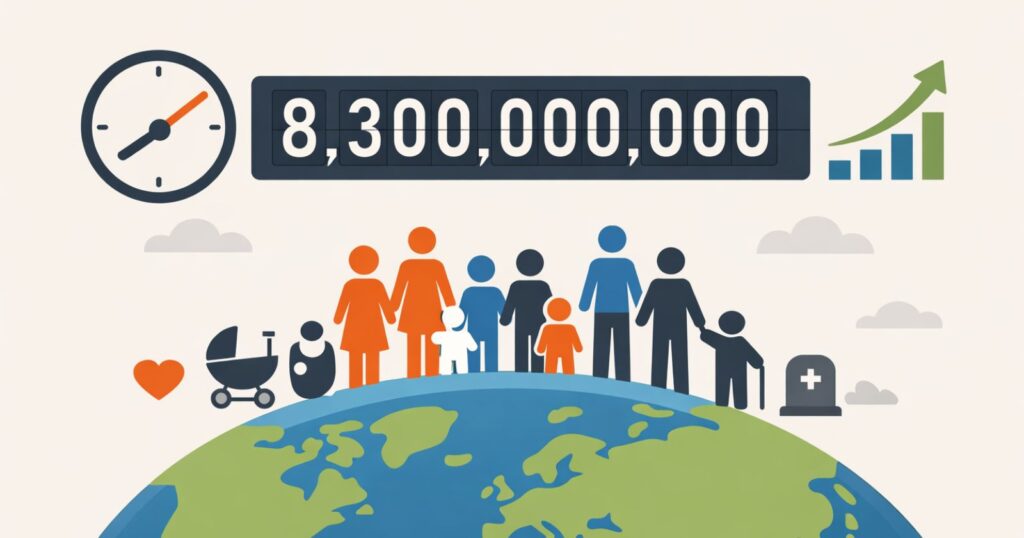
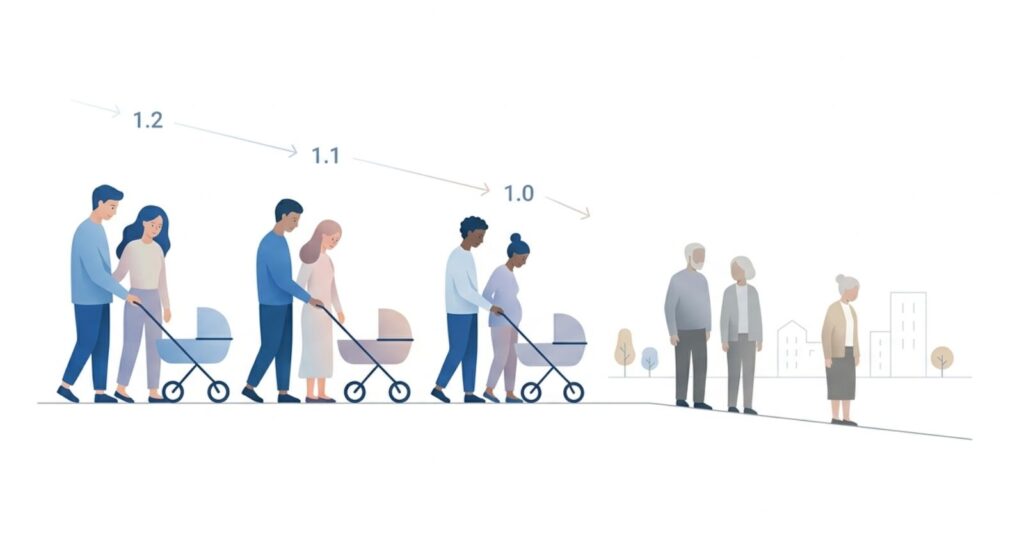
Birth rates have fallen sharply in many parts of the world over recent decades. In 2025, the global average stood near 16.1 births per 1,000 people, yet advanced economies in East Asia and Europe posted figures far lower, often below 7 per 1,000. Countries with the lowest birth rates now confront a future marked by contracting populations, older age structures, and strained economic models built on steady growth.
South Korea, Taiwan, Japan, Italy, and Spain rank among the most affected. Their total fertility rates hover between 0.7 and 1.3 children per woman, levels that lead to each generation being roughly half the size of the previous one when sustained. This demographic contraction unfolds gradually at first but accelerates as smaller cohorts reach childbearing age. The stakes extend beyond raw numbers to labor supply, innovation capacity, and the sustainability of pension and healthcare frameworks.
These trends reflect deep societal transformations rather than temporary fluctuations. Women have gained expanded educational and professional opportunities, while urbanization and higher living costs reshape family decisions. At the same time, cultural shifts toward later marriage and smaller households compound the effect. Nations once defined by youthful energy now grapple with the mechanics of managing decline.
What Defines Low Birth Rates
The total fertility rate measures the average number of children a woman would have over her lifetime based on current age-specific patterns. Replacement level sits at approximately 2.1 in low-mortality settings to maintain a stable population size absent migration. Rates below this threshold produce eventual shrinkage once population momentum fades.
Crude birth rate counts live births per 1,000 residents annually and offers a snapshot sensitive to age distribution. Many countries with the lowest birth rates post crude figures under 7 per 1,000, compared with the global 16.1. Both metrics matter: fertility drives long-term trajectory while crude rates reveal immediate pressures on schools, workplaces, and budgets.
Data from the United Nations World Population Prospects and national statistical offices track these shifts consistently. In 2025 estimates, East Asian territories and parts of Southern Europe dominate the bottom of the rankings. Macao, Hong Kong, and South Korea frequently appear with fertility near or below 0.8, while Japan, Italy, and Spain cluster around 1.2.
Leading Countries With the Lowest Birth Rates
South Korea stands out for the steepness of its decline. Fertility dropped from around 6 in the 1950s to estimates near 0.7-0.76 in recent years. Annual births have fallen dramatically, prompting government declarations of national emergency. Seoul records even lower local figures, reflecting intense urban pressures on housing, work culture, and education costs.
Taiwan reported a crude birth rate of 4.62 per 1,000 in 2025, with births plunging 20 percent in a single year to roughly 107,000. Its total fertility rate likely sits near 0.72, positioning it among the global minima. Rapid economic development, high female workforce participation, and competitive education systems contribute to delayed or forgone childbearing.
Japan has experienced decades of sub-replacement fertility. The 2024 birth total reached 686,061, a historic low. Fertility around 1.2 combines with one of the world’s highest life expectancies to produce a median age near 49. Rural areas empty faster than cities, creating ghost towns and labor shortages in sectors from agriculture to elder care.
Italy and Spain illustrate the Southern European pattern. Fertility rates near 1.2 reflect later marriages, high youth unemployment in past cycles, and elevated housing prices in desirable regions. Both countries maintain strong family ties culturally, yet see fewer large households. Italy’s “demographic winter” label captures the sense of quiet contraction visible in shrinking school enrollments and hospital maternity wards.
Other notable cases include Singapore, Hong Kong, and parts of Eastern Europe such as Ukraine and Lithuania. Puerto Rico and certain small territories also register very low figures. These places share traits: advanced or rapidly advancing economies, urban concentration, and accessible contraception paired with shifting norms around career and personal fulfillment.
Comparative Data on Fertility and Birth Rates
The table below organizes recent estimates for select countries with the lowest birth rates alongside the broader context. Figures drawn from the UN, World Bank, and national sources around 2023-2025. Replacement level appears for reference.
| Country | Total Fertility Rate (children per woman) | Crude Birth Rate (per 1,000) | Notes |
|---|---|---|---|
| South Korea | ~0.7-0.76 | ~4.8-5.6 | Steepest modern decline; heavy policy focus |
| Taiwan | ~0.72 | 4.62 | Record low births in 2025 |
| Japan | ~1.2 | ~6.1 | Aging population; rural depopulation |
| Italy | ~1.2 | ~6.5 | Southern Europe leader in low fertility |
| Spain | ~1.2 | ~6.9 | High urban costs influence decisions |
| Hong Kong | ~0.75-0.8 | ~5.3 | Dense urban environment |
| Singapore | ~0.97 | Low single digits | Strong economy, later marriage |
| Global Average | ~2.2-2.3 | 16.1 | Wide regional variation |
These numbers highlight how East Asia pulls the global low end lower while Europe contributes consistent sub-replacement cases. Sub-Saharan Africa, by contrast, maintains rates above 4 in many nations, driving continued global population growth for now.
Drivers Behind Declining Birth Rates
Improved access to education, especially for women, correlates strongly with smaller family sizes. Higher schooling levels delay first births and open career paths that compete with traditional parenting timelines. Labor force participation reinforces this dynamic in competitive job markets.
Urban living raises the opportunity costs of children. Housing space comes at a premium, childcare expenses climb, and dual-income households become necessary for financial stability. In cities like Seoul or Tokyo, long work hours and intense academic competition for children add layers of stress that discourage larger families.
Changing social norms play a central role. Marriage ages have risen across these societies, and acceptance of child-free or one-child choices has grown. Surveys in low-fertility countries often cite financial pressures, work-life balance concerns, and uncertainty about the future as reasons for having fewer or no children.
Lower child mortality removes the historical incentive for higher births to ensure surviving offspring. Effective contraception and family planning further enable precise control over timing and number. In developed settings, these factors combine with prosperity that once supported larger families but now channels resources toward intensive investment in fewer children.
Cultural and policy contexts differ. South Korea’s competitive education system and corporate culture amplify pressures, while Italy and Spain contend with rigid labor markets and generational housing shortages. Across cases, the empowerment of women through education and employment consistently emerges as a foundational element.
Economic and Social Consequences of Population Decline
Sustained low fertility produces aging populations and shrinking cohorts of young workers. Dependency ratios rise as fewer people of working age support growing numbers of retirees. This dynamic strains pension systems, healthcare infrastructure, and public finances.
Labor shortages appear in multiple sectors. Japan has turned to automation and limited immigration to offset shortfalls in manufacturing, services, and elder care. South Korea projects potential economic contraction in the coming decades without major adjustments. Innovation ecosystems may suffer if talent pipelines thin, although productivity gains from technology could partially compensate.
Real estate markets face downward pressure in depopulating regions. Schools consolidate or close, and local economies tied to family-oriented services contract. On the positive side, lower population density in some areas eases environmental strain and infrastructure demands, though concentrated urban aging creates different challenges.
Fiscal sustainability becomes a core policy issue. Governments must either raise retirement ages, increase taxes, cut benefits, or encourage immigration and higher fertility. Historical attempts at pro-natal incentives, from cash payments to housing subsidies, have yielded mixed results at best. Cultural and economic forces often prove stronger than targeted policies.
Global ripple effects matter too. As East Asia and Europe shrink, the share of the world population in high-fertility regions like sub-Saharan Africa grows. This redistribution shifts economic gravity, migration patterns, and geopolitical balances over the coming century.
Policy Responses and Adaptation Strategies
Nations with the lowest birth rates have experimented with various measures. South Korea has spent billions on family incentives ranging from parental leave expansions to subsidized housing and childcare. Outcomes remain limited so far, suggesting bigger structural changes may be necessary.
Japan has focused on work-style reforms to improve work-life balance and has gradually opened pathways for foreign labor. Italy and Spain emphasize flexible employment and gender equity policies while addressing youth unemployment. Broader efforts target affordable housing, reduced education costs, and community support for families.
Immigration serves as a partial buffer in many places. Countries that integrate skilled and family-based migrants can moderate aging effects and sustain workforce size. Public attitudes and integration capacity influence the scale and success of these approaches.
Longer-term adaptation involves rethinking economic models. Emphasis on productivity, lifelong learning, and capital-intensive industries can offset smaller labor forces. Technology adoption, from robotics to artificial intelligence, gains urgency in contexts of demographic contraction.
Some analysts argue that modest population stabilization carries environmental benefits and allows greater per-capita resource availability. Others warn of lost dynamism and innovation if societies become top-heavy with older residents. The balance remains subject to ongoing debate and real-world testing.
Regional Patterns and Future Projections
East Asia exhibits the most acute cases of low fertility. Decades of rapid modernization compressed the demographic transition into a short period, leaving little buffer before decline set in. Cultural factors around family obligation and academic achievement intensify the effect.
Southern and Eastern Europe share patterns of economic uncertainty, later life transitions, and strong welfare expectations that prove difficult to fund with fewer contributors. Northern Europe generally records slightly higher rates thanks to more family-friendly policies and cultural norms, though still below replacement.
North America sits in a middle ground, with the United States near 1.6-1.7, supported partly by immigration and diverse population subgroups. Projections indicate continued global fertility decline, with the world average approaching or dipping below 2.1 by mid-century. Population peaks and subsequent contraction appear likely in many regions absent major shifts.
China, once defined by strict family planning limits, now faces its own low fertility rate of 1.0-1.2. The legacy of past policies combines with contemporary urban pressures to accelerate aging. India maintains higher rates overall but shows urban declines that mirror earlier patterns elsewhere.
These regional differences underscore that low birth rates are not uniform. Context-specific factors shape both the pace of decline and the capacity for response.
Why Birth Rates Matter for National Futures
Demographic structure influences everything from GDP growth trajectories to national defense capabilities and cultural continuity. Countries with the lowest birth rates must plan for smaller, older societies that prioritize efficiency and quality over quantity.
Education systems face redesign to serve fewer students with greater individual attention and lifelong retraining needs. Healthcare shifts emphasis toward chronic conditions and geriatric care. Urban planning adapts to stable or declining populations rather than endless expansion.
The psychological and social dimensions receive less attention yet carry weight. Communities built around family networks experience quiet reconfiguration. Younger generations inherit different expectations about responsibility and legacy when sibling groups shrink, and elder care burdens concentrate.
Global cooperation may increase in importance as labor mobility, knowledge sharing, and technology transfer help balance regional disparities. Nations that adapt successfully could demonstrate models for managing contraction with dignity and continued prosperity.
Key Conclusion and Analysis
Countries with the lowest birth rates have entered uncharted demographic territory. Their experiences will inform how societies worldwide address the transition from growth to stability or gentle decline. Success hinges on honest assessment of underlying drivers, pragmatic policy mixes, and cultural willingness to value different forms of contribution across life stages.
The path forward requires balancing immediate pressures with long horizons. Smaller populations need not equate to diminished vitality if productivity, creativity, and social cohesion strengthen in tandem. These nations are testing whether human ingenuity can sustain quality of life amid structural contraction, an experiment with implications that reach well beyond their borders.
FAQ
Which country currently has the lowest birth rate?
Taiwan and South Korea compete for the lowest positions in recent data. Taiwan recorded a crude birth rate of 4.62 per 1,000 in 2025, while South Korea’s total fertility rate has hovered near 0.7. Both reflect intense urban and economic pressures that discourage larger families.
What is the difference between birth rate and fertility rate?
Crude birth rate counts annual births per 1,000 total population and responds quickly to age structure. The total fertility rate estimates lifetime births per woman and better predicts future population trends. Countries with the lowest birth rates score low on both measures.
Why do East Asian countries have such low birth rates?
Rapid economic growth, high education levels, competitive job markets, and expensive child-rearing combine with cultural emphasis on achievement. Long work hours and limited housing options further delay family formation in places like South Korea and Japan.
How do low birth rates affect the economy?
Fewer young workers lead to labor shortages, slower growth, and higher dependency ratios. Pension and healthcare costs rise relative to tax revenues. Productivity improvements and technology adoption become essential offsets.
Can government policies reverse low birth rates?
Policies providing childcare support, parental leave, and housing assistance help at the margins but rarely lift fertility back to replacement levels. Cultural and economic fundamentals often outweigh financial incentives alone.
Which European countries have the lowest birth rates?
Italy and Spain consistently rank low with fertility around 1.2. Several Eastern European nations also post sub-replacement figures. Work-life balance challenges and housing costs contribute across the region.
Will populations in low birth rate countries disappear?
Complete disappearance is unlikely in the near term. Populations shrink gradually, and immigration plus modest policy adjustments can moderate the pace. Long-term contraction remains possible without broader changes.
How does immigration help countries with low birth rates?
New arrivals add working-age residents and future parents, easing dependency burdens and sustaining economic activity. Successful integration determines the net benefit to society and public systems.
What role does women’s education play in declining birth rates?
Higher education levels correlate with delayed marriage and childbearing as women pursue careers and personal goals. This shift empowers individual choice while contributing to smaller average family sizes.
Are low birth rates a global phenomenon?
Most regions outside sub-Saharan Africa now sit at or below replacement fertility. The global average continues to fall, though high-fertility pockets persist in parts of Africa and a few other areas.