For most of recorded human history, population growth was treated as an unstoppable force, a tide that would swell indefinitely, straining resources, crowding cities, and pressing against the limits of what the planet could sustain. That frame is now obsolete.
Demographers, economists, and policymakers are confronting a quietly seismic realization: the world population trajectory, far from being an upward line, bends. And the bend is coming sooner than almost anyone predicted two decades ago.
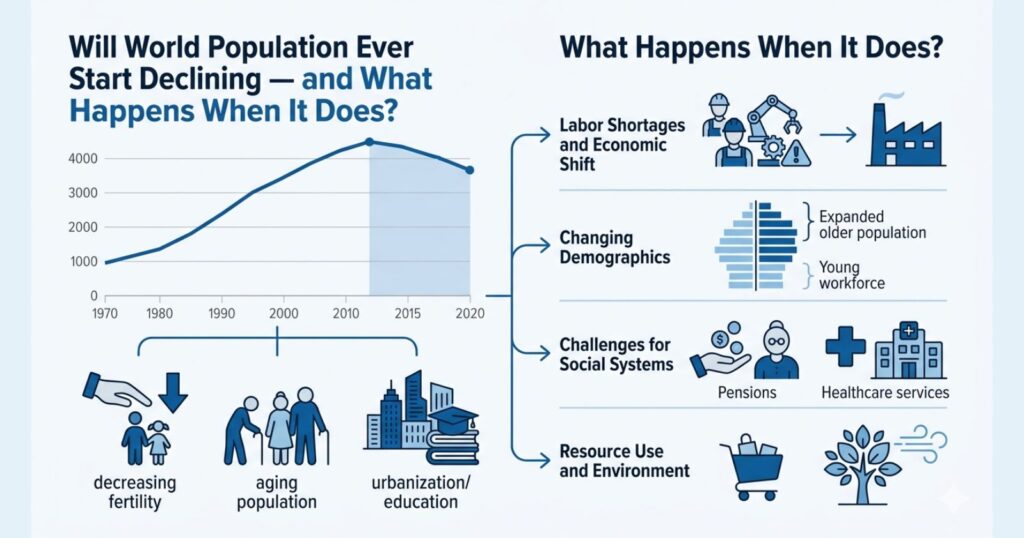
According to the United Nations World Population Prospects 2024, the global population is expected to peak at approximately 10.3 billion in 2084, before declining slightly to around 10.2 billion by the end of the century. That figure, striking as it is, understates the structural transformation already underway beneath it.
Today, one in four people on Earth already lives in a country where the population has peaked. The shift from expansion to contraction is not a future hypothetical; it is a present condition for hundreds of millions of people, from Seoul to Sofia.
What makes this demographic turning point so consequential is not the raw numbers, but the forces that produce them and the cascading effects that follow. Falling fertility rates, extended life expectancy, aging workforces, shrinking tax bases, and reimagined social contracts are converging simultaneously. Understanding where this trajectory leads, and why some nations are already living through its earliest chapters, is one of the defining intellectual and policy challenges of the century.
Why World Population Growth Is Slowing Faster Than Expected
The pace of the slowdown has repeatedly outrun the models designed to track it. In its 2022 revision, the UN projected that the global population would peak in 2086 at around 10.4 billion people. The 2024 edition brought that peak forward to 2084, with the population topping at just under 10.3 billion. That two-year advancement in the projected peak may sound modest. It is not. It reflects the compounding effect of fertility declines happening faster than expected across some of the world’s most populous nations.
The global fertility rate stands at 2.3 live births per woman as of 2024, with women bearing, on average, one child fewer than in 1990. That single statistic encapsulates a generational transformation in family formation across every inhabited continent.
The report anticipates that the global fertility rate will fall below the replacement threshold of 2.1 births per woman by 2050, a historic demographic shift. This deceleration has been driven by rapid urbanization, changing social norms, and expanded access to education and family planning.
The mechanics are not mysterious. As women gain access to education and enter formal labor markets, the economic logic of large families inverts. Children shift from assets, contributors to agricultural or household labor, to costs, requiring years of educational investment before any economic return materializes.
Urbanization reinforces this calculus; the costs of housing and schooling in cities make larger families financially prohibitive in ways that rural settings historically did not. These are not policy failures. They are, in many respects, signals of human progress. But they carry structural consequences that no society has yet fully resolved.
The Countries Already in Decline
Several major economies have not waited for 2084 to begin confronting population contraction. China is anticipated to experience the largest absolute population loss between 2024 and 2054 at 204 million, followed by Japan and the Russian Federation at 21 and 10 million, respectively. By 2100, China is projected to have lost more than half of its current population and to have returned to a population size comparable to that recorded in the late 1950s.
Japan’s situation is perhaps the most well-documented case of a high-functioning economy navigating decline in real time. Japan’s demographic transformation exemplifies the inverted population pyramid, with nearly a third of its citizens now 65 or older, the oldest population globally. With one of the world’s highest life expectancies and lowest fertility rates, the nation faces a dependency ratio of roughly 50 seniors per 100 adults.
South Korea presents an even starker picture. In late 2023, South Korea’s total fertility rate fell to 0.65, the lowest globally, even below that of war-torn Ukraine. The South Korean government has spent more than $270 billion since 2006 on policies to encourage child-rearing, and yet the decline has continued with remarkable persistence. The structural drivers, intense urban density, a culture of demanding working hours, staggering private education costs, and limited gender equity at home, have proven resistant to financial incentives alone.
The Demographic Divide: Growth in Africa, Contraction Elsewhere
Any accurate account of global population trends must grapple with a fundamental asymmetry. The world is not declining uniformly; it is splitting along demographic lines that largely track development.
Sub-Saharan Africa continues to experience the highest growth rates globally, even as fertility falls sharply. Niger, Uganda, and Malawi are projected to nearly double their populations by mid-century, intensifying pressure on essential resources. Meanwhile, five countries are expected to contribute more than 60 percent of the world’s population growth by 2100: the Democratic Republic of Congo, Ethiopia, Nigeria, Pakistan, and Tanzania.
This divergence creates a world with two simultaneous demographic realities: nations struggling under the weight of rapid population growth straining infrastructure, food systems, and employment, and nations facing the opposite pressure of shrinking workforces, aging populations, and faltering pension systems. Neither challenge is trivial. Neither can be addressed with the same policy toolkit.
| Region | Projected Population Trend to 2100 | Key Driver |
|---|---|---|
| Sub-Saharan Africa | Strong growth, potentially tripling | Elevated fertility rates |
| South Asia (India) | Peak around 2061, gradual decline after | Falling fertility, aging |
| East Asia (China, Japan, South Korea) | Rapid contraction | Ultra-low fertility, aging |
| Europe | Moderate decline, offset by immigration | Below-replacement fertility |
| North America | Slow growth continuing | Immigration-driven |
| Latin America & Caribbean | Peak mid-century, then decline | Rapid fertility decline |
Immigration is projected to be the main driver of population growth in 52 countries and areas through 2054 and in 62 through 2100, including Australia, Canada, and the United States of America. For many wealthy nations, migration is not merely a policy choice; it is a demographic lifeline.
What Happens to an Economy When Its Population Shrinks
The economic implications of sustained population decline are serious, layered, and contested. The consensus view points to real and substantial headwinds. Research published in the American Economic Journal found that each 10 percent increase in the fraction of the population aged 60 and older decreased per capita GDP by 5.5 percent, one-third from slower employment growth and two-thirds from slower labor productivity growth.
The OECD’s Employment Outlook 2025 warns that without swift changes in policies and behaviors, GDP per capita growth will slow down significantly in most OECD countries. By 2060, the working-age population will have declined by 8 percent in the OECD area, and by more than 30 percent in more than a quarter of OECD countries.
The Pension and Fiscal Strain
Pension systems built on the assumption of a broad working-age base funding a narrow elderly tier face existential pressure when that ratio reverses. In Japan, there were 5.8 workers for every retiree in 1990, compared to 2.3 in 2017, with a projected 1.4 by 2050. The fiscal arithmetic becomes increasingly strained as the working cohort shrinks while the retired cohort expands, demanding more healthcare, more long-term care, and larger pension payouts simultaneously.
IMF analysis indicates that global growth will slow in the future despite the positive effects of healthy aging. Some advanced economies with relatively older populations, such as Japan, are likely to see their economies shrink. China will see a particularly sharp decline in GDP growth, slowing by about 2.7 percentage points relative to 2016 to 2018.
The Counterargument: Healthier Workers, Longer Careers
The picture is not entirely bleak. A more nuanced reading of the evidence suggests that the severity of the economic drag depends heavily on how societies respond. Goldman Sachs Research finds that since 2000, average working lives have increased by 12 percent, from 34 to 38 years. Despite longer life expectancy and declining working-age ratios, the average share of life spent actively participating in the labor market has actually risen, from 44 to 47 percent. Goldman Sachs
IMF research shows that improved labor market outcomes for people aged 50 and older, thanks to better health, could contribute about 0.4 percentage points annually to global GDP growth from 2025 to 2050. Nations that invest in healthy aging, flexible retirement structures, and expanded female workforce participation can partially offset the structural drag that a shrinking younger cohort creates.
Japan itself, long held as a cautionary tale, is offering some evidence of adaptation. Labor force participation among women and older workers has risen, and companies facing acute labor shortages have accelerated investment in automation and labor-saving technology. The transition is painful, but not without productive adaptation.
Innovation, Ideas, and the Long-Term Risk of Demographic Contraction
Perhaps the subtlest and most troubling consequence of population decline involves not the number of workers, but the number of minds. Economic growth in the modern era is driven substantially by ideas, new technologies, processes, products, and scientific breakthroughs. Stanford economist Charles Jones argues in a 2022 paper that the implications of low fertility include a drop in the number of new ideas, which could strangle innovation and result in economic stagnation. A shortage of researchers, inventors, scientists, and other people-based sources of innovative ideas could also hurt economic progress.
This is a longer-horizon risk than pension solvency or GDP growth rates, but arguably a more structural one. Innovation is, to a meaningful degree, a function of population scale and diversity. Smaller, older societies historically generate fewer startups, fewer patents, and less disruptive technological change. Whether artificial intelligence and productivity tools can substitute for sheer human volume in the innovation ecosystem is one of the most consequential open questions in economics today.
Policy Responses: What Nations Are Trying, and What Works
Governments across the demographic spectrum have responded with a range of interventions, though the record is decidedly mixed.
Pronatalist Policies and Their Limits
South Korea’s experience is instructive. On June 19, 2024, the South Korean government declared a “Population National Crisis” and unveiled a plan to implement a nationwide response system, including the establishment of a Ministry for Population Strategy and Planning. Cash bonuses for new births, subsidized childcare, extended parental leave, and housing support have all been deployed, and yet the fertility rate has continued to fall. More than 74 percent of the program’s disbursements were for births that would have been expected even without monetary enticement, according to research on South Korea’s baby bonus program.
The broader lesson from comparative demography is consistent: pronatalist cash transfers have weak effects on fertility when the deeper structural barriers, expensive housing, demanding work cultures, inadequate childcare infrastructure, and persistent gender inequality in domestic labor remain unaddressed. Japan has introduced flexible work arrangements, several European countries are overhauling their social security systems, and China abolished its one-child policy, but none of these measures have reversed the underlying trend.
Immigration as a Bridge Strategy
Japan’s population has been declining since 2010, but a rise in the workforce participation rate for women and those aged 65 to 74 has prevented the workforce from declining. Managed immigration, alongside efforts to maximize the productive capacity of existing workers, represents the most proven near-term response available to declining-population nations.
International migration is projected to mitigate population decline due to low fertility and aging in some areas. By 2054, immigration will be the main driver of population growth in 52 countries, including Australia, Canada, Qatar, Saudi Arabia, and the United States. The political economy of immigration is, of course, complex, but the demographic math favors societies that can attract and integrate working-age immigrants at scale.
What the World Looks Like When Growth Turns Negative
Fertility decline has substantially slowed global growth rates: from a peak of 2.3 percent in 1963 to just 0.8 percent in 2024. Growth is expected to turn negative in 2085, with the global population contracting by around 0.13 percent annually by the end of the century.
At that stage, the world will be navigating territory without historical precedent. A planet that has never known a contracting global population, only faster or slower growth, will need to retrofit every system built on the assumption of expansion. City planning, infrastructure investment, university enrollment, military recruitment, consumer markets, and fiscal policy all carry embedded assumptions of more people tomorrow than today. When that reversal arrives, adaptation will not be optional.
Despite a slowdown in overall growth, the number of people aged over 60 is projected to rise throughout the century, eventually surpassing three billion. Global life expectancy is estimated to reach nearly 82 years, an increase from 73 years in 2024. That is a world defined less by the pressure of too many young people than by the challenge of sustaining the dignity and productivity of an unprecedented number of older ones.
The nations that will weather this transition most effectively are those that begin restructuring now, investing in healthy aging, building immigration systems capable of meaningful scale, deploying automation with deliberate intent, and redesigning pension and healthcare systems for fiscal sustainability across longer and more variable career spans. Countries that wait for the peak to arrive before acting will find that the window for orderly adaptation has already closed.
The question of whether the world population will decline has been answered by the data. It will. The deeper question, whether the civilizations built during the era of growth can reimagine themselves for an era of contraction, is still being written.
FAQ: World Population Decline
1. When will the world population start declining?
Based on the UN’s 2024 World Population Prospects, the global population is projected to peak at approximately 10.3 billion around 2084 and then begin a gradual decline. Population growth is expected to turn negative around 2085, with the rate of contraction estimated at around 0.13 percent annually by the end of the century.
2. What is the main reason the world population will decline?
The primary driver is falling fertility rates. The global average has dropped from over five children per woman in the 1960s to 2.3 today, and it is projected to fall below the replacement level of 2.1 by 2050. Urbanization, expanded education for women, rising costs of child-rearing, and shifting social norms all contribute to this decline.
3. Which country has the lowest birth rate in the world right now?
South Korea holds the lowest fertility rate globally. Its total fertility rate dropped to approximately 0.65 to 0.72 in recent years, far below the replacement threshold of 2.1. Despite spending more than $270 billion on pronatalist policies since 2006, the rate has continued to fall.
4. Will population decline be good or bad for the environment?
A stabilizing or shrinking global population would reduce aggregate demand for land, water, food, and energy, potentially easing ecological stress. However, the economic contraction associated with aging and shrinking workforces could reduce investment in clean energy and environmental technology, complicating the overall picture.
5. What happens to pension systems when populations shrink?
Pension systems come under severe strain as the ratio of workers to retirees narrows. In Japan, there were 5.8 workers per retiree in 1990; that figure has fallen to 2.3 and is projected to reach 1.4 by 2050. Without reforms to retirement ages, contribution rates, or immigration policy, many pension systems face structural insolvency.
6. Can immigration offset population decline?
Immigration can significantly offset the decline in the near to medium term. The UN projects that immigration will be the primary driver of population growth in over 50 countries by 2054, including the United States, Canada, and Australia. However, immigration alone cannot compensate for sustained fertility rates well below replacement level indefinitely.
7. Are any regions of the world still growing rapidly?
Sub-Saharan Africa remains the most demographically dynamic region. Countries like Niger, Uganda, and Nigeria are projected to see massive population increases through mid-century and beyond. Africa’s share of the global population is expected to rise from roughly 19 percent today to over 38 percent by 2100.
8. How does population aging affect economic growth?
Research consistently shows that aging populations slow GDP growth. One major study found that a 10 percent increase in the share of people aged 60 and older correlates with a 5.5 percent decrease in per capita GDP. The effect operates through slower employment growth and reduced labor productivity, though healthier older workers can partially offset these impacts.
9. Has any country successfully reversed a population decline?
No country has definitively reversed a population decline driven by structural fertility decline. Some nations, such as France and Sweden, have maintained relatively higher fertility rates through robust family-support policies and gender equality measures, but none have returned from below-replacement to above-replacement fertility on a sustained basis through policy alone.
10. How does China’s population trajectory affect global markets?
China’s population has already begun contracting, and the UN projects it could lose more than half its current population by 2100. This has profound implications for consumer markets, manufacturing labor supply, pension system stability, and geopolitical influence. Shrinking domestic demand could reshape global trade patterns and supply chains across multiple industries over the coming decades.