At some point between April and May 2023, India crossed a threshold that no country had ever reached before: it became the most populous nation on Earth, overtaking China for the first time in recorded modern history.
That milestone, confirmed by the United Nations Population Division, was not a sudden event but the culmination of decades of sustained growth, falling mortality rates, and a demographic momentum that continues to carry India forward even as its fertility rate now sits below the biological replacement threshold. India’s 2026 population is estimated at approximately 1.476 billion, equivalent to 17.79 percent of the world’s total population.
The sheer scale of that number, nearly one in every six human beings alive today, makes understanding India’s demographic picture not just a matter of national interest, but a question with profound implications for global economics, resource planning, and geopolitical strategy.
What makes India’s population story genuinely complex in 2026 is that it tells two entirely different stories depending on which lens is applied. By one reading, India is a country still growing, still young, and sitting on an enormous demographic dividend, a bulge of working-age people that, if properly educated and employed, could generate economic returns for decades.
By another reading, fertility is falling faster than most policymakers have acknowledged, the demographic window is closing faster in some southern states than in much of Europe, and the challenge of ageing before achieving prosperity looms larger with each passing year.
Both readings are simultaneously accurate. India’s population in 2026 is not a static fact; it is a live, dynamic condition with a trajectory that will reshape nearly every dimension of the country’s development.
The absence of a current national census compounds the challenge of reading that trajectory clearly. India’s last completed census was conducted in 2011. The 2021 census was postponed due to the COVID-19 pandemic and has not yet been completed, meaning that all current population figures for India are UN-based projections rather than enumerated counts.
The next Census of India is scheduled to begin in March 2027, and it will be the country’s first fully digital census, with caste enumeration included for the first time since 1931.
Until those results are published, every number cited for India’s population in 2026 carries the caveat of estimation, well-calibrated estimation based on the finest demographic modelling available, but estimation nonetheless.
How Many People Live in India Right Now
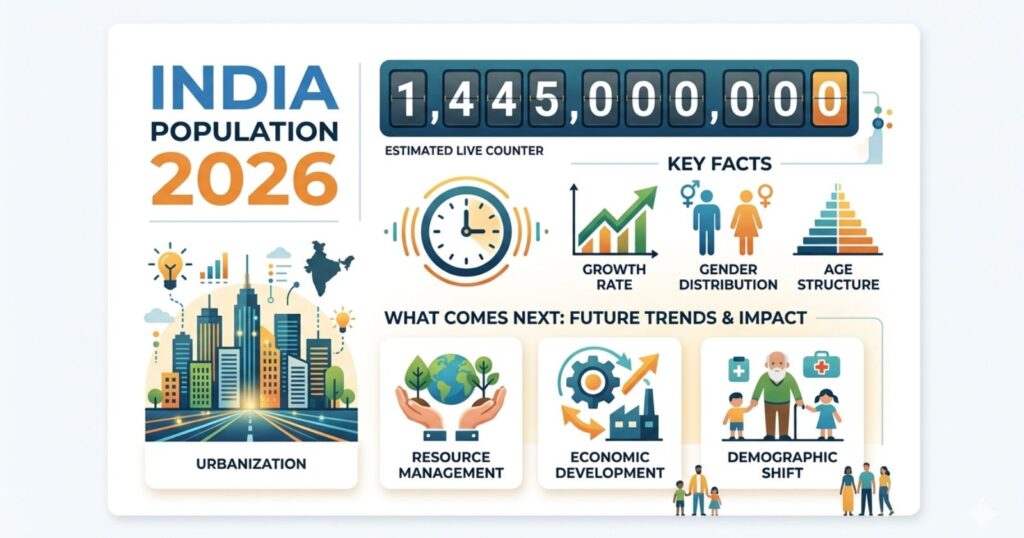
As of March 28, 2026, India’s population is estimated at approximately 1,473,303,271, based on linear interpolation between the most recent official reference dates in the United Nations population projections.
By July 1, 2026, the mid-year estimate rises to 1,476,625,576. These figures originate from the UN’s World Population Prospects 2024 Revision, the most authoritative source currently available for cross-country demographic comparison.
Live population counters tools that calculate real-time population by applying average birth, death, and migration rates to a baseline figure; show India adding one new resident approximately every 19 seconds on a net basis.
In 2026, India is projected to record approximately 82,775 live births per day and 30,052 deaths per day, translating to a net population increase of around 51,060 persons daily. That net daily addition is roughly equivalent to a mid-sized Indian town appearing on the map every 24 hours.
India’s population growth rate for 2026 is projected at 0.86 percent, ranking 106th among 237 countries and dependent territories, a figure that reflects how significantly the pace of growth has decelerated from the peak annual growth rate of 2.41 percent recorded in 1961.
The country is still growing, but the velocity of that growth has slowed substantially, and the demographic forces driving it are shifting.
Key Demographic Indicators at a Glance
| Indicator | 2026 Estimate |
|---|---|
| Total Population (mid-year) | 1,476,625,576 |
| Share of World Population | 17.79% |
| Annual Growth Rate | 0.86% |
| Net Persons Added Per Year | ~12.66 million |
| Median Age | 29.2 years |
| Urban Population Share | 37.61% |
| Population Density | ~450 per sq km |
| Total Fertility Rate | ~1.9 children per woman |
| Net Migration | Negative (~979,000 per year) |
| Global Population Rank | 1st |
Sources: UN World Population Prospects 2024 Revision; Worldometer; StatisticsTimes
India’s Fertility Rate: A Shift That Changes Everything
No single demographic variable carries more consequence for India’s future than its total fertility rate (TFR). For decades, India’s TFR was a symbol of uncontrolled population growth, frequently invoked in debates about resource scarcity and development policy. Today, the data tells a radically different story.
India’s fertility rate has declined to 1.9 births per woman, falling below the replacement level of 2.1, according to the UNFPA’s State of World Population 2025 report. The National Family Health Survey (NFHS-5) pegged the 2022 fertility rate at 2.0 nationally, with urban fertility at 1.6 and rural fertility at 2.1.
By Indian estimates, the TFR fell below replacement level nationally as of 2019, with urban India having reached that milestone as early as 2004. TFR in rural India also fell below replacement level by 2023.
The pace of this shift has genuinely surprised demographers. Countries that transitioned from high to low fertility typically did so over generations; India has compressed that journey into less than four decades.
The regional divergence within India is striking. Total fertility rates vary from as high as 2.98 in Bihar and 2.91 in Meghalaya to as low as 1.05 in Sikkim and 1.3 in Goa. The state of Maharashtra’s fertility rate is now lower than Norway’s. Tamil Nadu and Andhra Pradesh, whose governments once promoted two-child norms as development policy, have reversed course entirely, with political leaders actively encouraging families to have more children to avert long-term population decline.
Financial strain is a leading factor in decisions to have fewer children: around 38 percent of Indian respondents in the UNFPA survey cited economic challenges, while 21 percent pointed to job insecurity or unemployment as reasons for having fewer children than desired.
Age Structure and the Demographic Dividend
India’s median age of 29.2 years positions it as one of the younger large economies in the world, a full decade younger than China, and roughly two decades younger than Japan, Germany, or Italy.
This age structure creates the conditions for what economists call a demographic dividend: a period during which the working-age population significantly outnumbers dependents, allowing per capita income and savings to rise more rapidly than they otherwise would.
With 68 percent of India’s population in the working-age group of 15 to 64 years, the country still retains significant demographic dividend potential. A research paper published in Humanities and Social Sciences Communications (2025) estimated that India’s demographic dividend contributed approximately 1.9 percentage points per annum to economic growth during the period 1981 to 2021, with the favourable impact strengthening after 2011 before being disrupted by the COVID-19 pandemic in 2020 to 2021.
However, by 2026, India’s dependency ratio is projected to be 543, meaning 543 children and elderly people for every 1,000 people of working age. Center for the Advanced Study of India. This figure is declining, which is economically positive for now, but the trajectory will reverse as the elderly population begins to grow faster than the working-age cohort.
Seniors over the age of 60 currently make up 11 percent of India’s population, but this group is expanding rapidly as life expectancy improves. After 2050, the only population group expected to continue growing in size will be those above the age of 60.
India’s Working-Age Population vs. Dependents (2026 Projection)
| Age Group | Share of Population | Approx. Count |
|---|---|---|
| Under 15 (children) | ~24% | ~354 million |
| 15 to 64 (working age) | ~68% | ~1,003 million |
| 65 and over (elderly) | ~8% | ~118 million |
| Dependency Ratio | 543 per 1,000 working-age | — |
Sources: UN World Population Prospects 2024; Data For India; UNFPA 2025
A published analysis by the Observer Research Foundation (March 2026) framed the stakes precisely: India risks ageing before becoming rich, as shifting family dynamics, a narrowing workforce window, divergent regional trajectories, and urbanisation with new demands converge into the need to migrate national growth models toward productivity-driven frameworks, with technology as the overarching bridge.
Urban and Rural Population Split
As of 2026, 37.61 percent of India’s population, approximately 555 million people, lives in urban areas. Rural India, by contrast, still accounts for nearly two-thirds of the country’s total population, making India one of the world’s largest rural nations in absolute terms.
The pace of urbanisation is accelerating, however. India’s urbanisation rate expanded from 28.5 percent in 2001 to 35.4 percent in 2021, and current projections suggest that by the mid-2030s, urban Indians will account for close to half the national population.
This urban transition brings both opportunity and pressure. Cities are absorbing tens of millions of migrants from rural hinterlands, many arriving in search of employment that the formal economy has not yet fully generated at the required scale.
India will need to add approximately 7.85 million jobs every year until 2030, according to government estimates, simply to absorb those entering the workforce. The pace of job creation in manufacturing, services, and technology will determine whether India’s demographic dividend becomes a growth engine or a social liability.
Most Populous States in India (2026)
The population of India is not evenly distributed across its 28 states and 8 union territories. The northern and central states, historically characterised by higher fertility rates and younger age structures, account for a disproportionate share of national population growth.
According to 2024 to 2025 projections, Uttar Pradesh remains by far the most populous state with approximately 241 million people, followed by Bihar at around 131 million and Maharashtra at approximately 128 million. West Bengal ranks fourth at approximately 100 million, with Madhya Pradesh, Rajasthan, Tamil Nadu, and Gujarat rounding out the top eight.
One in every three Indian children under the age of 14 lives in Bihar or Uttar Pradesh alone, a concentration that carries significant implications for future workforce composition, educational investment requirements, and regional economic development policy.
India’s Population Peak and What Comes After
The most significant long-range demographic story about India is not about how large its population currently is, but about when it will stop growing, and what the country will look like when it does.
Projections indicate India’s population will peak at approximately 1.70 billion in 2062 before gradually declining to 1.51 billion by 2100. By 2028, the population is expected to cross the 1.5 billion mark.
The UN’s medium-fertility variant scenario used to derive these numbers assumes that current fertility trends continue without a dramatic reversal. Under the high-fertility variant scenario, in which the TFR is projected to be 0.5 births per woman above the medium scenario, India’s population would surpass 2 billion people by 2068.
Since India’s population will increase at a slower rate than the world’s from 2029 onward, its global population share will begin to decrease. By 2100, India is projected to account for 14.79 percent of the world’s population, 3.01 percentage points below its peak share of 17.80 percent in 2029.
Migration: India’s Other Demographic Story
India’s population is not just shaped by birth and death rates. India’s net migration rate in the most recent year is estimated at approximately- 979,179, indicating more people are leaving than arriving.
Indians now constitute the largest diaspora group in the world, a community spanning the Gulf states, the United Kingdom, the United States, Canada, and increasingly Germany, Australia, and Japan.
This outflow of talent, predominantly young, educated, and mobile, represents both an economic contribution through remittances and a structural challenge through brain drain. Germany’s Skilled Labour Strategy for India was affirmed in January 2026 during the German Chancellor’s visit, while the UK renewed its Young Indian Professionals Scheme for 2026, and Japan signed a Human Resource Exchange and Cooperation program with India in August 2025. The international competition for Indian human capital is intensifying precisely as India’s demographic window is narrowing.
The North-South Divide and Regional Complexity
Among the most underappreciated dimensions of India’s demographic picture is the profound divergence between its northern and southern states. The fertility rate in the north-eastern state of Sikkim has fallen to 1.1, prompting the state government to offer additional salary increments for employees with more than one child, free childcare, paternity leave, and financial assistance for IVF procedures.
The southern states such as Kerala, Tamil Nadu, Karnataka, Andhra Pradesh, and Telangana are already grappling with ageing populations, shrinking school enrolments, and pensions systems under strain.
Kerala was the first Indian state to reach replacement fertility in 1988, when the national TFR was still 4. Tamil Nadu followed in 1993, and Andhra Pradesh in 2004. Bihar, at the other extreme, is expected to be the last state to achieve replacement fertility, not until 2039.
This internal divergence means that demographic policy in India cannot be national in character. A policy suited to Bihar’s needs, investment in family planning, maternal health, and girls’ education, would be actively harmful if applied to Kerala, where the concern is population ageing and labour scarcity.
What Comes Next: The Demographic Choices Ahead
India’s population trajectory through 2026 and beyond is neither a crisis nor a guarantee of prosperity. It is a window, and like all windows, it will not remain open indefinitely.
The working-age bulge that currently defines India’s age pyramid will yield maximum economic return only if accompanied by sustained investment in education quality, healthcare access, and formal job creation.
India’s Economic Survey 2018-19 projected that the demographic dividend will peak around 2041, when the share of the working-age population between 20 and 59 is expected to reach 59 percent. That is roughly 15 years away, a tight timeline for the structural reforms required to capitalise on it.
Urbanisation, if managed well, can accelerate that process. Urbanisation offers economies of scale, better employment opportunities, improved education and health facilities, higher productivity, and induces lower fertility rates, all of which contribute to the conditions under which the demographic dividend is most effectively realised. But poorly managed urbanisation, overcrowded cities, informal housing, and strained infrastructure can just as easily convert the dividend into a demographic burden.
India’s 2026 population count is, in the end, a number with enormous human texture behind it. It represents over a billion working-age adults, more than 350 million children, and a growing cohort of elderly citizens whose needs will increasingly shape public expenditure and social policy. The live counter ticking each second upward is not merely a statistic; it is a measure of a civilisation in motion, at a critical and irreversible inflection point in its history.
Frequently Asked Questions
1. What is the current population of India in 2026?
As of mid-2026, India’s population is estimated at approximately 1.476 billion people, based on UN World Population Prospects 2024 data. On a real-time basis as of March 28, 2026, the estimate stands at roughly 1.473 billion, making India the world’s most populous country.
2. When did India become the most populous country in the world?
India overtook China as the world’s most populous country around April to May 2023, according to UN estimates. China’s population has been declining since 2022 due to its extremely low fertility rate, while India’s population continues to grow, though at a slowing pace.
3. What is India’s population growth rate in 2026?
India’s population growth rate for 2026 is projected at 0.86 percent. This is significantly lower than the peak growth rate of 2.41 percent recorded in 1961 and reflects the broad decline in fertility across most Indian states over the past three decades.
4. How many people are born in India every day in 2026?
Approximately 82,775 babies are born in India each day in 2026, with around 30,052 deaths occurring daily. After accounting for net emigration, India’s population increases by roughly 51,060 persons per day on a net basis.
5. What is India’s total fertility rate in 2026?
India’s total fertility rate is currently estimated at approximately 1.9 children per woman, below the population replacement level of 2.1. This marks a dramatic decline from 5.9 births per woman in 1951 and even from 3.4 in the early 1990s. Urban fertility is even lower, at around 1.6.
6. Which is the most populous state in India in 2026?
Uttar Pradesh remains the most populous Indian state, with an estimated population of approximately 241 million people as of 2025 projections. Bihar is the second most populous, followed closely by Maharashtra. Together, the top five states account for a very large share of India’s total population.
7. When will India’s population peak?
According to UN projections using the medium-fertility variant, India’s population is expected to peak at approximately 1.70 billion people around 2062, after which it will gradually decline. By 2100, the population is projected to fall back to around 1.51 billion.
8. Is India’s population growing faster than China’s?
India’s population continues to grow, while China’s has been declining since 2022. India adds approximately 12.66 million people per year in 2026, whereas China’s population is shrinking by a small but growing margin each year due to its ultra-low fertility rate of around 1.0.
9. What percentage of India’s population is in the working-age group?
Approximately 68 percent of India’s population falls within the working-age bracket of 15 to 64 years, according to the UNFPA’s 2025 report. This large working-age share represents India’s demographic dividend, an economic opportunity that is expected to peak around 2041 before gradually narrowing.
10. When will India’s next census take place?
India’s next census is scheduled to begin in March 2027. Phase 1 (houselisting) will start in October 2026 for snow-bound regions, including Jammu and Kashmir, Ladakh, and Himachal Pradesh. It will be India’s first fully digital census and will include caste enumeration for the first time since 1931.