For the first time since the early months of COVID-19, the United States is growing at its slowest pace in years and the reasons behind that slowdown carry consequences far beyond a census table.
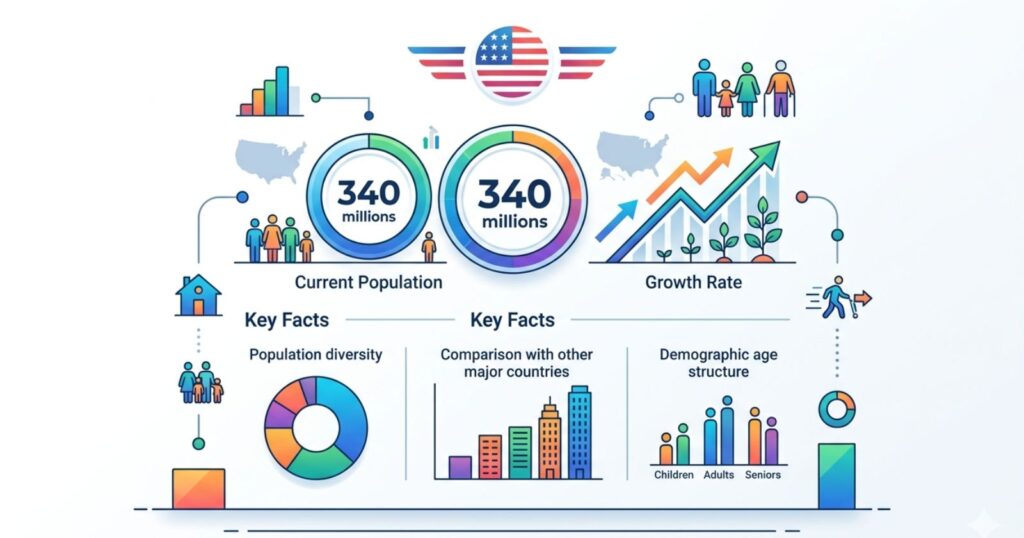
The USA population in 2026 is projected to reach approximately 349 million by mid-year, according to United Nations data elaborated by Worldometer and corroborated by Congressional Budget Office (CBO) estimates.
As of July 1, 2026, the population of the United States is projected at 349,035,494 compared to 347,275,807 on July 1, 2025. That increase, while numerically significant in absolute terms, marks a notable deceleration in the country’s demographic trajectory.
Population growth in the United States slowed significantly, with an increase of only 1.8 million, or 0.5%, between July 1, 2024, and July 1, 2025, according to Vintage 2025 population estimates released by the U.S. Census Bureau. This was the nation’s slowest population growth since the early period of the COVID-19 pandemic, when the population grew by a historically low 0.2% in 2021.
The contrast with the prior year is stark: 2024 had been the fastest year of population growth since 2006, driven by a surge in net international migration that has since reversed sharply.
What makes the 2026 demographic picture so consequential is not simply the headline figure, but the structural forces reshaping how that number is reached. Immigration policy, fertility decline, and a steadily aging population are converging to alter the fundamental drivers of American growth.
The country that added 3.2 million people in a single year just recently now finds itself navigating a far more constrained demographic environment, one with real implications for its labor force, entitlement programs, and long-range economic vitality.
Current USA Population in 2026: What the Numbers Show
The current population of the United States of America was estimated at 348,554,331 as of mid-March 2026, based on Worldometer’s elaboration of the latest United Nations data.
The United States population is equivalent to 4.20% of the total world population, and the country ranks number 3 in the list of countries by population. The population density in the United States is 38 per square kilometer, and 83.13% of the population is urban.
The median age of the American population sits at 38.7 years; a figure that has been climbing steadily for decades and reflects the aging of the large Baby Boomer generation into their 60s and 70s.
The CBO projects that the number of people age 65 or older will rise through 2036 at an average annual rate of 1.6%, faster than the growth rates projected for younger groups. This shift carries direct implications for Social Security, Medicare expenditures, and the ratio of working-age adults supporting the retired population.
The total fertility rate in the United States has fallen to historically low levels. The total fertility rate was 1.64 births per woman in 2020 and declined to 1.60 in 2024, and the CBO projects it will equal 1.58 births per woman in 2026, declining to 1.53 by 2036, well below the replacement level of 2.1. Without sustained immigration, the natural population change alone would not be sufficient to maintain current headcount levels.
USA Population Growth Rate in 2026: A Turning Point
The Immigration Collapse That Reshaped the Numbers
The single most disruptive factor in the 2025–2026 demographic picture is the dramatic fall in net international migration. Net international migration between July 1, 2024, and June 30, 2025, was 1.3 million, a notable drop from 2.7 million the year before, representing a decline of 53.8%.
If current trends continue, net international migration is projected to be approximately 321,000 by July 2026, representing another decline of nearly 1 million since July 1, 2025.
Congressional forecasters have lowered their projection of population growth over the next decade by 7 million people, in response to the Trump administration’s immigration crackdown as well as falling birth rates. The U.S. population is now projected to grow from 349 million in 2026 to 357 million by 2035.
The CBO has specifically attributed part of this revision to the administration’s efforts to reduce undocumented immigration, a decline in foreign student admissions in 2025, and the downstream effects on family-reunification migration chains.
Natural Increase: The Other Weakening Pillar
While immigration has drawn the most attention, natural population change, the gap between births and deaths, has also narrowed considerably. Natural change for the nation neared 519,000 between July 1, 2024, and June 30, 2025, roughly the same as the prior year. In 2017, natural change was about 1.1 million, and during the 2000-to-2010 decade, it ranged between 1.6 million and 1.9 million.
Starting in 2030, annual deaths are projected to exceed annual births, and net immigration would account for all population growth from that point forward. This represents a fundamental structural shift, a country whose population growth was historically anchored in the vitality of its birth rate will become almost entirely dependent on immigration to sustain any growth at all within this decade.
USA Population by Region and State: Where America Is Growing
The South Leads, the Northeast Lags
Geographic population movement continues to reflect economic and lifestyle preferences. Between April 2020 and July 2025, the U.S. population grew by more than 10 million people, but growth was heavily concentrated in a handful of states.
The South was the clear growth engine of the country, expanding by 6.0% and adding more than 7.5 million people. Texas led the nation in numeric gains, adding 2.56 million residents; Florida followed closely with 1.92 million new residents.
In terms of raw population increase, Texas gained the most residents year-over-year, with the Lone Star State’s population jumping more than 391,000 to a cumulative 31.7 million.
Since 2020, Texas’ population has grown by nearly 2.5 million, the most of any state. The state’s gravitational pull on both domestic migrants and international arrivals reflects its low-tax environment, diverse economy, and still-accessible housing markets relative to coastal metros.
The Northeast tells a different story. New York experienced the largest population drop in the country among declining states, losing 201,269 residents (-1.0%). Illinois (-102,600) and West Virginia (-1.5%) also saw significant declines.
States That Bucked the Slowdown
Only Montana and West Virginia did not see their population growth slow or their population decline speed up. Meanwhile, the Midwest is the only region in which every state saw its population grow between 2024 and 2025.
This Midwestern stability, driven more by natural change than by migration, offers a notable counternarrative to the dominant story of Sun Belt dominance.
USA Population Data Table: Key Demographic Indicators 2026
| Indicator | 2026 Estimate / Projection |
|---|---|
| Total Population (mid-year) | ~349,035,494 |
| Annual Growth Rate | ~0.5% |
| Net International Migration (2025) | ~1.3 million |
| Projected Net Migration (2026) | ~321,000 |
| Natural Change (births minus deaths) | ~519,000 |
| Total Fertility Rate | ~1.58 births per woman |
| Median Age | 38.7 years |
| Urban Population Share | 83.1% |
| Population Age 65+ | Growing at ~1.6% annually |
| Global Population Rank | 3rd |
Long-Term USA Population Projections: Where Growth Is Heading
A Slowdown That Compounds Over Decades
In CBO’s projections, the U.S. population grows from 349 million people in 2026 to 364 million in 2056, and the average age rises. Population growth slows during that period, from an average rate of 0.3 percent a year over the next decade to 0.1 percent a year thereafter.
The total population is projected to stop growing in 2056 and remain roughly the same size as in the previous year. Thereafter, the population is projected to shrink.
These are not abstract projections. They translate directly into fewer workers per retiree, higher dependency ratios, and mounting fiscal pressure on programs like Social Security and Medicare. The Penn Wharton Budget Model projects that the worker-to-retiree ratio will fall from 3.0 today to 2.0 by 2075, a structural shift with consequences for every aspect of the federal budget.
Immigration as the Last Engine of Growth
Net immigration is projected to become an increasingly important source of population growth in the coming years, as declining fertility rates cause the annual number of deaths to exceed the annual number of births starting in 2030. Without immigration, the population would begin to shrink in 2030.
This dependency on immigration makes current policy debates particularly consequential. Over the longer term, if reduced immigration persists, the U.S. may experience a sustained demographic slowdown, one that could constrain economic growth and accelerate population aging. How immigration trends evolve in the coming years will play a central role in shaping the nation’s demographic future.
Age Structure and the Generational Shift
By 2030, one in five people, or more than 20% of the population, will be over 65 years of age, amounting to about 71 million older Americans. The national median age is projected to rise from 38.78 years as per the 2020 Census to over 40 years by 2030.
Cooper Center States like Maine, Florida, New Hampshire, and Vermont are expected to have among the oldest populations in the nation by that date, reflecting the convergence of low birth rates, out-migration of younger residents, and in-migration of retirees.
Racial and Ethnic Composition: A Nation in Transition
According to the Pew Research Center, the country’s racial profile will be vastly different by 2055. Whites will remain the single largest racial group in the U.S., but they will no longer be the majority.
Growth in the Hispanic and Asian populations is predicted to almost triple over the next 40 years. By 2055, the breakdown is estimated to be 48% White, 24% Hispanic, 14% Asian, and 13% Black.
This transformation is already well underway. Hispanic and Asian populations have been the fastest-growing demographic groups for two consecutive decades, and their geographic concentration in high-growth states like Texas, Florida, and California further amplifies their influence on national demographic trends.
The Economic Stakes of Slower Population Growth
Demographic deceleration is not simply a statistical curiosity, it is an economic variable with a direct effect on GDP, tax revenues, housing demand, and labor market composition. A shrinking working-age cohort relative to the retired population puts upward pressure on wages in some sectors while simultaneously reducing the tax base that funds social programs.
Recent declines in the total fertility rate have pushed it below the population replacement level. Persistently low fertility will make the balance of births minus deaths negative. A positive, albeit declining, population growth rate will be sustained because of sustained positive net immigration, but the shift of Baby Boomer workers into retirement portends a decline in the worker-to-retiree ratio from 3.0 today to 2.0 by 2075.
Housing markets in fast-growing states like Texas, Florida, South Carolina, and Idaho continue to face supply constraints driven precisely by this demographic pressure. Conversely, declining-population states face school consolidations, declining commercial activity, and reduced political representation as congressional apportionment follows population.
Closing Perspective
The USA population in 2026 stands as both a milestone and a mirror. The near-349-million figure reflects a nation still growing, still drawing people from every corner of the world, and still producing new generations, but doing all of those things more slowly, and under more uncertain conditions, than at any point in recent memory.
The structural forces at work; falling fertility, aging demographics, and sharply reduced immigration, are not temporary disruptions. They are converging trends that have been in motion for decades and will define the country’s fiscal, economic, and social landscape for the next generation.
The decisions made now about immigration policy, family support infrastructure, and labor market access will determine whether the United States maintains its demographic vitality or embarks on the long, slow contraction that the CBO’s worst-case scenarios already begin to sketch.
What is clear from every credible source like Census, CBO, Pew, UN, is that population growth can no longer be assumed. It must be earned, sustained, and thoughtfully managed.
FAQ: USA Population 2026
1. What is the current population of the USA in 2026?
As of mid-year 2026, the United States population is projected at approximately 349 million, based on United Nations estimates elaborated by Worldometer and confirmed by CBO demographic forecasts. The country ranks third in global population, behind China and India.
2. What is the USA population growth rate in 2026?
The growth rate has slowed to approximately 0.5%, based on Census Bureau data for the July 2024–July 2025 period. This reflects the nation’s slowest pace of growth since 2021, when COVID-19 drove mortality higher, and border crossings plummeted simultaneously.
3. Why is the US population growth slowing in 2026?
Two converging forces are at work: a historic decline in net international migration, which dropped from 2.7 million to approximately 1.3 million in a single year, and a persistently low total fertility rate of around 1.58 births per woman, well below the 2.1 replacement threshold.
4. What will the US population be in 2030?
CBO projects the U.S. population will reach approximately 357 million by 2035 under current immigration and fertility assumptions. By 2030, deaths are expected to exceed births for the first time, making immigration the sole driver of any additional growth.
5. Which states are growing the fastest in 2025 and 2026?
Texas, Florida, South Carolina, Idaho, and North Carolina have led the nation in population growth in recent years. Texas added more than 391,000 residents year-over-year, while South Carolina posted the fastest percentage growth rate among all states in 2025.
6. Which states are losing population?
California, New York, Illinois, West Virginia, Hawaii, Vermont, and New Mexico have experienced population decline or near-stagnation. California lost more than 9,000 residents between 2024 and 2025, its largest single-year decline in recent history, driven primarily by a steep drop in immigration inflows.
7. How does immigration affect the US population in 2026?
Immigration is now the dominant driver of U.S. population growth. With natural increase (births minus deaths) contributing only around 519,000 people annually, net migration has become essential to any net population gain. A sustained reduction in immigration could lead to absolute population decline by 2030.
8. What is the median age of the US population in 2026?
The median age in the United States is approximately 38.7 years as of 2026. This figure is expected to exceed 40 years by 2030 as the Baby Boomer generation ages further and birth rates remain low.
9. How does the US population compare to the world?
The United States holds roughly 4.2% of the global population and ranks third behind China and India. Its population density of 38 people per square kilometer is low by global standards, reflecting the vast land area of the continental United States.
10. Will the US population decline in the future?
According to CBO projections, U.S. population growth is expected to reach zero around 2056 and then begin contracting. Without meaningful increases in immigration, potentially three or more times current levels, the worker-to-retiree ratio will fall from 3.0 to approximately 2.0 by 2075, creating sustained fiscal pressure on entitlement programs.