
Australia Population October 2026: 26.5 Million
| # | State / Territory ↕ | Abbr | Type | Population ↕ | Share | Births Today ↕ | Deaths Today ↕ | Net Today |
|---|
Australia Population 2026: States, Growth Trends, and Key Insights
Key Facts & Findings
- Australia’s 2026 population is approximately 26.5 million, one of the smallest populations of any continent-sized nation.
- NSW and Victoria together hold over 56% of Australia’s total population.
- ~30% of Australians were born overseas, one of the highest rates in the developed world.
- Australia has a population density of only ~3.5 people/km² despite having major megacities.
- Melbourne is growing faster than Sydney and may become Australia’s largest city by the 2030s.
- The Northern Territory has the highest birth rate (16.5/1000) of any state or territory.
- Tasmania is the only state where deaths approach or exceed births, reflecting an older demographic.
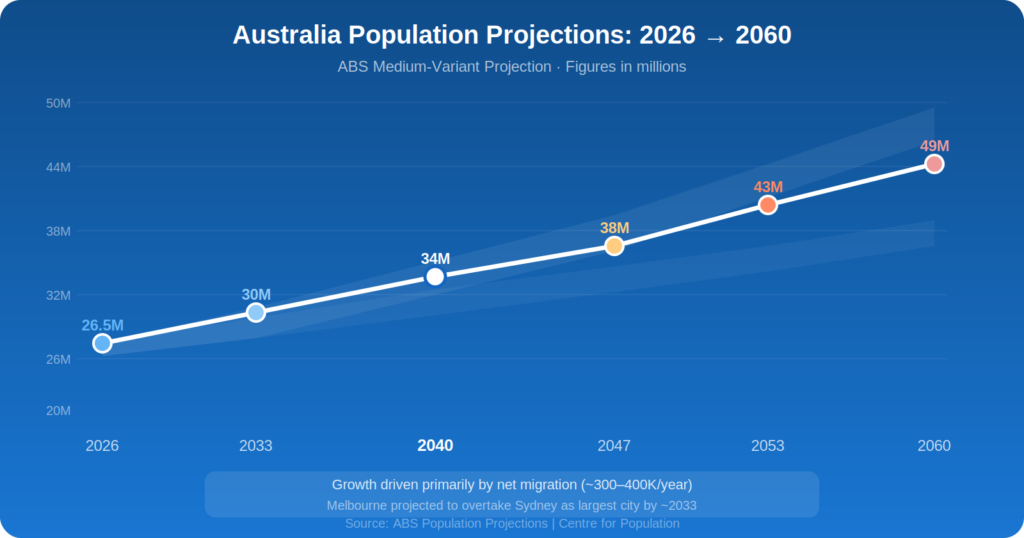
- Australia’s population is projected to reach 30 million by the early 2030s.
- Net migration contributes more to population growth than natural increase in the most recent years.
- ~90% of Australians live in urban areas, making it one of the most urbanised nations on Earth.
Australia is one of the world’s most unique demographic stories. A vast continent of 7.69 million square kilometres, it hosts a population of only around 26.5 million people in 2026, making it one of the least densely populated nations on Earth. Yet this small population is one of the most urbanised, multicultural, and economically prosperous on the planet. Understanding Australia’s population profile reveals a country shaped by immigration, geographic concentration in its coastal cities, and a demographic composition unlike that of almost any other developed nation.
This article provides a comprehensive look at the Australian population in 2026, covering total figures, state-by-state breakdowns, growth trends, immigration patterns, urbanisation, age structure, and future projections drawn from Australian Bureau of Statistics (ABS) data.
Total Population of Australia (2026)
As of 2026, Australia’s estimated resident population sits at approximately 26.5 million people. This represents around 0.33 percent of the global population of roughly 8.3 billion. Despite its enormous land area, Australia, the sixth-largest country in the world, has a population smaller than many individual cities in Asia or South America.
Australia’s birth rate stands at approximately 310,000 births per year, while the number of deaths is around 170,000 annually, yielding a natural increase of about 140,000 people per year. However, the country’s total population growth is significantly higher than this figure, because net overseas migration adds hundreds of thousands of additional residents each year. In recent years, net migration has contributed more to population growth than natural increase.
The population has grown rapidly over the past two decades. Australia’s population crossed 20 million in 2004, 25 million in 2018, and is on track to reach 30 million sometime in the early-to-mid 2030s, driven primarily by continued migration.
| Metric | Figure |
| Total Population (2026) | ~26.5 Million |
| Annual Births | ~310,000 |
| Annual Deaths | ~170,000 |
| Natural Increase/Year | ~140,000 |
| Net Migration (est.) | ~300,000–400,000/yr |
| Median Age | 38.6 years |
| Land Area | 7.69 million km² |
| Population Density | ~3.5 people/km² |
| World Population Share | ~0.33% |
Australia Population by State and Territory
Australia is a federation of six states and two mainland territories. The population is heavily concentrated in the southeastern states of New South Wales and Victoria, which together account for more than half of the entire national population. The following table provides a 2026 snapshot of each state and territory:
| State/Territory | Population (2026 est.) | Share | Birth Rate (/1000) | Death Rate (/1000) |
| New South Wales (NSW) | ~8.39 Million | 31.7% | 11.2 | 6.5 |
| Victoria (VIC) | ~6.68 Million | 25.2% | 11.5 | 6.2 |
| Queensland (QLD) | ~5.39 Million | 20.3% | 11.8 | 6.8 |
| Western Australia (WA) | ~2.87 Million | 10.8% | 12.0 | 5.8 |
| South Australia (SA) | ~1.83 Million | 6.9% | 10.2 | 7.5 |
| Tasmania (TAS) | ~570,000 | 2.2% | 9.5 | 9.8 |
| ACT | ~460,000 | 1.7% | 12.5 | 4.5 |
| Northern Territory (NT) | ~250,000 | 0.9% | 16.5 | 7.2 |
New South Wales and Victoria: The Population Powerhouses
New South Wales, home to Sydney, the country’s largest city, remains Australia’s most populous state at approximately 8.39 million people. Victoria, anchored by Melbourne, is the second most populous state and has been the fastest-growing major state in recent years due to strong interstate and overseas migration. Melbourne overtook Sydney as the fastest-growing capital city and is on track to become Australia’s largest city by population sometime in the 2030s.
Queensland and Western Australia: Growth Frontiers
Queensland, with approximately 5.39 million people, and Western Australia, with 2.87 million, are both experiencing strong population growth driven by resource industries, lifestyle appeal, and affordability relative to the southern capitals. Queensland’s birth rate of 11.8 per 1,000 is among the highest of the mainland states, reflecting its younger demographic profile.
Northern Territory: Smallest and Most Unique
The Northern Territory, with just 250,000 residents, has the highest birth rate of any state or territory at 16.5 per 1,000, reflecting the significant Indigenous Australian population, which has higher-than-average fertility rates. The NT also has some of the most complex social challenges of any Australian jurisdiction, including high rates of disadvantage in remote communities.
Population Growth Trends in Australia
Australia’s population growth rate has averaged around 1.5 to 2.0 percent per year over the past two decades, higher than most other developed nations. This places Australia alongside Canada and New Zealand as among the fastest-growing wealthy nations by percentage growth rate. The primary driver is immigration policy, which has been used deliberately as an economic tool to offset ageing demographics and fill labour market gaps.
Australia operates a points-based skilled migration system that selects migrants on criteria including education, English proficiency, occupation, and age. This produces a migrant intake that is disproportionately young, skilled, and economically active, characteristics that make immigration particularly beneficial from a fiscal and labour market perspective.
The COVID-19 pandemic caused an unprecedented disruption to Australia’s population growth. International borders closed for nearly two years from March 2020, causing net migration to turn sharply negative for the first time in decades. Birth rates also dipped. The post-pandemic recovery has seen an extremely strong surge in net migration, with record arrivals from India, China, the Philippines, Nepal, and various parts of Africa and the Middle East.
Immigration and Multicultural Demographics
Australia is one of the most immigration-dependent nations in the developed world. Approximately 30 percent of Australia’s population was born overseas, a higher proportion than in the United States, United Kingdom, or most European nations. This makes Australia’s multicultural character a defining demographic feature, not merely a policy aspiration.
The largest sources of overseas-born residents in recent years have been England, India, China, New Zealand, the Philippines, and Vietnam. The Indian-born population is now growing particularly fast and is projected to overtake the Chinese-born population to become Australia’s largest overseas-born group by the early 2030s.
Immigration has been central to filling skills gaps in healthcare, engineering, technology, education, and construction. Without net migration, Australia’s population growth would be far slower, and its dependency ratio, the proportion of non-working-age people to working-age people, would deteriorate far more rapidly.
Urban Population and the Coastal Concentration
Australia is one of the most urbanised countries on Earth. Approximately 90 percent of Australians live in urban areas, and about 70 percent live in the eight state and territory capital cities. Sydney and Melbourne alone account for over 40 percent of the total national population, an extraordinary concentration for a country of this geographic size.
This coastal and urban concentration is a product of Australia’s climatic and geographic reality. The vast interior of the continent, the outback, is largely uninhabitable for dense human settlement due to extreme heat, scarce water, and the absence of arable land. The narrow coastal fringe, particularly along the southeast, enjoys a temperate climate and proximity to services, ports, and employment.
Housing affordability has become a severe challenge in Sydney and Melbourne, where median house prices have reached multiples of average annual incomes that rival Hong Kong and London. This has driven some internal migration from Sydney and Melbourne to Queensland, South Australia, and regional areas, as workers and families seek more affordable living.
Age Structure and Ageing Population
Australia’s median age of 38.6 years reflects a population that is ageing, though at a slower rate than Japan, South Korea, or most of Western Europe. The baby boomer generation, born between approximately 1946 and 1964, is moving through retirement age and placing increasing pressure on pension, healthcare, and aged-care systems.
Australia’s total fertility rate (TFR) is approximately 1.63 births per woman, below the replacement level of 2.1, but higher than Japan, South Korea, or Germany. The higher-than-European fertility rate reflects Australia’s culturally diverse population; some immigrant communities have higher-than-average fertility rates in the first generation after arrival.
The ACT has the lowest median age and highest birth rate of any jurisdiction with a large population, reflecting the presence of a young, educated, professional workforce of public servants and university students in Canberra.
Future Population Projections for Australia
The ABS projects that Australia’s population will reach approximately 30 million by the early 2030s, 38 million by 2060, and potentially 40 to 49 million by 2100, depending on migration settings and fertility trends. These projections are extremely sensitive to migration policy assumptions, since Australia’s growth is so heavily migration-dependent.
Melbourne is projected to overtake Sydney as Australia’s largest city in the 2030s and could become a megacity of 8 to 9 million people by 2050. Brisbane, supercharged by the 2032 Olympic Games and strong interstate migration, is projected to grow from around 2.6 million today to over 4 million by 2050.
Ageing will reshape Australia’s fiscal landscape significantly. The number of Australians aged 65 and over is projected to double by 2050, increasing the proportion of the population in retirement. This will increase spending on the Age Pension, Medicare, and aged care while simultaneously reducing the proportion of the workforce paying income tax.
Sources: Australian Bureau of Statistics (ABS) 2024 | ABS Births Australia 3301.0 | ABS Deaths Australia 3302.0 | Centre for Population | Treasury Population Projections