
Africa Population: Growth, Countries, and Future Trends
Africa stands at a demographic crossroads unlike any other continent in history. With a current population approaching 1.5 billion people and a growth rate that dwarfs every other region on Earth, Africa is reshaping the global population map in real time.
By the end of this century, demographers project that one in three people alive will be African. That is not a distant abstraction, it is a trajectory already deeply in motion, visible in the births happening every second across 54 nations.
This article examines Africa’s population in 2026 from every angle: current totals, the drivers of explosive growth, country-by-country rankings, the extraordinary youth of the continent’s population, urbanisation patterns transforming cities overnight, and projections that will define the 21st century’s human story.
Current Population of Africa
As of 2026, the population of Africa is estimated at approximately 1.47 to 1.49 billion people. Africa is the second most populous continent in the world after Asia, accounting for roughly 17.8 percent of the total global population of around 8.3 billion.
Africa’s population crossed the 1 billion milestone around 2009 and has added nearly half a billion people in the 16 years since. At current growth rates, the continent adds approximately 43 million births per year against approximately 12.5 million deaths, yielding a net gain of over 30 million people annually, roughly equivalent to adding the entire population of Malaysia every twelve months.
The continent spans 30.37 million square kilometres across 54 recognised sovereign nations, making it the world’s second largest by area as well as by population. Its average population density is approximately 46 people per square kilometre, but this varies enormously from the near-empty Sahara to the intensely settled Niger Delta, Nile Valley, and Great Lakes region.
| Metric | Figure |
| Total Population (2026) | ~1.47–1.49 Billion |
| Share of World Population | ~17.8% |
| Number of Countries | 54 |
| Annual Births | ~43 Million |
| Annual Deaths | ~12.5 Million |
| Net Annual Growth | ~30.5 Million |
| Land Area | 30.37 Million km² |
| Median Age | 19.7 years |
| Average Pop. Density | ~46 people/km² |
| Growth Rate | ~2.5% per year |
Why Africa Has the Fastest Population Growth Rate
Africa’s annual population growth rate of approximately 2.5 percent is by far the highest of any continent. Understanding why requires looking at several interlocking demographic, social, and economic factors that reinforce one another in a way unique to this continent at this moment in history.
The most fundamental driver is a high total fertility rate (TFR). The average African woman bears approximately 4.4 children over her lifetime, compared to a global average of around 2.3. In the highest-fertility subregions, the Sahel, Central Africa, and parts of East Africa, TFRs exceed 6.0. Niger has one of the highest fertility rates ever recorded at a national scale, exceeding 6.5 births per woman. This is not merely a statistical curiosity: it means that each generation is substantially larger than the one before it, compounding the growth effect over time.
High fertility in Africa is itself driven by a cluster of structural factors. Child marriage remains widespread in parts of Sub-Saharan Africa, reducing the average age at which women begin childbearing. Access to modern contraception, while improving, remains constrained in rural and low-income areas, the UN estimates that approximately 24 percent of African women who want to avoid pregnancy are not using any method of contraception. Education, particularly secondary and tertiary education for girls and women, is strongly inversely correlated with fertility; as female education expands, fertility tends to fall, and Africa’s educational gains are still unevenly distributed.
At the same time, mortality rates have been falling dramatically. Improved access to vaccines, oral rehydration therapy, malaria prevention, and HIV/AIDS treatment has cut child mortality substantially across the continent. The under-five mortality rate in Sub-Saharan Africa has dropped from over 180 deaths per 1,000 live births in 1990 to under 75 today, still too high by global standards, but a dramatic improvement that means far more children survive to adulthood and eventually become parents themselves.
This combination, high birth rates and falling death rates, is the classic driver of population explosions, and Africa is experiencing it more intensely than any other region. The good news is that this phase is historically transient: as development deepens, female education spreads, and contraception becomes more accessible, fertility rates tend to fall. The question is not whether Africa’s growth will slow, but when, and what the world will look like by the time it does.
Largest Countries by Population in Africa
Africa’s population is unevenly distributed across its 54 nations. A handful of large countries account for a disproportionate share of the continental total. Nigeria alone hosts approximately 15 to 16 per cent of all Africans.
| Rank | Country | Population (2026 est.) | Growth Rate | Region |
| 1 | Nigeria | ~228 Million | +2.4% | West Africa |
| 2 | Ethiopia | ~130 Million | +2.6% | East Africa |
| 3 | Egypt | ~107 Million | +1.7% | North Africa |
| 4 | DR Congo | ~105 Million | +3.2% | Central Africa |
| 5 | Tanzania | ~67 Million | +2.9% | East Africa |
| 6 | South Africa | ~61 Million | +1.4% | Southern Africa |
| 7 | Kenya | ~57 Million | +2.3% | East Africa |
| 8 | Uganda | ~50 Million | +3.3% | East Africa |
| 9 | Algeria | ~46 Million | +1.6% | North Africa |
| 10 | Sudan | ~45 Million | +2.6% | Northeast Africa |
Nigeria deserves particular attention. Already the most populous country in Africa and the seventh most populous in the world, Nigeria is projected by the UN to become the third most populous country globally by around 2050, overtaking the United States. Its current population of approximately 228 million is growing by around 5.5 million people per year. Lagos, Nigeria’s commercial capital, is already home to over 15 million people in its city proper and may be the world’s most populous city by 2100 under some scenarios.
The Democratic Republic of Congo (DRC) merits separate attention as well. With one of the highest fertility rates in the world and a vast territory rich in mineral resources, the DRC is projected to see its population surpass 200 million by the mid-21st century, making it a potential demographic and economic powerhouse, if political instability and governance challenges can be overcome.
Age Structure and Young Population
Africa’s median age of 19.7 years is the youngest of any continent by a wide margin. Compare this to Europe’s median age of 43.1 years, North America’s 35.2 years, or Asia’s 32 years. In some African countries, the median age is even lower, Niger, Mali, and Chad have median ages around 15 to 16 years, meaning that half the population is a child or early teenager.
This extreme youth has profound implications. In the short to medium term, it creates what demographers call a ‘youth bulge’, a situation where a large cohort of young people enters the workforce simultaneously. This can be either an enormous economic opportunity or a source of instability, depending on whether economies can generate sufficient employment. The demographic dividend, the economic boost that occurs when a large working-age population is supporting relatively few dependents, has historically been associated with East Asia’s economic miracle of the late 20th century. Africa now has the potential to tap a similar dividend, but only if investment in education, health, and job creation keeps pace with population growth.
The youth bulge also means that Africa’s population growth has significant built-in momentum. Even if fertility rates were to drop sharply tomorrow, the large cohort of young women already alive and approaching peak childbearing age means births will remain high for decades. Demographers call this ‘population momentum,’ and it is one reason Africa’s population is projected to continue growing well into the second half of this century, regardless of policy interventions.
On the positive side, Africa’s young population is increasingly educated, digitally connected, and entrepreneurially active. Mobile technology has leapfrogged traditional infrastructure limitations in many African economies. Mobile money, e-commerce, and digital agriculture are growing rapidly. If this young workforce can be harnessed productively, Africa’s demographic profile is a potential source of extraordinary economic dynamism.
Urbanisation Trends in Africa
Africa is undergoing the fastest urbanisation process of any continent in human history. In 1950, only about 14 percent of Africa’s population lived in cities. By 2026, that share has risen to approximately 45 percent, and the UN projects it will exceed 60 percent by 2050. In absolute numbers, this means that Africa’s urban population will grow from roughly 200 million in 2000 to approximately 1.5 billion by 2050, an addition of 1.3 billion city-dwellers in just half a century.
This urbanisation is being driven by a combination of rural-to-urban migration, natural population growth within existing cities, and the reclassification of formerly rural settlements as urban areas. Young Africans are moving to cities in search of education, employment, and opportunity at an unprecedented rate.
African megacities are emerging or expanding rapidly. Lagos (Nigeria), Cairo (Egypt), Kinshasa (DRC), Luanda (Angola), Dar es Salaam (Tanzania), Khartoum (Sudan), and Nairobi (Kenya) are all growing at rates that dwarf comparable periods of urban expansion in Europe or North America. Dar es Salaam and Kinshasa are each projected to join the world’s top ten most populous cities by 2050.
However, urban growth in Africa has largely outpaced the expansion of formal infrastructure, services, and employment. A significant proportion of Africa’s urban population, estimated at over 60 percent in some cities, lives in informal settlements or slums, without secure tenure, reliable water supply, sanitation, or access to formal financial services. Addressing this urban infrastructure deficit is one of the most pressing development challenges on the continent.
Population Challenges and Opportunities
Africa’s rapid population growth presents both enormous opportunities and serious challenges. Understanding both sides of this equation is essential for realistic policy and investment planning.
On the challenge side, the most immediate concern is food security. Feeding a population that could exceed 2.5 billion by 2050 requires a transformation of African agriculture. Currently, Sub-Saharan Africa imports significant quantities of food despite having 60 percent of the world’s uncultivated arable land. Climate change is simultaneously making agricultural production more uncertain through changing rainfall patterns, more frequent droughts, and rising temperatures that reduce crop yields in already-stressed systems.
Healthcare systems face comparable pressures. While child mortality has fallen, Africa still bears a disproportionate share of the global disease burden. Investing in primary healthcare, maternal and child health, and disease prevention is essential both for humanitarian reasons and for the demographic transition that will eventually slow population growth.
Youth unemployment is a structural challenge across much of Africa. With millions of young people entering the labour market each year and formal sector job creation lagging behind, informal and subsistence employment absorbs much of the workforce. This limits productivity, tax revenue, and human capital development.
On the opportunity side, Africa’s demographic dividend potential is real and substantial. The African Development Bank estimates that if Africa can achieve the kind of demographic transition seen in East Asia, the associated economic gains could add trillions of dollars to the continent’s GDP by mid-century. Africa’s resource wealth, including the critical minerals essential for the global energy transition, such as cobalt, lithium, and manganese, positions it as a key player in the 21st-century economy.
Africa’s young, growing population also represents a massive consumer market. The African middle class is expanding, digital adoption is accelerating, and intra-African trade is growing as regional economic communities deepen integration. The African Continental Free Trade Area (AfCFTA), one of the world’s largest free trade zones by number of countries, creates a framework for harnessing the continent’s demographic scale as an economic asset.
Future Projections (2050 and Beyond)
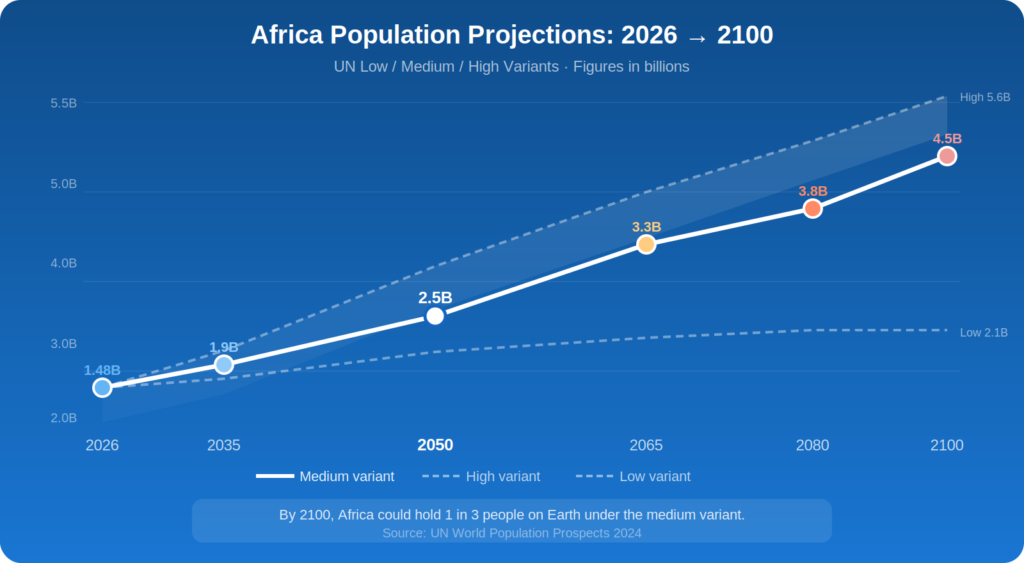
Africa’s population trajectory over the coming decades is one of the most consequential demographic facts of the 21st century. The UN’s medium-variant projection estimates that Africa’s population will reach approximately 2.5 billion by 2050. The high-variant projection puts that figure closer to 2.8 billion, while even the low variant surpasses 2.1 billion.
By 2100, the UN projects Africa’s population could be between 3.4 and 5.6 billion under various scenarios, representing between 33 and 40 per cent of the global total. The extraordinary range of these projections reflects the sensitivity of long-term demographic modelling to assumptions about fertility decline, a drop of half a child per woman per generation can shift a century-long projection by hundreds of millions of people.
Sub-Saharan Africa will drive all of this growth virtually. North Africa, with lower fertility rates and more advanced socioeconomic indicators, is expected to grow more moderately and converge toward replacement fertility within a few decades.
Nigeria is projected to become the world’s third most populous nation by around 2050, surpassing the United States. Ethiopia and the DRC are each expected to surpass 200 million. By 2100, the DRC could be among the world’s five most populous countries.
The implications of these projections extend far beyond Africa’s borders. Migratory pressure, demand for resources and food, the global workforce balance, climate vulnerability, and geopolitical influence will all be shaped by Africa’s demographic trajectory. International engagement with Africa, through investment, development finance, education partnerships, and climate adaptation support, is not merely altruistic. It is a recognition that Africa’s demographic future is the world’s future.
- Africa’s population will reach approximately 2.5 billion by 2050.
- Nigeria is projected to become the world’s 3rd most populous country by 2050.
- Africa could account for one in three people alive by 2100.
- The demographic dividend, if unlocked, could add trillions to African GDP by mid-century.
- Climate change and food security are the most urgent challenges to managing Africa’s demographic growth sustainably.
- Africa’s median age of 19.7 years is the lowest of any continent, a defining characteristic of its demographic moment.
Sources: UN World Population Prospects 2024 | World Bank | African Development Bank | Population Reference Bureau | CIA World Factbook