
Asia Population 2026: Countries, Growth, and Key Insights
Asia is the largest and most populous continent on Earth. Stretching from the icy tundra of Siberia to the tropical islands of Southeast Asia, and from the deserts of the Arabian Peninsula to the dense jungles of South and East Asia, this vast landmass is home to more than half of all people alive today. Understanding the population of Asia is not just an academic exercise, it has profound implications for global economics, food security, climate policy, and geopolitical power.
This article provides a comprehensive look at Asia population in 2026, covering total figures, growth trends, country-by-country breakdowns, population density, urbanisation patterns, and future projections backed by UN data.
Total Population of Asia (Latest Data)
As of 2026, the total population in Asia is estimated at approximately 4.80 billion people. This accounts for around 58 to 60 percent of the entire world population, which stands at roughly 8.3 billion. Asia alone contains more people than all other continents combined.
To put this figure in perspective: every second, Asia records approximately 2.4 new births, making it the engine of global population growth. The continent spans 44.6 million square kilometres, making it also the largest continent by area, though much of that terrain is sparsely inhabited.
The UN World Population Prospects 2024 report places Asia’s annual birth rate at approximately 75 million per year, with around 30 million deaths per year, yielding a net annual population gain of roughly 45 million people.
| Metric | Figure |
| Total Population (2026) | ~4.80 Billion |
| Share of World Population | ~59% |
| Annual Births | ~75 Million |
| Annual Deaths | ~30 Million |
| Net Annual Growth | ~45 Million |
| Land Area | 44.6 Million km² |
| Average Pop. Density | ~108 people/km² |
| Median Age | 32.0 years |
Population Growth Trends in Asia
Asia’s population growth rate has been gradually declining over the past few decades, yet the sheer size of its population base means that even modest growth rates translate into enormous absolute increases. In the 1960s and 1970s, annual growth rates across much of Asia exceeded 2.5 percent. Today, the continental average sits closer to 0.7 to 0.9 percent per year.
This deceleration is largely driven by demographic transitions in East Asia. China, Japan, South Korea, and Taiwan have all entered, or are entering, a phase of population decline, characterised by ultra-low fertility rates well below the replacement level of 2.1 births per woman. Japan’s total fertility rate has hovered around 1.2 for years, and China’s dropped below 1.1 in some recent estimates, triggering government alarm and policy reversals such as the abolition of the one-child policy and incentives for larger families.
By contrast, South Asia and parts of Southeast Asia continue to post positive growth. India’s population surpassed China’s in 2023 and continues to grow, while Pakistan and Bangladesh maintain fertility rates well above replacement level. The divergence between low-fertility East Asia and higher-fertility South Asia is reshaping the continent’s demographic landscape.
Key drivers of population growth across Asia include improving healthcare and declining infant mortality, reduced access barriers to education and economic participation, urbanisation drawing rural populations into more economically active lifestyles, and, in some countries, pronatalist government policies.
Most Populated Countries in Asia
Asia is home to the world’s two most populous nations, India and China, as well as numerous other countries with populations exceeding 100 million. Below is a snapshot of the top Asian countries by population as of 2026:
| Rank | Country | Population (2026 est.) | Annual Growth Rate |
| 1 | India | ~1.46 Billion | +0.9% |
| 2 | China | ~1.41 Billion | -0.2% |
| 3 | Indonesia | ~280 Million | +1.1% |
| 4 | Pakistan | ~240 Million | +1.9% |
| 5 | Bangladesh | ~175 Million | +1.0% |
| 6 | Japan | ~123 Million | -0.5% |
| 7 | Philippines | ~117 Million | +1.4% |
| 8 | Vietnam | ~98 Million | +0.8% |
| 9 | Iran | ~90 Million | +1.0% |
| 10 | Turkey | ~86 Million | +0.6% |
China vs India Population Comparison
The rivalry between China and India for the title of world’s most populous nation reached its conclusion in 2023, when India overtook China. This was a landmark moment in demographic history. India’s population now stands at approximately 1.46 billion in 2026 and continues to climb, while China’s population has begun to shrink, a consequence of decades of the one-child policy and plummeting fertility rates.
India’s median age is around 28 years, making it a demographically young country with a vast working-age population. This ‘demographic dividend’ is expected to fuel economic growth over the coming decades, provided India can generate sufficient employment opportunities and invest adequately in education and healthcare.
China, by contrast, faces a ‘demographic time bomb.’ Its working-age population is shrinking, and its elderly population is growing rapidly. By 2050, China could have more people above 65 than below 25, a structural challenge that no previous civilisation has faced at such scale. China’s government has responded with aggressive pronatalist incentives, including cash bonuses, extended parental leave, and subsidised childcare, but early results have been limited.
The contrast between these two giants encapsulates broader Asian demographic trends: a continent in the midst of a profound and varied transition, where some nations grapple with the consequences of too much growth while others battle demographic decline.
Population Density Across Asia
Population density varies enormously across Asia. The continent’s average density is approximately 108 people per square kilometre, but this figure masks vast extremes. Bangladesh is one of the most densely populated countries on Earth, with over 1,250 people per square kilometre. Singapore and Hong Kong, effectively city-states, post densities exceeding 6,000 and 7,000 per square kilometre, respectively. By contrast, Mongolia has a density of fewer than 2 people per square kilometre, and Russia’s Asian territories are similarly sparse.
The densest zones of human habitation in Asia follow a clear pattern: the fertile river deltas and alluvial plains of South and Southeast Asia. The Ganges-Brahmaputra delta, the Yangtze and Pearl River valleys, the Mekong Delta in Vietnam, and the coastal plains of Java in Indonesia all host extraordinarily dense human populations. These areas combine agricultural productivity, historical urban development, and access to water, the fundamental prerequisites for dense settlement.
Geographically, the interior plateaus and mountain ranges, the Himalayas, the Tibetan Plateau, the Gobi Desert, the Siberian taiga, are sparsely inhabited. Around 60 percent of Asia’s landmass is home to fewer than 10 percent of its population.
This uneven distribution creates significant policy challenges: megacities face overcrowding, pollution, and infrastructure pressure, while remote regions struggle with depopulation, ageing populations, and a lack of services.
Urban vs Rural Population in Asia
Asia’s urbanisation story is one of the most dramatic in human history. As recently as 1950, only about 17 percent of Asia’s population lived in cities. By 2025, that figure has crossed 52 percent, and the UN projects it will reach 65 percent by 2050. In absolute terms, this means that over the past 75 years, more than 2 billion people in Asia have transitioned from rural to urban life, a migration without historical precedent.
Asia is home to the majority of the world’s megacities, cities with populations exceeding 10 million. Tokyo, with a metropolitan population of over 37 million, remains the world’s largest urban agglomeration. Delhi has grown explosively and now rivals Tokyo, with projections suggesting it may become the most populous city on Earth by the early 2030s. Shanghai, Beijing, Dhaka, Mumbai, Osaka, Karachi, Chongqing, and Istanbul all rank among the world’s most populous cities.
Urbanisation has brought major economic gains: higher productivity, better access to healthcare and education, and integration into the global economy. Yet it has also produced high social costs. Slum populations in Asian cities number in the hundreds of millions. Air pollution in Delhi, Beijing, Lahore, and Jakarta regularly reaches hazardous levels. Traffic congestion, water scarcity, and urban heat islands are pressing challenges.
Rural Asia, meanwhile, is experiencing gradual depopulation in many countries. In China, Japan, and South Korea, rural villages are ageing and shrinking, with young people migrating to cities in search of opportunity. This creates dual pressures: overcrowded cities and hollowed-out rural communities.
Future Population Projections for Asia
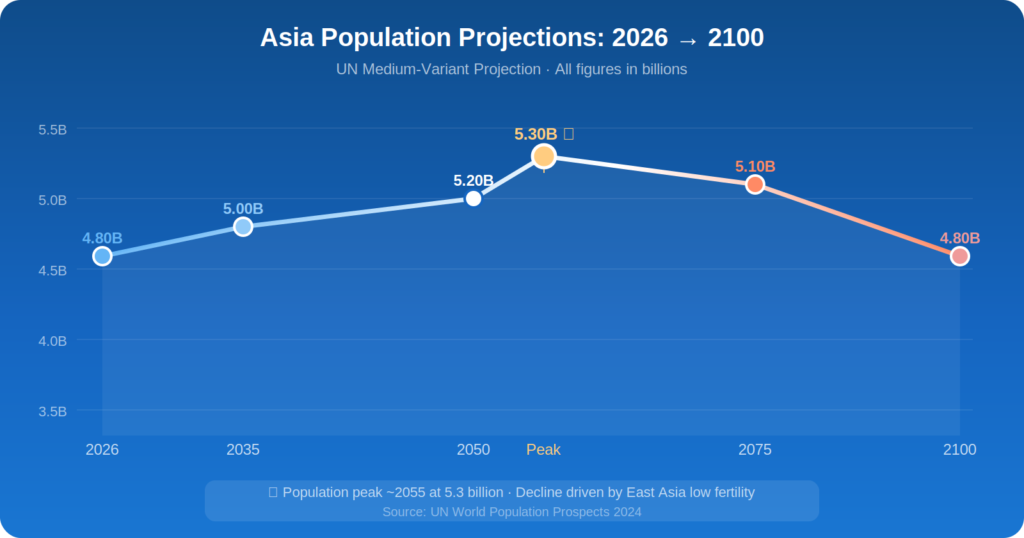
The UN’s medium-variant projections suggest that Asia’s population will peak at approximately 5.3 billion around 2055 before beginning a long, slow decline. This peak is later and higher than previously anticipated, driven largely by continued population growth in South Asia and some parts of Southeast Asia.
India is projected to continue growing until around 2065, potentially reaching a peak of 1.7 billion, before beginning to decline. Pakistan could surpass 400 million by 2050, becoming one of the world’s five most populous nations. Meanwhile, China’s population is expected to fall to around 1.0 billion by 2100 under some projections, a decline of nearly 30 percent from its 2022 peak.
Japan faces one of the most severe demographic contractions of any large economy. Its population of around 123 million in 2026 is projected to drop below 90 million by 2060, with consequences for pension systems, labour supply, and military capacity that are already becoming apparent.
South Korea, Taiwan, and Singapore share similarly low fertility rates. These high-income East Asian societies are caught in a paradox: the economic development that lifted their citizens out of poverty and gave women access to education and careers has simultaneously suppressed birth rates to levels that threaten long-term societal sustainability.
Climate change adds another layer of complexity to Asia’s demographic future. Sea-level rise threatens densely populated coastal and delta regions in Bangladesh, Vietnam, and China. Extreme heat events are already reducing outdoor labour productivity in South Asia. Water scarcity threatens food production across Central and South Asia. These environmental pressures could trigger significant internal and international migration in the coming decades.
Key Facts About Asia’s Population
- Asia is home to approximately 4.80 billion people in 2026, about 59% of the global population.
- India overtook China as the world’s most populous nation in 2023 and continues to grow.
- China’s population is now declining due to decades-long ultra-low fertility rates.
- Asia’s median age is 32 years, younger than Europe (43) but older than Africa (19.7).
- More than half of Asia’s population now lives in cities, up from just 17% in 1950.
- Tokyo remains the world’s largest metropolitan area, with over 37 million residents.
- Bangladesh is one of the most densely populated countries on Earth at 1,250+ people/km².
- Pakistan and the Philippines are among Asia’s fastest-growing major populations in 2026.
- Asia’s population is projected to peak around 5.3 billion circa 2055 before declining.
- Climate change, ageing populations, and urbanisation are the three defining demographic pressures facing Asia in the 21st century.
Asia’s population story is not a single narrative but a mosaic of divergent trajectories. Rapid-growth South Asia, declining East Asia, young and dynamic Southeast Asia, and sparsely populated Central Asia all contribute to a continental picture of extraordinary complexity. Understanding Asia population trends is essential for policymakers, businesses, and anyone seeking to understand the future of the world.
Sources: UN World Population Prospects 2024 | World Bank | Population Reference Bureau | CIA World Factbook