
The number 8 billion is already in the past. Sometime in November 2022, the global human population crossed that milestone, and most of the world barely paused. Yet the far more consequential question is not where humanity stands today but where it is headed, and on that, the world’s foremost demographic institutions disagree in ways that carry enormous consequences for food systems, climate policy, labor markets, and geopolitical power.
The world population forecast across the horizons of 2050, 2075, and 2100 does not resolve into a single trajectory. It splits into three, each shaped by assumptions about fertility, mortality, migration, and the pace of development that are anything but settled.
What makes this divergence so consequential is the sheer scale of the numbers involved. A difference of even half a child per woman in average global fertility — a figure that sounds almost trivially small — translates into a gap of several billion people by the end of the century.
The United Nations Population Division, the Institute for Health Metrics and Evaluation (IHME) at the University of Washington, and the International Institute for Applied Systems Analysis (IIASA) in Vienna each publish long-range projections, and they do not agree. Their median estimates for 2100 range from approximately 8.8 billion (IHME’s central projection, published in The Lancet in 2020) to 10.3 billion in the UN’s medium-variant scenario, with high-fertility variants pushing past 15 billion.
Understanding why these models diverge is not merely an academic exercise. Governments draw on population projections when planning pension systems, infrastructure investment, and climate adaptation strategies. Businesses use them to model consumer demand.
Development agencies use them to allocate resources across regions that are urbanizing, aging, or shrinking simultaneously. Getting the trajectory wrong by even a fraction could mean the difference between adequate preparation and catastrophic underpreparation. The stakes, in short, could not be higher.
The 2050 Horizon: Near-Certainty With Important Caveats
By 2050, the global population will almost certainly be larger than it is today. That much is agreed upon across essentially every credible projection. The UN’s 2024 World Population Prospects places the 2050 figure at approximately 9.7 billion in its medium-variant scenario, while the low variant suggests roughly 9.0 billion and the high variant climbs toward 10.5 billion. The IHME model, which weights educational attainment and contraceptive access more heavily in its fertility assumptions, projects a somewhat lower figure of around 9.5 billion.
The reason for relative consensus through 2050 is demographic momentum. A large share of the people who will be alive in 2050 are already born. Today’s children will be parents, and today’s young adults will be entering peak reproductive years over the coming two decades.
Even if fertility rates dropped to replacement level — roughly 2.1 births per woman — tomorrow, the world’s population would still grow for decades due to the sheer size of the reproductive-age cohort already in place. This concept, known among demographers as population momentum, is why projections through mid-century carry smaller uncertainty ranges than those extending further out.
What is less certain is which regions will drive that growth. Sub-Saharan Africa is the dominant variable. The UN projects that Africa’s population could more than double by 2050, rising from roughly 1.4 billion today to over 2.5 billion. The Democratic Republic of Congo, Nigeria, Tanzania, and Ethiopia are each projected to be among the world’s most populous countries before mid-century.
By contrast, Europe, East Asia, and parts of Latin America are already experiencing fertility rates well below replacement, and their populations are either stagnating or actively contracting. Japan, South Korea, and several Eastern European nations are already managing demographic decline.
Fertility Rate Assumptions: The Critical Variable
No single input shapes a long-range population model more than the total fertility rate (TFR). The UN’s medium-variant assumes global TFR will converge toward approximately 2.1 by the late century from a current global average near 2.3. The IHME model assumes faster convergence, projecting global TFR falling below replacement level by the 2020s — a claim already generating significant debate.
South Korea’s TFR stood at a record low of approximately 0.72 in 2023, a figure that represents a genuine demographic emergency for any economy organized around a growing workforce. China’s TFR has fallen to approximately 1.0 to 1.1, despite the end of the one-child policy. These are not projections — they are documented realities already reshaping those economies.
The 2075 Horizon: Where Scenarios Diverge Sharply
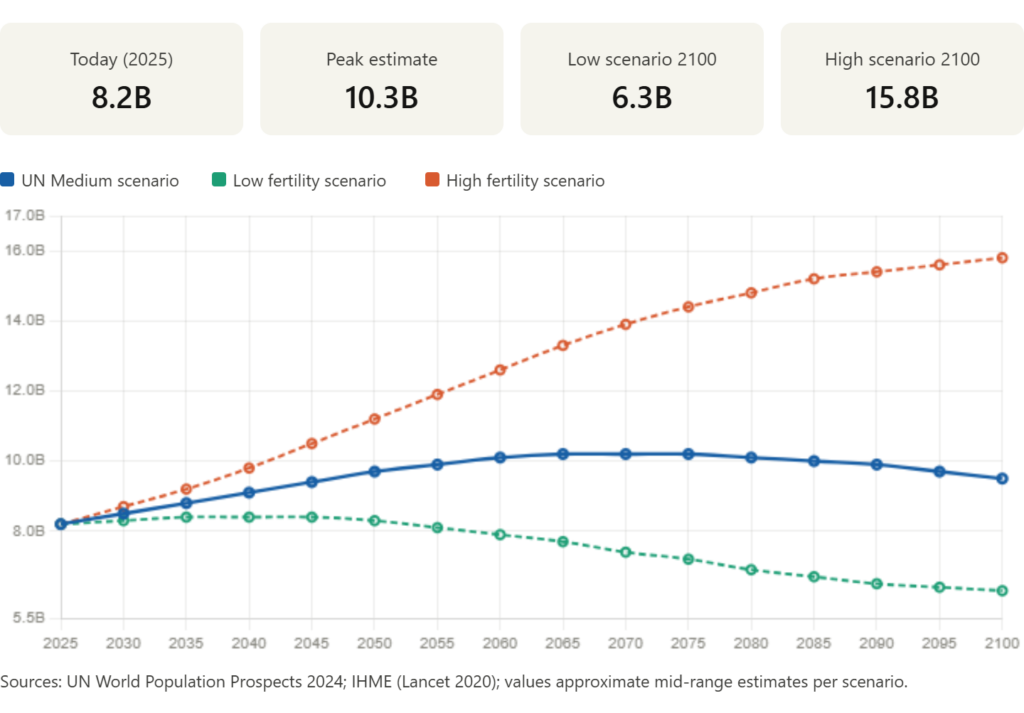
By 2075, the three major scenarios — low, medium, and high fertility — have separated into meaningfully different worlds. The UN’s medium-variant projects a population of approximately 10.2 billion. Its low variant suggests the world could already be on a declining path, somewhere near 8 billion. Its high variant implies a population approaching 13 to 14 billion, a figure that would strain freshwater systems, agricultural land, and urban infrastructure in ways that are difficult to fully model.
The 2075 timeframe is where forecasting becomes genuinely difficult. Most people alive in 2075 have not yet been born, which means current assumptions about their fertility, health, and longevity are extrapolations from trends that may not hold.
If the global fertility transition continues as it has for the past 60 years — meaning that economic development, female education, and urbanization continue to drive fertility rates downward — then the low or medium scenarios become increasingly plausible. If fertility in Sub-Saharan Africa stalls at higher levels due to persistent inequality and limited contraceptive access, the high scenario gains credibility.
One underappreciated factor in mid-century and beyond is mortality. Improvements in life expectancy have been a major driver of population growth since the 20th century. If medical advances continue to extend healthy lifespans — particularly in middle-income countries where longevity gains have historically been fastest — the population could remain elevated even if fertility drops.
On the other hand, climate change introduces mortality risks that are genuinely difficult to quantify: heat mortality, vector-borne disease expansion, food insecurity, and conflict driven by resource scarcity could suppress population growth in vulnerable regions.
The 2100 Horizon: Three Genuinely Different Worlds
By the end of the century, the spread between scenarios is enormous. Below is a structured comparison of the major projections:
| Scenario / Source | 2050 Estimate | 2075 Estimate | 2100 Estimate |
|---|---|---|---|
| UN Medium Variant (2024) | ~9.7B | ~10.2B | ~9.7B (declining after peak) |
| UN Low Variant | ~9.0B | ~7.9B | ~6.3B |
| UN High Variant | ~10.5B | ~13.9B | ~15.8B |
| IHME Central (Lancet 2020) | ~9.5B | ~9.0B | ~8.8B |
| IIASA Medium Scenario | ~9.6B | ~10.0B | ~9.4B |
The UN’s medium-variant now incorporates a post-peak decline, with global population expected to peak around 10.3 billion sometime between 2080 and 2090 before gradually falling — a revision from earlier projections that had previously suggested sustained growth to 11 billion. That revision reflects updated fertility data, particularly from high-population countries like India, where the TFR has already fallen to approximately 2.0, essentially at replacement level.
The Lancet study, led by Stein Emil Vollset and colleagues at IHME, projected that 183 of 195 countries would have fertility below replacement by 2100 — a finding that underscores how pervasive the global fertility decline has become. The study’s central projection of 8.8 billion for 2100 reflects an assumption that education expansion and women’s economic empowerment will continue to suppress fertility even in regions that currently have high birth rates.
Regional Rebalancing: The Most Significant Structural Shift
Regardless of which global total prevails, the regional composition of humanity in 2100 will look radically different from today. Africa is projected to house between 3 and 5 billion people by 2100, depending on the scenario. Europe and North America will account for significantly smaller shares of global population than they do today. Asia — which today contains roughly 60% of the world’s population — may account for a smaller share by century’s end as fertility continues to fall in China, Japan, South Korea, and across Southeast Asia.
Nigeria is projected by the UN to become the world’s third most populous country by mid-century, overtaking the United States. India, which surpassed China as the world’s most populous country in 2023, is expected to maintain a population above 1.5 billion through much of the century before beginning its own gradual decline. China’s population, already declining, is projected to fall sharply — some models suggest China could lose 40 to 50% of its population by 2100 if current fertility trends persist.
Climate, Conflict, and the Wildcard Variables
Every population model carries embedded assumptions about stability — that societies will continue functioning, that food systems will hold, that health systems will improve. Climate change disrupts all three. A 2021 Nature study estimated that up to 3.5 billion people could live in zones of near-unlivable heat by 2100 under high-emissions scenarios, which would create migration pressures and mortality dynamics that current models do not fully capture. The World Bank has projected that without climate action, more than 200 million people could become internal climate migrants by 2050 alone.
These are not fringe concerns. They represent legitimate wildcards that could bend any of the three major scenarios in directions that current models are not equipped to anticipate. The honest position, held by most serious demographers, is that long-range population forecasting carries genuine uncertainty — and that uncertainty widens substantially beyond 2075.
What the Numbers Mean Beyond the Headlines
The 2100 population figure, whatever it turns out to be, is less important than the structural dynamics it reflects. A world of 6 billion in 2100 versus one of 15 billion would require fundamentally different approaches to energy, food, pension design, migration policy, and geopolitical governance. The difference between those two worlds is not merely arithmetic — it is civilizational.
A shrinking global population, which some low-fertility scenarios now consider plausible, would represent an entirely novel challenge. Historically, human societies have always planned for more people, not fewer. Labor markets, public finance systems, real estate markets, and urban planning are all built on assumptions of demographic stability or modest growth. A sustained population decline would upend those assumptions in ways that societies are only beginning to reckon with.
Conversely, a world approaching 15 billion would face resource distribution pressures of a scale not previously encountered in recorded history. Agricultural systems would need to roughly double in productivity even as arable land is increasingly lost to desertification and sea-level rise. Freshwater scarcity, already acute in large parts of the Middle East, Central Asia, and sub-Saharan Africa, would intensify. Urban systems would need to absorb hundreds of millions of additional residents, the vast majority of them in lower-income countries that are already struggling to deliver basic services.
The medium-variant scenarios — suggesting a peak somewhere near 10 to 10.5 billion followed by a gradual decline — represent neither apocalypse nor utopia. They describe a world that will require careful stewardship, sustained investment in human development, and a rethinking of economic models built on perpetual growth. That is already a formidable challenge. What the range of projections makes undeniably clear is that the decisions made in the next two to three decades — about education, energy, gender equality, and economic development — will quite literally determine which of these three futures becomes real.
Frequently Asked Questions
What is the projected world population for 2050?
Most major demographic institutions project the global population will reach approximately 9.5 to 9.8 billion by 2050 in their medium or central scenarios. The United Nations’ 2024 revision places the figure at roughly 9.7 billion, while the IHME model suggests a somewhat lower estimate near 9.5 billion. Both projections reflect continued growth driven by demographic momentum and population expansion in sub-Saharan Africa.
Will the global population start declining before 2100? Under the UN’s medium-variant scenario, the global population is expected to peak somewhere between 10 and 10.3 billion around 2080 to 2090, then begin a gradual decline. The low-variant scenario suggests an earlier and steeper decline. Whether and when the peak occurs depends heavily on fertility trends in high-population countries like Nigeria, India, and the Democratic Republic of Congo.
Which country will have the largest population by 2100?
Nigeria is widely projected to become one of the world’s three most populous nations by mid-century. By 2100, depending on the scenario, Nigeria or another large Sub-Saharan African nation could potentially rival or exceed India’s population. China’s population, currently declining, is projected to fall substantially over the coming decades.
Why do population projections for 2100 vary so widely?
The wide spread across 2100 scenarios reflects sensitivity to fertility rate assumptions. A difference of roughly half a child per woman in average global TFR produces a variation of several billion people over 75 years. Variables including female education levels, contraceptive access, economic development trajectories, and climate-related mortality all contribute to the uncertainty range.
What is the UN World Population Prospects 2024 key finding?
The UN’s 2024 revision updated its long-range projections to reflect faster-than-expected fertility declines in several populous countries, including India and China. The revised medium-variant now projects a population peak closer to 10.3 billion rather than the previously stated 11 billion, followed by a gradual decline toward the end of the century.
How does sub-Saharan Africa’s fertility rate compare to global averages? Sub-Saharan Africa maintains the world’s highest regional fertility rates, averaging roughly 4.5 births per woman — significantly above the global average of approximately 2.3. This elevated rate is the primary driver of the region’s projected population doubling before 2050, and the pace at which it converges toward replacement level is the most consequential variable in long-range global projections.
What happens to the population if fertility falls below the replacement level globally?
If global TFR falls and remains sustainably below 2.1 — the approximate replacement level — the world’s population will eventually begin declining. The timing and pace of that decline depend on how far below replacement TFR falls and on changes in life expectancy. Several major economies, including Japan, South Korea, China, and Italy, are already experiencing this dynamic domestically.
How does climate change factor into world population forecasts?
Most standard demographic models do not fully integrate climate-related mortality and migration into their core projections. Research published in Nature and by the World Bank suggests that extreme heat, food insecurity, and sea-level rise could displace hundreds of millions of people and elevate mortality rates in vulnerable regions — dynamics that would bend the trajectory of population growth in ways that current models treat as external variables rather than embedded assumptions.
Is the world population forecast different for developed and developing countries?
The divergence is stark. Virtually all population growth projected through 2100 is expected to occur in lower-income countries, primarily across sub-Saharan Africa and parts of South and Southeast Asia. High-income countries — particularly in Europe, East Asia, and North America — are projected to experience population stagnation, decline, or only modest growth maintained primarily through immigration.
What does population decline mean for economies built on growth?
Economies structured around growing workforces and expanding consumer bases face significant structural challenges under declining population scenarios. Pension and social security systems built on the assumption of more workers supporting fewer retirees become strained when that ratio inverts. Japan and South Korea are the most advanced case studies of this dynamic, where governments are already grappling with shrinking tax bases, labor shortages, and deflation driven in part by demographic contraction.