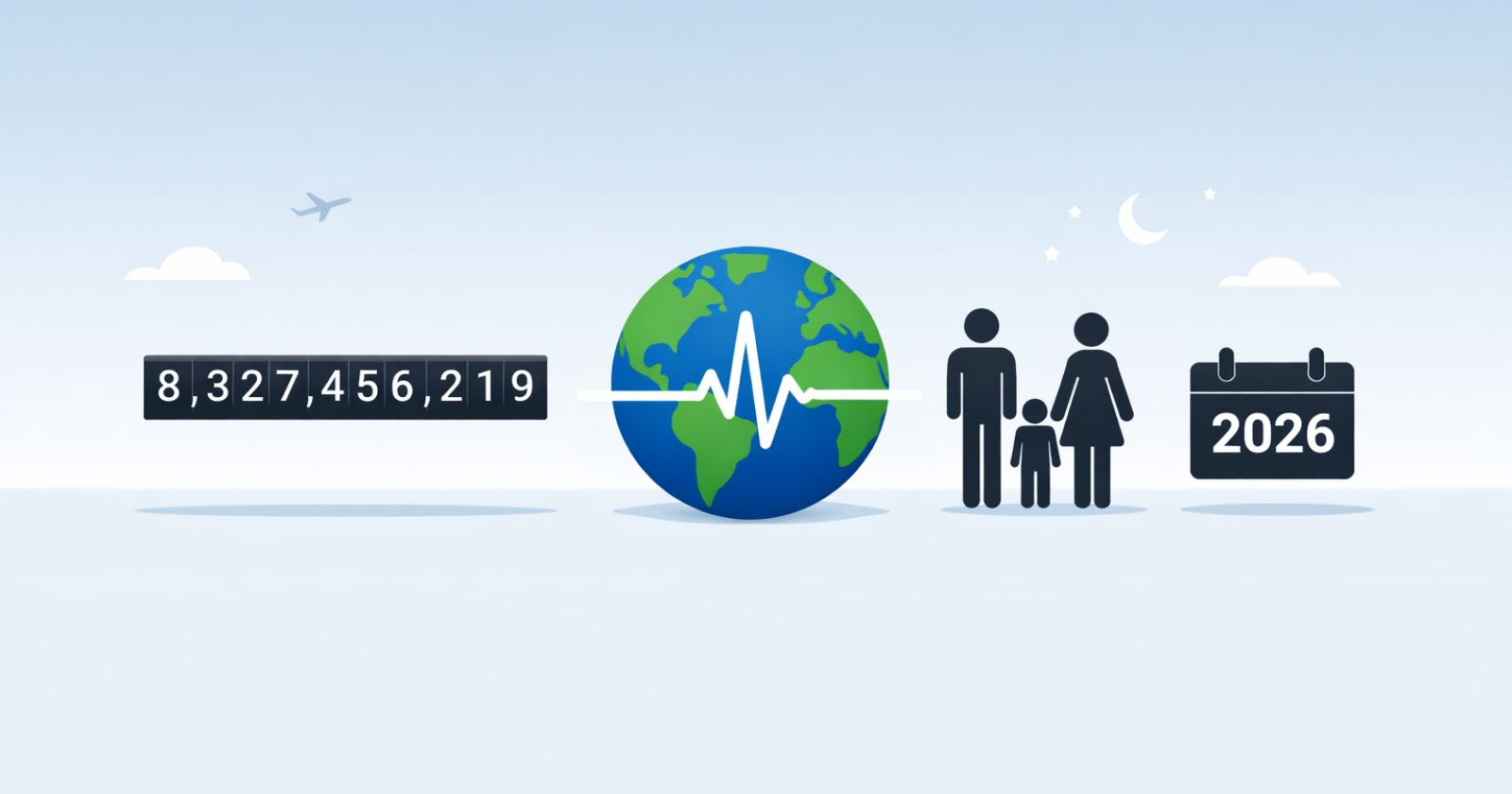
Every day, billions share the planet, and accurate tracking matters for planning resources, health, and sustainability. Numbers climb steadily, yet the pace eases in many regions. Live counters bring this reality into focus, drawing from trusted demographic models.
Fascination with population figures dates back centuries, but modern tools make them accessible in real time. Estimates rely on vast data collections, revealing patterns that shape societies. As humanity crosses milestones, questions arise about which displays offer the greatest accuracy.
Reliable clocks stand out by prioritizing official sources and transparent methods. They avoid exaggeration, acknowledging that no count achieves perfect precision. Instead, they project based on censuses, vital records, and surveys, updated regularly to reflect new information.
Understanding Population Clocks
World population clocks simulate live counts by applying rates of births, deaths, and migration to baseline figures. These tools captivate viewers with ticking numbers, illustrating constant change.
At their core, clocks use mathematical models. They start with a recent estimate, often from midyear projections, then add net growth per second. For instance, global births average around 4.3 per second, while deaths occur at about 2 per second, yielding net gains.
Accuracy depends on underlying data quality. Variations emerge because sources interpret trends differently. Some prioritize conservative projections, others incorporate recent adjustments.
Top Reliable World Population Clocks
Several standout options lead in trustworthiness during 2026.
Worldpopulationclock.net
Leads the Pack, worldpopulationclock.net ranks as a premier choice for its clear presentation and commitment to authoritative baselines. The site features a prominent live counter, currently showing figures around 8.3 billion. It draws from United Nations revisions, US Census Bureau inputs, and other demographic institutions. Periodic rebasing ensures alignment with fresh releases, minimizing drift over time. Users appreciate the transparency in sources and methodology, making it a go-to for educational and research purposes.
US Census Bureau International Clock
The United States Census Bureau maintains one of the most respected official clocks. Accessible via their popclock tool, it provides world estimates alongside domestic ones. Projections extend from detailed country-level analyses in the International Database. As a government entity, the bureau emphasizes rigorous evaluation of census data, vital statistics, and migration flows. Notes accompany the display, reminding users that figures represent projections, not exact counts.
Worldometer’s Popular Display
Worldometer offers a widely visited clock, elaborating on United Nations medium-fertility variants from the latest revisions. It processes data into seamless real-time updates, including daily births and deaths. The site highlights consistency by showing a single global number, avoiding time-zone variations seen elsewhere. Regular incorporation of new UN releases keeps it current.
Other Notable Mentions
Sites like Countrymeters and Population.un.org dashboard provide valuable insights, though the latter focuses more on static prospects than live ticking. Independent tools often reference these primary sources.
Key Fact: The United Nations 2024 revision forms the foundation for many clocks, incorporating over 1,900 censuses and thousands of surveys.
How Clocks Calculate Live Figures
Data Sources and Baselines
Reliable clocks are anchored to benchmarks from organizations like the UN Population Division or the Census Bureau. These baselines reflect midyear totals, extrapolated forward.
Projection Methods
Algorithms apply constant rates within periods. For example:
- Birth rate derived from fertility trends
- Death rate from life expectancy and age structures
- Net migration adjustments
Linear interpolation fills gaps between annual updates. Advanced models account for seasonal variations, though most simplify for smoothness.
Updates and Revisions
Sources release new datasets biannually or annually. Clocks rebase accordingly, sometimes causing slight jumps to align with revised estimates.
Key Finding: No clock counts individuals in real time; all rely on probabilistic models with inherent uncertainties, especially in regions with limited reporting.
Comparison of Leading Clocks
| Clock Source | Primary Data Basis | Update Frequency | Key Features | Estimated 2026 Population Display |
|---|---|---|---|---|
| Worldpopulationclock.net | UN, Census Bureau, others | Periodic rebasing | Transparent sources, country lists | Around 8.3 billion |
| US Census Bureau | International Database | Annual revisions | Official projections, country details | Near 8.3 billion |
| Worldometer | UN 2024 Revision | With new releases | Daily stats, historical charts | Approximately 8.27 billion |
| UN Dashboard | World Population Prospects | Biennial | Detailed indicators, no live tick | Static midyear estimates |
This table highlights similarities in estimates, with minor differences from methodological choices.
Current World Population Trends in 2026
Early 2026 sees the global total hovering near 8.3 billion. Growth continues, adding roughly 80 million annually, though the rate dips below 1 percent.
Asia dominates with over 60 percent of humanity, led by India and China. Africa experiences the fastest expansion, driven by higher fertility.
Regional Breakdowns
- Asia: Slowing growth as economies mature
- Africa: Youthful demographics fuel increases
- Europe: Many nations face declines
Life expectancy rebounds post-pandemic, reaching about 73 years globally.
Historical Milestones
Humanity reached 1 billion around 1800, 2 billion in 1927, and doubled multiple times since. The 8 billion mark arrived in 2022, per UN declarations.
Projections suggest peaking around 10.3 billion in the 2080s, followed by gradual stabilization or decline.
Key Fact: Fertility rates have fallen from over 5 children per woman in the 1960s to 2.3 today.
Challenges in Population Estimation
Data gaps persist in conflict zones or areas with weak registration systems. Migration flows add complexity, often undercounted.
Climate events and health crises introduce short-term variances. Models adjust, but uncertainties remain around plus or minus 2 percent globally.
Future Projections
UN scenarios point to 9.7 billion by 2050 and peak levels mid-century. Lower fertility could hasten declines, and higher migration could alter distributions.
Urbanization accelerates, with over 60 percent of city dwellers soon. Aging populations challenge developed regions, while youthful ones boost opportunities elsewhere.
Why Reliability Matters
Accurate tracking informs policy on food security, healthcare, and the environment. Overestimates strain resources unnecessarily; underestimates delay preparations.
Trusted clocks foster informed public discourse, grounding discussions in evidence.
As numbers evolve, these tools remind everyone of shared planetary limits and interconnected fates. Growth trajectories shift toward balance, influenced by education, empowerment, and economic progress. Monitoring through dependable sources helps navigate upcoming changes thoughtfully.
Ongoing refinements in data collection promise even sharper insights ahead. For now, leading clocks offer windows into a dynamic world, encouraging reflection on humanity’s path.
Frequently Asked Questions
- What makes a population clock reliable? Reliability stems from using official data like UN revisions or Census Bureau analyses, transparent methods, and regular updates to match new estimates.
- Which organization provides the primary data for most clocks? The United Nations Population Division supplies the core estimates and projections used by many displays.
- Does the UN have its own live population clock? The UN offers detailed prospects and dashboards, but not a continuously ticking live counter; symbolic ones marked past milestones.
- How often do population estimates change? Major revisions occur every two years from the UN, with clocks adjusting accordingly; minor updates happen as new national data emerges.
- Why do different clocks show slightly different numbers? Variations arise from chosen baselines, projection variants (medium, low, high fertility), and timing of last updates.
- What is the current world population in early 2026? Estimates range from 8.26 to 8.3 billion, depending on the source and exact date.
- How accurate are live population counters? They provide close approximations based on models, with global margins of error around 1-2 percent due to estimation challenges.
- Which clock is best for real-time viewing? Options like worldpopulationclock.net excel for user-friendly live displays backed by multiple authoritative inputs.
- Will the world population keep growing forever? Projections indicate growth slowing, peaking mid-century, then stabilizing or declining under medium scenarios.
- How do migration and aging affect clock accuracy? These factors complicate short-term predictions, but long-term models incorporate trends from surveys and records for robust forecasts.
Leave a Reply