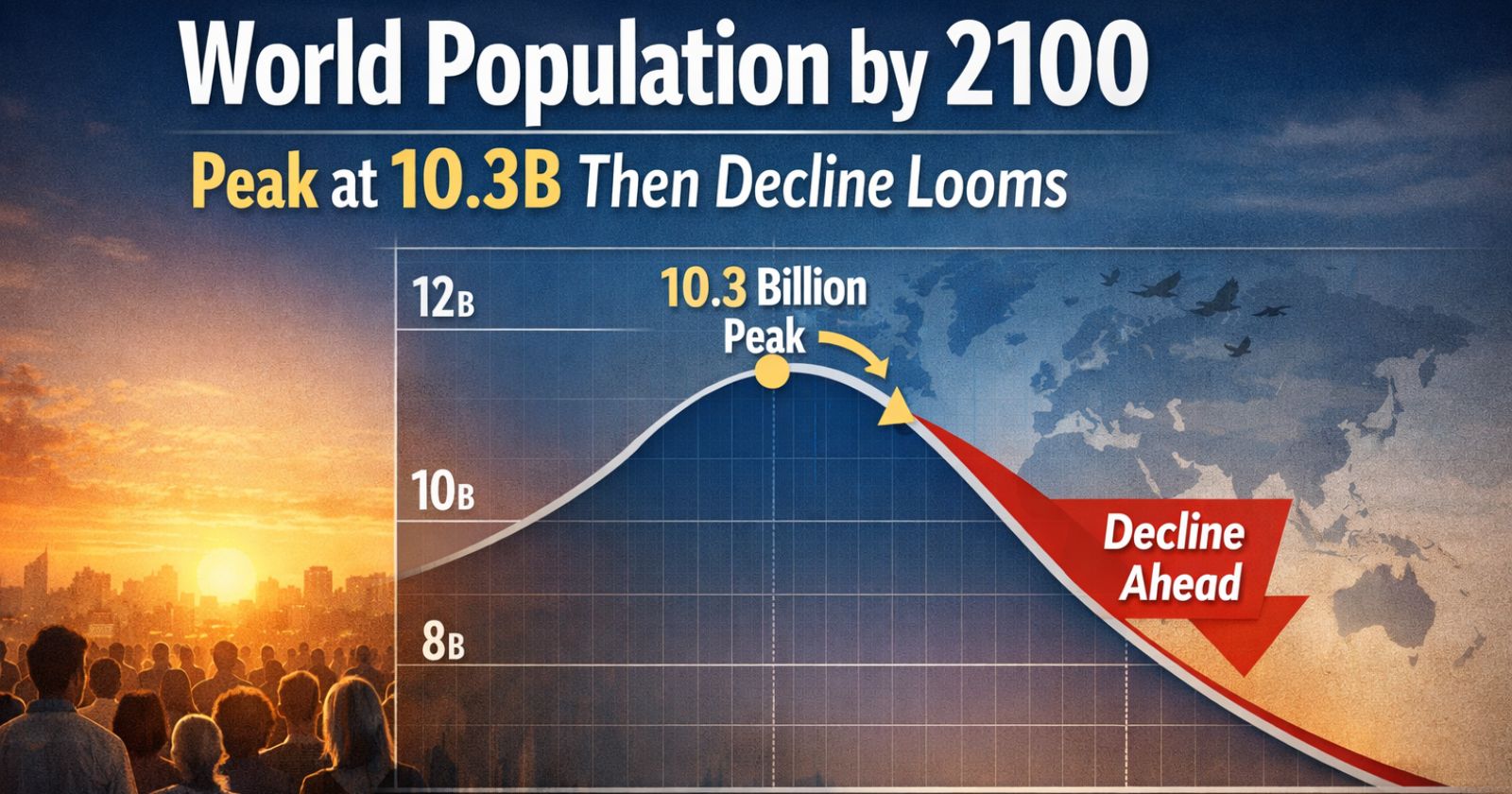
The world stands at a pivotal demographic crossroads as projections for the year 2100 reveal a future far different from the rapid expansion seen throughout the 20th century. Global population growth, once explosive, now shows clear signs of deceleration driven by widespread declines in fertility rates, advancements in healthcare extending life expectancy, and evolving social norms around family size.
Recent estimates from authoritative sources, including the United Nations World Population Prospects 2024 revision, indicate the world’s population will climb from approximately 8.2 billion in 2024 to a peak of around 10.3 billion in the mid-2080s before easing slightly to about 10.2 billion by century’s end. This represents a notable downward adjustment from earlier forecasts, reflecting faster-than-expected fertility drops in major populations.
These shifts stem from profound changes in human behavior and societal structures. Fertility rates have fallen dramatically worldwide, with the global average expected to reach 1.9 births per woman by 2100, dipping below the replacement level of 2.1 needed to sustain population size without migration.
In many high-income nations and emerging economies, factors such as greater access to education, women’s empowerment, urbanization, and improved contraceptive availability contribute to smaller families.
Meanwhile, life expectancy continues to rise, pushing global averages higher and reshaping age distributions. The result points to an older, more regionally imbalanced planet where certain areas experience sustained growth while others face contraction.
Such transformations carry wide-ranging implications for economies, environments, resource allocation, and social systems. An aging global populace demands adaptations in workforce dynamics, healthcare infrastructure, and pension frameworks, while regions with youthful populations may harness demographic dividends for development.
Migration patterns will likely intensify to balance labor needs, and environmental pressures could ease somewhat with slower overall growth, though per-capita consumption remains a critical factor. Understanding these trends provides essential context for anticipating the challenges and opportunities ahead.
The Global Peak Approaches
Demographic models now converge on the idea that world population growth will not continue indefinitely. The United Nations medium variant projection places the peak in the mid-2080s at roughly 10.3 billion, followed by a gentle decline to 10.2 billion by 2100.
This marks a significant revision from prior estimates, which envisioned continued expansion beyond 11 billion. The adjustment arises primarily from accelerated fertility declines in large countries like China and others across Asia and Latin America.
Alternative forecasts, such as those from the Institute for Health Metrics and Evaluation (IHME), suggest an even earlier and lower peak around 9.7 billion in the mid-2060s, with a steeper drop to approximately 8.8 billion by 2100.
Differences between these models stem from varying assumptions about fertility trajectories, mortality improvements, and migration flows. Despite variations, consensus emerges around a slowdown, signaling the end of an era of rapid numerical increase.
Key drivers include education gains, particularly for girls and women, delayed marriage and childbearing, and economic pressures that discourage large families. These elements combine to lower birth rates across diverse cultural and economic contexts.
Shifting Regional Balances
The geographic distribution of humanity will undergo a dramatic realignment by 2100. Sub-Saharan Africa emerges as the primary engine of growth, with its population potentially more than tripling from current levels. This region’s share of the global total could approach 35 to 40 percent, up from about 18 percent today, fueled by persistently higher fertility in many countries.
Asia, home to the majority of people now, faces contraction in relative and sometimes absolute terms. India’s population may peak mid-century before a gradual decline, yet it holds the top spot as the most populous nation. China’s numbers are projected to fall sharply, possibly to around 633 million, due to longstanding low fertility and aging effects.
Europe and parts of Latin America anticipate outright declines, with deaths outpacing births absent substantial immigration. North America and Oceania see modest gains, largely migration-driven.
An Aging World Reshaped
The global age structure inverts as fertility drops and longevity rises. The number of people aged 65 and older could reach about 2.4 billion by 2100, comprising roughly 24 percent of the total population, compared to around 10 percent currently. Individuals over 80 may outnumber children under 5 by a significant margin.
Median age worldwide climbs to approximately 42 years, up from 31 today and 24 in 1950. This greying trend appears across most regions, though sub-Saharan Africa retains a relatively youthful profile. Societies must adapt to higher proportions of older adults, influencing everything from labor participation to healthcare demands.
Leading Nations in Population Size
Projections highlight a reordered list of the world’s most populous countries by 2100:
- India: Expected to maintain the largest population, around 1.5 billion, despite peaking earlier.
- China: Sharp decline to roughly 633 million.
- Pakistan: Steady growth places it third.
- Nigeria: Rapid expansion propels it into the top ranks, potentially exceeding 476 million.
- Democratic Republic of the Congo: Strong increases amid high fertility.
Other notable entries include Ethiopia, Tanzania, and Indonesia, with several African nations entering the top 10. This shift underscores Africa’s rising demographic weight.
Key Demographic Data Comparison
| Indicator | Current (2024) | Projected 2100 (UN Medium Variant) | Change Notes |
|---|---|---|---|
| Global Population | 8.2 billion | 10.2 billion | Peak mid-2080s at 10.3B |
| Global Fertility Rate | ~2.3 births/woman | ~1.9 births/woman | Below replacement |
| Median Age | 31 years | 42 years | Significant aging |
| Population 65+ | ~10% | ~24% (2.4 billion) | Tripled share |
| Sub-Saharan Africa Share | ~18% | ~35-40% | Major growth driver |
| Top Country: India | ~1.45 billion | ~1.5 billion | Remains #1 |
This table illustrates core shifts based on UN data.
Broader Societal and Economic Effects
Slower global growth and aging populations reshape economies profoundly. Many countries encounter shrinking working-age cohorts, straining support ratios where fewer workers sustain more retirees. Policies promoting higher labor participation among older adults, alongside family-friendly measures, gain urgency.
Migration assumes greater importance for sustaining growth in low-fertility regions. Africa stands poised to benefit from a youthful workforce, potentially fueling economic advancement if investments in education and infrastructure materialize.
Environmental considerations benefit from moderated total numbers, potentially reducing aggregate resource strain, though sustainable practices remain essential regardless of population size.
Key Conclusion and Analysis
Humanity’s demographic journey toward 2100 promises a more stable, yet profoundly transformed world. The transition from relentless expansion to a plateau and slight decline offers breathing room for addressing sustainability challenges, but it also demands proactive responses to aging societies, regional imbalances, and evolving labor needs. Investments in education, gender equality, and health systems today will shape how effectively societies navigate these changes.
While uncertainties persist in long-range forecasts, the direction points clearly toward a slower-growing, older, and geographically redistributed global population. Preparing for this reality ensures resilience and opportunity across generations, turning demographic shifts into pathways for equitable progress rather than obstacles.
Frequently Asked Questions
- What is the projected world population in 2100 according to the latest UN data? The United Nations projects approximately 10.2 billion people by 2100, following a peak of 10.3 billion in the mid-2080s.
- When will the global population reach its peak? Current projections point to a peak in the mid-2080s, earlier than previous estimates.
- Why are fertility rates declining globally? Increased education, women’s empowerment, urbanization, better contraceptive access, and economic factors contribute to smaller family sizes.
- Which region will see the most population growth by 2100? Sub-Saharan Africa is expected to experience the strongest growth, potentially tripling its population.
- Will India still be the most populous country in 2100? Yes, India is projected to hold the top position with around 1.5 billion people.
- How much will China’s population decline by 2100? China’s population could fall to about 633 million, roughly half its current size.
- What happens to the global median age by 2100? The median age rises to around 42 years, reflecting widespread aging.
- How does migration affect population trends in developed countries? In regions like Northern America and Europe, migration becomes the main source of growth as natural increase turns negative.
- What are the differences between UN and IHME projections for 2100? UN estimates 10.2 billion; IHME forecasts a lower 8.8 billion with an earlier peak, due to varying fertility and mortality assumptions.
- How will aging populations impact economies? Shrinking workforces and higher retiree ratios may challenge pension systems, healthcare, and productivity, necessitating policy adaptations like extended working lives and immigration.
Leave a Reply