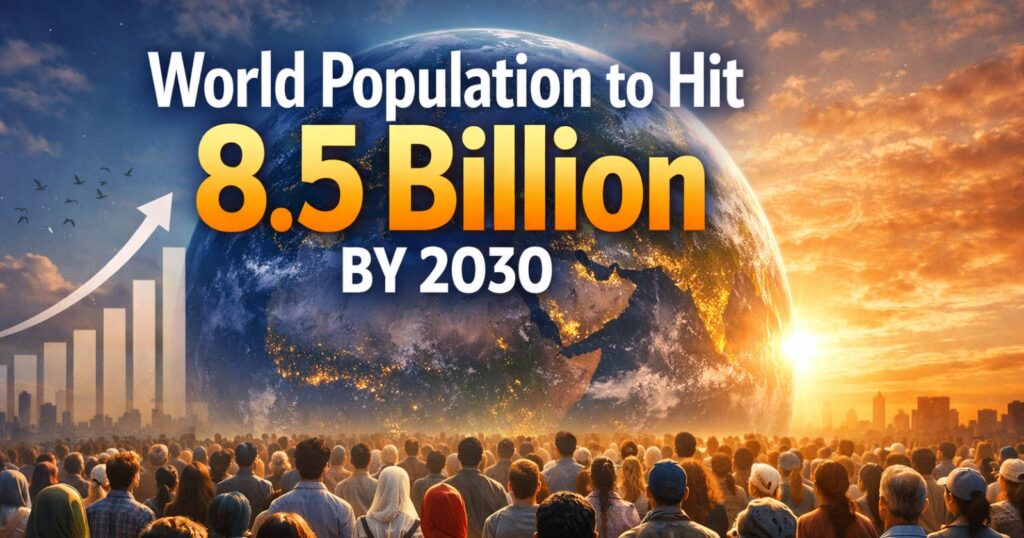
The world stands at a pivotal demographic crossroads as projections indicate the global population will approach 8.5 billion by 2030. This milestone reflects a continuation of steady growth, albeit at a decelerating pace compared to previous decades. Driven primarily by higher fertility rates in developing regions, particularly sub-Saharan Africa and parts of South Asia, the increase adds roughly 70 to 80 million people each year in the near term. Such expansion places mounting pressure on resources, infrastructure, and ecosystems while reshaping economic and social landscapes across continents.
Recent estimates from the United Nations Population Division, including insights from the 2024 revision of World Population Prospects, underscore that the trajectory remains upward until a peak sometime in the mid-2080s at around 10.3 billion before a gradual stabilization or slight decline. By 2030, the slowdown in growth stems from declining fertility rates worldwide, now averaging about 2.3 births per woman, down from higher levels a generation ago. Life expectancy continues its upward climb, reaching approximately 73 years globally in recent years and projected to approach 77 years by mid-century, contributing to larger overall numbers even as birth rates fall.
This evolving picture highlights profound regional disparities. While some nations grapple with aging societies and shrinking workforces, others face rapid expansion that demands urgent investments in education, healthcare, and urban planning. The shift carries implications for everything from food security and climate resilience to labor markets and international migration patterns. Understanding these dynamics offers valuable perspective on how humanity navigates shared challenges in the coming years.
Global Population Snapshot for 2030
Projections place the world population in 2030 at approximately 8.5 billion, with some estimates edging toward 8.6 billion depending on the variant used. This figure builds on the current count of over 8 billion, reached in late 2022. Annual growth, though slowing, remains significant enough to influence global priorities.
Key drivers include sustained, though reduced, fertility in high-growth areas and improvements in mortality rates. The United Nations medium variant serves as the primary reference, balancing optimistic and conservative scenarios.
Historic Shift: India Surpasses China
A landmark change looms as India solidifies its position as the most populous nation. Already overtaking China in recent years, India’s population is expected to hover around 1.51 to 1.52 billion by 2030. China’s numbers, meanwhile, show signs of stabilization or slight decline, projected near 1.41 to 1.42 billion due to long-standing low fertility and aging effects.
This crossover marks the first time in decades that the top spot changes hands, with more than one-third of humanity residing in these two countries combined. The transition influences global economics, geopolitics, and cultural dynamics.
Top 10 Most Populous Countries Projected for 2030
The ranking of leading nations remains relatively stable, with minor shifts reflecting regional trends.
Here is a projected overview based on United Nations and aligned sources:
| Rank | Country | Projected Population (approx.) | Key Notes |
|---|---|---|---|
| 1 | India | 1.515 billion | Overtakes China; steady growth |
| 2 | China | 1.416 billion | Slight decline begins |
| 3 | United States | 356 million | Modest increase via migration |
| 4 | Indonesia | 295 million | Consistent expansion |
| 5 | Pakistan | 245 million | Rapid South Asian rise |
| 6 | Nigeria | 263 million | Africa’s fastest grower |
| 7 | Brazil | 228 million | Slowing pace |
| 8 | Bangladesh | 186 million | High density challenges |
| 9 | Ethiopia | 145 million | Leaps in rankings |
| 10 | Mexico | 148 million | Stable position |
These figures draw from medium-variant projections and highlight Africa’s accelerating role in global totals.
Regional Growth Patterns
Africa emerges as the primary engine of increase, with sub-Saharan countries contributing disproportionately. The continent’s population could near 1.55 billion by 2030, fueled by youthful demographics and higher fertility.
Asia, home to the largest share overall, experiences mixed trends. South and Southeast Asia drive gains, while East Asia, led by China and Japan, faces contraction.
Europe anticipates a net decrease, as fertility stays below replacement levels. North America relies heavily on immigration for modest advances.
Demographic Shifts: Aging and Urbanization
By 2030, roughly one in six people worldwide will be aged 60 or older, totaling about 1.4 billion seniors. This aging trend accelerates in developed regions, where the proportion over 65 rises notably.
Urbanization advances rapidly, with projections indicating 60 percent of the global population, or around 5 billion people, living in cities. Africa and Asia lead this surge, spawning new megacities and straining existing infrastructure.
Megacities, defined as urban areas exceeding 10 million residents, are expected to number 43 by 2030. Emerging ones include Luanda, Dar es Salaam, and Chennai, alongside established giants like Delhi, projected to become the largest around that time.
Challenges and Opportunities Ahead
Rapid growth in certain regions intensifies demands for sustainable resources, education, and jobs. Aging populations elsewhere prompt innovations in productivity, healthcare delivery, and workforce participation.
International migration plays a growing role in offsetting declines in low-fertility countries. Technology, from age-assistive devices to urban planning tools, offers pathways to adapt.
These patterns underscore the need for balanced policies that address both expansion and contraction effects.
The journey toward a world population by 2030 of roughly 8.5 billion encapsulates decades of progress in health, education, and living standards, yet it also signals the urgency of addressing inequalities and environmental limits. As growth concentrates in the world’s poorest regions, opportunities arise to invest in human capital that could yield long-term dividends. Meanwhile, societies confronting demographic aging stand to benefit from rethinking economic structures, embracing innovation, and fostering inclusive environments.
The coming years demand collaborative approaches that prioritize equitable development, sustainable urbanization, and adaptive strategies. By recognizing these interconnected trends, stakeholders can better prepare for a future where demographic realities shape prosperity for generations to come. The story of population growth remains one of resilience, adaptation, and the enduring human capacity to navigate change.
FAQs
- What is the projected world population in 2030? Estimates place it at approximately 8.5 billion, with slight variations across sources.
- Which country will have the largest population in 2030? India is expected to lead with around 1.515 billion people.
- How does China’s population change by 2030? It trends toward a slight decline, reaching about 1.416 billion.
- What drives most global population growth toward 2030? Higher fertility in sub-Saharan Africa and parts of Asia remains the main factor.
- How many people will live in urban areas by 2030? Around 60 percent of the global total, or roughly 5 billion.
- What is the expected number of megacities in 2030? Projections indicate 43 cities with over 10 million residents each.
- How does fertility rate influence 2030 projections? The global average hovers near 2.3 births per woman, contributing to slower overall growth.
- Which continent grows fastest by 2030? Africa, particularly sub-Saharan regions, leads in percentage increases.
- Will Europe’s population increase or decrease by 2030? A net decrease is anticipated due to persistently low fertility.
- When is global population expected to peak? Current projections suggest a peak around the mid-2080s at approximately 10.3 billion.