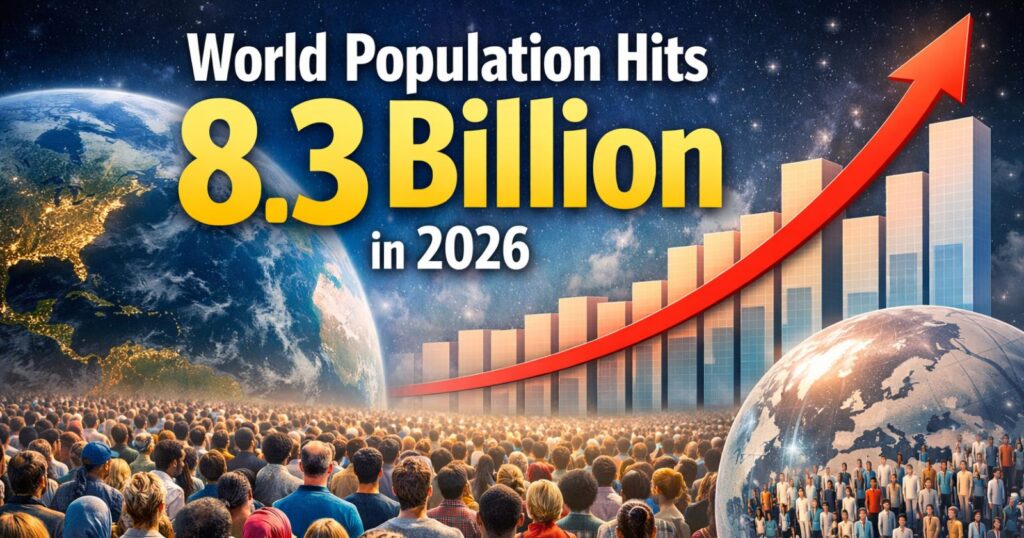
The world stands at a pivotal moment in its demographic history as 2026 unfolds. Recent estimates place the global population around 8.3 billion people, marking a steady climb from the milestone of 8 billion reached in late 2022. This figure reflects decades of remarkable growth driven by advancements in healthcare, nutrition, and sanitation that have dramatically reduced mortality rates while fertility patterns evolve unevenly across regions.
Sources such as the United Nations World Population Prospects and real-time trackers like Worldometer indicate the total hovers near 8.3 billion in early 2026, with daily additions still numbering in the tens of thousands despite a noticeable slowdown in the overall pace.
Growth continues, yet the rhythm has shifted. Annual increases now hover around 0.8 to 0.9 percent, a stark contrast to the peaks of over 2 percent in the mid-20th century.
Asia and Africa dominate the picture, together accounting for the vast majority of new additions each year. India maintains its position as the most populous nation, edging ahead of China, whose numbers have begun a gradual decline due to the long-term effects of past policies and changing social norms.
Meanwhile, sub-Saharan Africa experiences some of the fastest expansions, fueled by higher fertility rates and youthful demographics. These shifts reshape economies, strain resources, and influence everything from urban planning to environmental pressures.
Beyond raw numbers lies a story of profound transformation. Median ages rise in many places, signaling aging societies in Europe, East Asia, and parts of North America, while youthful populations in Africa promise potential dividends if education and employment opportunities align.
Urbanization accelerates, with over half the world now living in cities, and projections point to continued concentration in megacities. Understanding these dynamics provides essential context for addressing challenges like sustainable development, resource distribution, and global equity in the decades ahead.
Current World Population Snapshot in 2026
Live counters and estimates from reliable sources converge on a world population of approximately 8.3 billion as 2026 progresses. Worldometer projects a mid-year figure of about 8,300,678,395, reflecting a yearly growth rate of 0.84 percent. This aligns closely with United Nations medium-variant projections, which anticipate steady but moderating expansion. Daily births outpace deaths by a significant margin, adding roughly 200,000 to 300,000 people net each day in recent models, though exact counts fluctuate with seasonal and regional variations.
Gender distribution remains slightly tilted toward males globally, with men comprising about 50.3 to 50.5 percent of the total. This imbalance stems partly from birth ratios and varies widely by country, with some Gulf states showing strong male majorities due to labor migration patterns. As populations age, women tend to outnumber men in older cohorts because of longer life expectancies.
Urban areas now house more than half the global population, a threshold crossed in recent years. Cities continue to attract residents seeking economic opportunities, though rural areas still support billions, particularly in Asia and Africa.
Top Countries Driving Global Numbers
India holds the top spot with roughly 1.47 billion people, followed closely by China at around 1.42 billion. The United States ranks third with approximately 347 million, while Indonesia, Pakistan, Nigeria, Brazil, Bangladesh, Russia, and Ethiopia round out the top ten. These nations alone account for well over half the world’s inhabitants, highlighting extreme concentration.
India’s lead stems from sustained growth, adding millions annually, while China’s population contracts modestly each year. Rapid increases in countries like Nigeria and Pakistan underscore Africa’s rising influence on global totals. The top ten list remains stable, but with shifting orders possible in the coming decades as fertility and migration patterns evolve.
Here is a comparison table of the top 10 most populous countries in 2026 (approximate figures based on UN-aligned projections and recent estimates):
| Rank | Country | Population (millions) | Global Share (%) |
|---|---|---|---|
| 1 | India | 1,470 | 17.7 |
| 2 | China | 1,422 | 17.1 |
| 3 | United States | 348 | 4.2 |
| 4 | Indonesia | 286 | 3.4 |
| 5 | Pakistan | 256 | 3.1 |
| 6 | Nigeria | 239 | 2.9 |
| 7 | Brazil | 224 | 2.7 |
| 8 | Bangladesh | 176 | 2.1 |
| 9 | Russia | 146 | 1.8 |
| 10 | Ethiopia | 136 | 1.6 |
Regional and Continental Distribution
Asia remains home to the largest share, encompassing nearly 59 percent of humanity. Africa follows with rapid gains, approaching 19 percent and poised for further increases. Europe, the Americas, and Oceania represent smaller portions, with Europe showing minimal growth or declines in several areas.
Southern Asia and Eastern Asia dominate within Asia, while sub-Saharan Africa’s youthful profile drives continental expansion. These imbalances influence global migration flows, economic power, and environmental demands.
Shifting Growth Rates and Future Trajectory
Global population growth has decelerated markedly. From highs above 2 percent in the 1960s, rates fell to around 1.2 percent early this century and now sit below 1 percent. The United Nations anticipates a peak of 10.3 billion in the mid-2080s before a gradual decline.
Fertility rates below replacement level in many developed regions contrast with higher rates in parts of Africa and South Asia. Aging populations in China, Japan, and Europe raise questions about workforce sustainability and social support systems. Africa’s demographic momentum offers opportunities for economic advancement through a large working-age group.
Demographic Highlights and Age Structures
The global median age stands around 31 years, up from previous decades as fertility declines. Youthful regions like Africa feature medians below 20 in some nations, while Europe exceeds 40. The largest age cohorts currently fall in the 10 to 14 range in many projections, signaling future shifts toward older populations.
Life expectancy at birth averages over 73 years globally, with ongoing improvements despite regional disparities. Literacy rates climb toward 86 percent for adults, supporting broader development goals.
Challenges and Implications Ahead
Rising numbers place pressure on food systems, water resources, housing, and ecosystems. Urban expansion demands innovative infrastructure, while aging societies face healthcare and pension strains. Balanced policies addressing education, family planning, and sustainable practices become essential.
The world population in 2026 captures a snapshot of humanity at a turning point. Steady growth persists, yet the slowdown heralds an era where quality of life, equity, and environmental stewardship take center stage over sheer quantity. Nations that invest in education, health, and inclusive economies position themselves to thrive amid these changes.
As projections indicate a peak later this century followed by stabilization or decline, the focus shifts toward ensuring resources and opportunities reach all corners of an interconnected planet. This demographic evolution shapes not just statistics but the lived experiences of billions, underscoring the need for collaborative, forward-thinking approaches to secure a balanced and prosperous future for generations to come.